Myeongdong
Seoul's busiest shopping streets, the food carts that fill them at dusk, and the red-brick cathedral on the rise above
Myeongdong is a grid of pedestrian streets in the middle of Seoul, lined with cosmetics shops, fashion stores and restaurants, and by some counts one of the most expensive shopping streets in the world. In the late afternoon it changes: food carts roll out into the lanes, and the district becomes the city's best-known street-food market. On a rise at its eastern edge, above all of it, stands Myeongdong Cathedral, built in 1898, the first brick Gothic church in Korea.
Go in the late afternoon, and stay until dark. Walk the shops while it is light, eat your way through the carts as they set up and the lights come on, and finish at the cathedral, where the noise falls away within a few steps. Bring an appetite rather than a shopping list, and share small portions so you can try more. From here, the cable car up Namsan to N Seoul Tower is a short walk away.
How this page was madeWe have not yet been to South Korea. With Japan, it is one of the two places at the top of our list, and this guide is researched rather than remembered: from Seoul's tourism office, the Jung-gu district's announcements, the Korean government's news service and published guides, checked on the date below. When we go, we will say so here.
Last updated 27 September 2026
Why it matters
Under the Joseon kings, Myeongdong was a residential quarter of the capital. Under Japanese rule it was renamed Meiji-cho, after the Japanese emperor, and became a commercial district. After the Korean War it grew into the country's fashion and shopping centre, and in the 1970s its department stores and new high-rises made it the place Seoul came to see and be seen. Its streets are now among the most expensive retail addresses anywhere: in 2023 one survey ranked it the ninth most expensive shopping street in the world.
It is also one of the most visited places in Korea. Some two million people are estimated to pass through the district on a busy day, and for many foreign visitors it is the first stop in Seoul: the place to buy Korean cosmetics and skincare, which fill shop after shop along the main streets.
The street food is the newer tradition, and it has had a difficult few years. After complaints about high prices, the Jung-gu district office brought in reforms in 2024: vendors registered as businesses and installed card readers, and the district began monitoring the prices of ten popular foods each month, with increases requiring consultation. The district described the aim plainly, as restoring trust in the neighbourhood.
The district has older layers too. The Chinese Embassy has stood at Myeongdong's edge since 1949, and the streets around it still hold Chinese restaurants and shops. The Myeongdong Theater, a restored 1930s building on the main street, puts on plays, a reminder of the decades when the district was the centre of Seoul's cultural life as well as its shopping.
The quiet above it
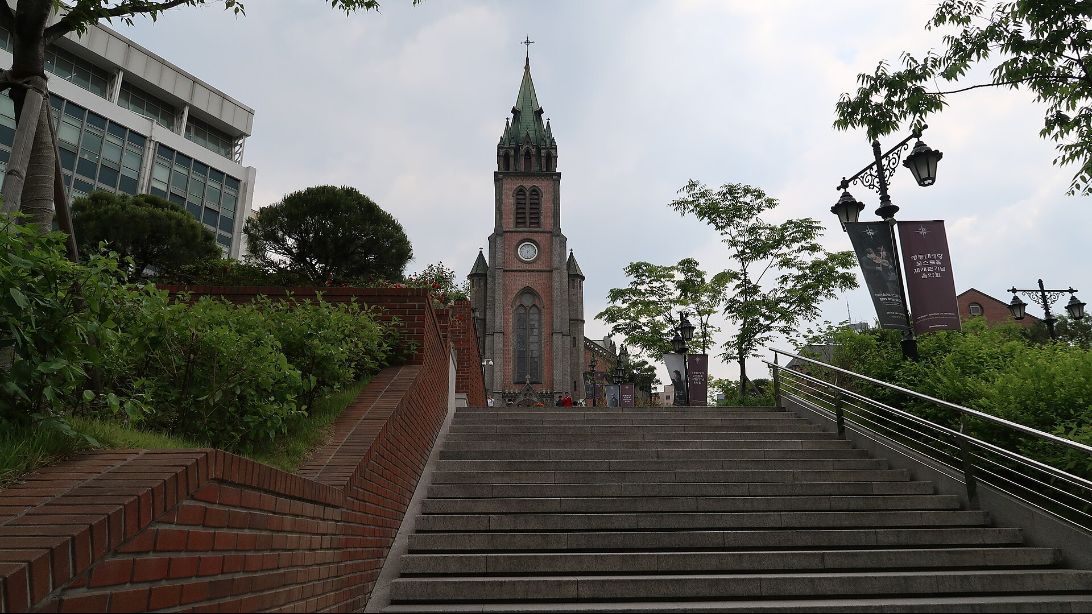
Myeongdong Cathedral stands on a slope once called Bell Hill, which Koreans had left unbuilt because it lay near a Confucian shrine. French missionaries built the cathedral there between 1892 and 1898, in the Gothic style and in twenty kinds of locally fired red and grey brick. It is the seat of the Catholic archdiocese of Seoul, and it has a place in modern Korean history as well: in 1987, some six hundred students held a hunger strike inside it after the death under torture of a university student, Park Jong-chol, one of the events that led to the end of military rule. It has remained a place of protest since.
What it's like
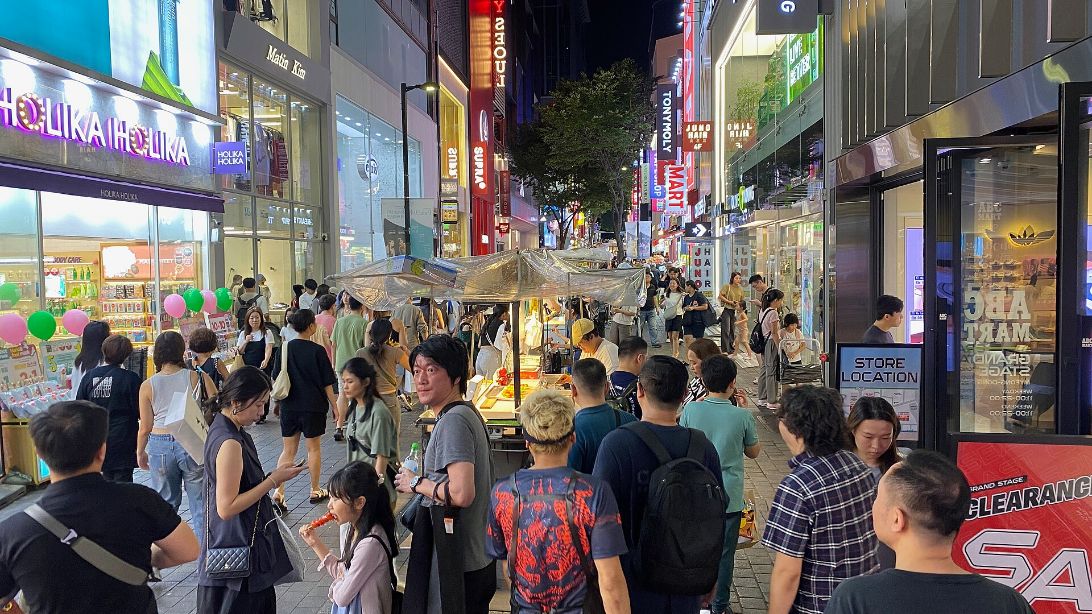
The main streets of Myeongdong are closed to traffic for most of the day, so the district is walked rather than crossed. During the day it is a shopping street at full volume: cosmetics shops with samples on offer, fashion chains, music from the shopfronts, and crowds moving slowly in both directions.
From the late afternoon the food carts arrive and take their places down the middle of the lanes. By early evening the district has become a market. The carts sell grilled skewers, spiral-cut tornado potatoes, glass-noodle japchae, grilled squid and fish-cake skewers in broth, alongside sweets such as fish-shaped bungeoppang, crêpes and tanghulu, fruit dipped in hard sugar. Portions are small and meant to be eaten standing, and most people graze from cart to cart.
| Food | What it is | Why try it |
|---|---|---|
| Eomuk | Fish cake folded onto a skewer and simmered in broth | Hot, cheap and savoury; the broth is the point on a cold night |
| Ojingeo-gui | Whole squid grilled on the cart, often glazed | The smell you follow down the lane |
| Tornado potato | A potato cut into one long spiral on a stick and fried | Crisp, salty and built to share |
| Japchae | Stir-fried sweet-potato glass noodles with vegetables | A classic Korean dish in street size |
| Bungeoppang | A fish-shaped waffle filled with sweet red-bean paste | The traditional winter sweet |
| Tanghulu | Fruit on a skewer coated in a shell of hard sugar | The newest fashion on the street, and a crack of sugar |
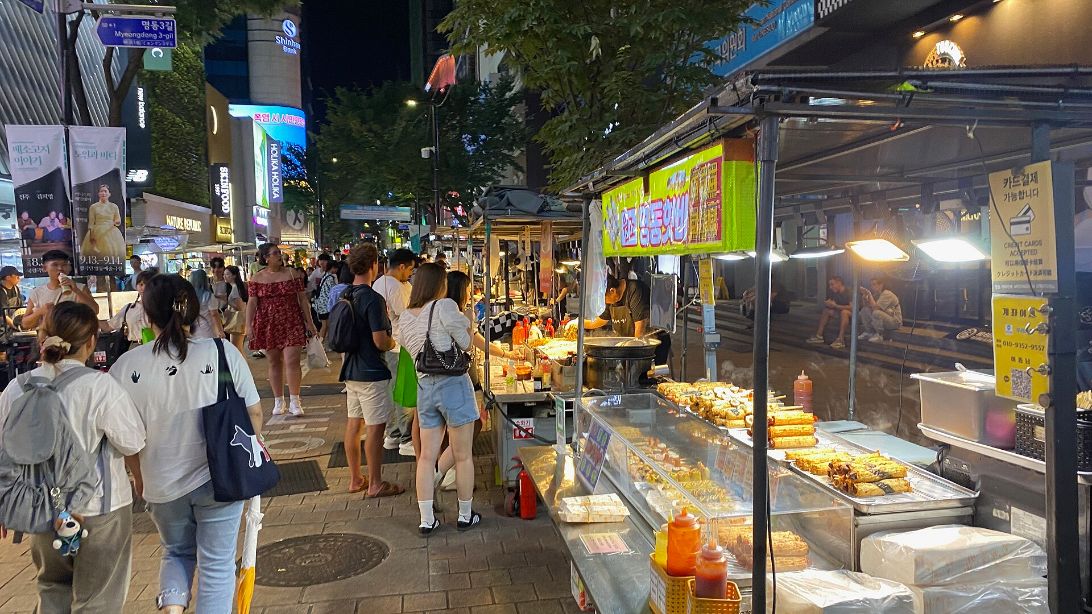
The crowds are part of the experience. The lanes can be tightly packed at peak times, especially at weekends, and the pace is slow. It is loud, bright and full of cooking smells, and it is best taken slowly, with pauses at the edges to eat.
Stand still in the food street as the carts light up, and let the crowd move round you. Watch the steam lift from the pots of fish-cake broth and drift across the lane; catch the smell of squid on the grill. Buy a small cup of broth and hold it in both hands; feel the warmth through the cup. Listen to what the street sounds like when you are not moving through it. Drink it where you are. Then walk up to the cathedral, and hear how quickly it goes.
The climb to the cathedral takes a few minutes from the busiest lanes, and the change is immediate. The grounds are open to visitors, and the church itself is a working place of worship, quiet inside even when the streets below are at their loudest.
The seasons change the market. On winter evenings, which in Seoul are sharply cold, the hot foods come into their own: broth, fish-shaped waffles straight from the iron, anything you can hold to warm your hands. Summer evenings are warm and humid, and the lanes are at their fullest after dark, when the heat has eased. Spring and autumn are the most comfortable for a long evening of walking and eating.
How to visit
Since the Jung-gu district's 2024 reforms, Myeongdong's street vendors are registered businesses with card readers, and the district monitors the prices of ten popular foods each month. Prices are generally shown on the carts; if one is not, ask before you order. A little cash is still useful for the smallest purchases.
Getting there
Myeongdong Station, on Line 4, lies at the district's southern edge, and Euljiro 1-ga Station, on Line 2, at its northern edge; both open straight onto the shopping streets. The cathedral is on the district's eastern side, a short walk uphill from the main streets.
Myeongdong is a compact grid of streets between Euljiro to the north and Toegye-ro to the south, with the cathedral on its rise to the east. Namdaemun Market lies a short walk to the west, and to the south the ground rises towards Namsan, where the cable car base is a 10 to 15 minute walk from Myeongdong Station, Exit 3.
When the carts are out
The food carts are not open all day. Published guides describe them setting up from around 4pm, the lanes filling by about 6pm, and most carts running until about 10pm, later at weekends. We could not find an official timetable, and the pattern varies with the weather and the season, so treat those times as a guide.
| When | What happens | What to do |
|---|---|---|
| Daytime | Shops open, streets busy, few food carts | Shop, and see the cathedral in daylight |
| Late afternoon | Food carts arrive and set up in the lanes | Walk the lanes and pick what to eat |
| Early evening | The market at its fullest, lights on | Eat, slowly, and stop at the edges |
| Later evening | Carts begin to pack up | Climb to the cathedral, or ride up Namsan |
Tax-free shopping
Many of Myeongdong's shops are registered for tax refunds, and at many of them the refund is taken off at the till, so you pay the lower price there and then. You will need your passport. Seoul's tourism office sets out the rules as follows.
| Rule | Detail |
|---|---|
| Who qualifies | Foreign visitors who have been in Korea for less than six months |
| Minimum purchase | ₩15,000 at a participating tax-free shop |
| Refund at the till | Purchases under ₩1,000,000 each, up to ₩5,000,000 in a trip |
| Larger purchases | Claimed at the airport counter or kiosk on departure |
| Deadline | The goods must leave Korea within three months of purchase |
Our guide to money, customs and tax refunds in South Korea explains the airport side of it.
Visiting the cathedral
Seoul's tourism office gives the cathedral's opening hours as 7am to 8pm on weekdays and 7am to 10pm at weekends. It is a working church, so dress and behave as you would in any place of worship, keep your voice down, and do not photograph people at prayer. There is a Mass for foreign visitors on Sunday mornings; check the time on the cathedral's own notices before you go.
Staying nearby
Myeongdong is one of the most central places to stay in Seoul, with the old city, the palaces, Namsan and the airport buses all close at hand, and the evening market on the doorstep. The trade-off is noise and crowds. Our guide to where to stay in Seoul compares it with the quieter alternatives.
Access
The shopping streets are flat and pedestrianised, which makes them easy going with a wheelchair or pushchair outside the busiest hours; at peak times the crowds are the obstacle. The approach to the cathedral climbs, by steps or a sloping path.
Making the most of it
Eat small, and share
The carts are built for grazing. Share each item between two or three people and you can try six or eight things in an evening instead of two. Start with something savoury and hot, a fish-cake skewer or grilled squid, and finish with something sweet.
Come on a weekday if you can
Weekend evenings are the most crowded. A weekday visit in the early evening gives you the carts at their best with more room to move and stop.
Buy skincare with a plan
Cosmetics are the district's main trade, and the choice is enormous. Know what you want before you go in, compare prices across two or three shops, and use the tax refund where it applies. Free samples are part of the pitch, and accepting them commits you to nothing. Many shops also sell travel sizes, a cheap way to try a product before you commit to the full one.
End high
Myeongdong makes a natural start to an evening on Namsan. Walk up from Myeongdong Station, Exit 3, to the Namsan cable car, ride up to N Seoul Tower as the city lights come on, and eat in Myeongdong on the way down, or the other way round.
Namdaemun by day, Myeongdong by night
Namdaemun Market, a few minutes' walk west, is Seoul's oldest and largest traditional market, and it keeps daytime hours. Spend the afternoon there among the stalls of clothes, kitchenware and food, then walk across to Myeongdong as its carts set up. The two together show two eras of Seoul shopping in a single afternoon and evening.
Look for the quiet
The cathedral is the obvious refuge, but not the only one. The side streets away from the main lanes are calmer, and a sit-down meal in one of the district's restaurants is a break from standing and walking. Plan one pause into the evening.
Nearby
South of Myeongdong, the Namsan cable car climbs to N Seoul Tower, a short walk from Myeongdong Station. West, Namdaemun Market is Seoul's great traditional general market, open by day. For street food of a different kind, Gwangjang Market to the east is older, rougher and famous for its mung-bean pancakes. A short walk north-west, Deoksugung palace and the lawns of Seoul Plaza open up in front of City Hall. North, beyond Euljiro and Cheonggyecheon stream, lie Insadong and the palaces. For what to eat once you are here, see our guide to what to eat in Korea, and for the rest of the city, start with our Seoul guide.
A final word on Myeongdong
Myeongdong is not a place to find old Seoul, and it does not pretend to be. It is Seoul at full volume: the shops, the carts, the crowds, the steam and the light. Come hungry in the late afternoon, eat slowly, and when you have had enough, climb to the cathedral and let the noise fall away behind you. It is near the top of our own list, and this is how we mean to see it.
Andrew + Margaret
- Seoul Overview
- N Seoul Tower Highlight
- Gwangjang Market Highlight
- What to eat in Korea Culture
- Money, customs and tax refunds Practical
- Where to stay in Seoul Decide
- Visit Seoul — Myeongdong Official
- Visit Seoul — tax refunds Official
- Korea.net — street vendors to accept cards Practical
What is Myeongdong known for?
Two things above all: Korean cosmetics and skincare, sold in shop after shop along its pedestrian streets, and, from late afternoon, a street-food market of carts in the middle of the lanes. On the rise above it stands Myeongdong Cathedral, built in 1898.
When does the Myeongdong street-food market open?
Published guides describe the carts setting up from around 4pm, the lanes filling by about 6pm, and most carts running until about 10pm, later at weekends. There is no official timetable and it varies with the weather, so treat those times as a guide. Checked September 2026.
How does tax-free shopping work in Myeongdong?
Foreign visitors staying less than six months can claim a refund on purchases of ₩15,000 or more at participating shops. Many deduct it at the till for purchases under ₩1,000,000, up to ₩5,000,000 in a trip; bring your passport. Larger claims are made at the airport.
What's the nearest subway station?
Myeongdong Station on Line 4, at the southern edge of the district, or Euljiro 1-ga Station on Line 2 at the northern edge. The Namsan cable car base, for N Seoul Tower, is a 10 to 15 minute walk from Myeongdong Station, Exit 3.