Bukchon Hanok Village
How to walk Seoul's hillside of lived-in hanok within the visiting hours, and how to find it quiet
Bukchon is a hillside of traditional houses climbing the slope between two royal palaces in the middle of Seoul, lived in since the early years of the Joseon dynasty. Its lanes of tiled roofs and wooden gates are the most complete survival of the old city's domestic architecture, and they are free to walk. They are also where people live, which is why the busiest lanes now have visiting hours.
Go, on a weekday morning, and walk it slowly. The famous lane, Bukchon-ro 11-gil, is open to sightseers from 10am to 5pm and is crowded by late morning. Arrive at ten, climb the side lanes before the main one, and combine the walk with Gyeongbokgung or Changdeokgung, each a few minutes' walk away. The condition is your legs: this is a hillside, and the best of it is uphill.
How this page was madeWe have not been to South Korea yet. It is one of the two places at the top of our own list, and this guide is part of our preparation, so everything here is researched rather than remembered: from Seoul's city government and district office, the Korea Tourism Organization and news reporting on the visiting rules, checked on the date below. When we go, we will walk these lanes ourselves and come back to tell you what we found.
Last updated 27 September 2026
Why it matters
Bukchon means "north village". Under the Joseon dynasty it was the district of the court's officials and aristocracy, the yangban, who built here because the ridge lies between Gyeongbokgung, the main palace, and Changdeokgung to the east. A census of 1906 still recorded nearly half its residents as officials or nobility.
The houses you see are mostly younger than that. In the 1920s and 1930s, under Japanese colonial rule, the large yangban estates were broken up, and a Korean developer, Jeong Se-gwon, bought land here and built rows of smaller hanok for Seoul's growing middle class, with glass windows and electric light. His aim, by his own account, was to keep the neighbourhood in Korean hands. The dense lanes of small, similar houses that make Bukchon look the way it does are his work.
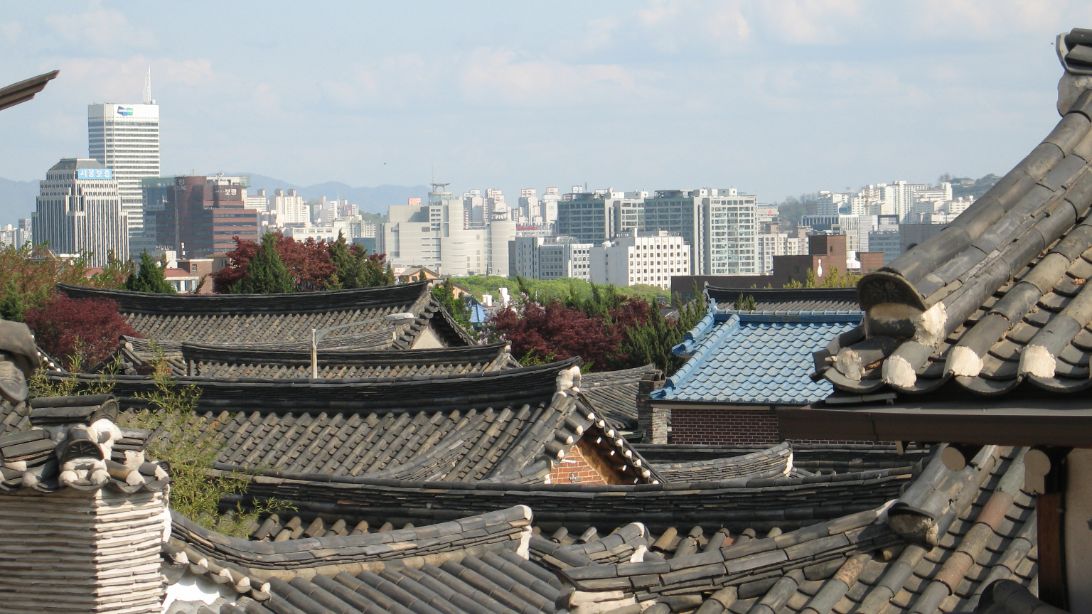
That is why Bukchon matters: it is not a reconstruction or an open-air museum, but a working residential neighbourhood that happens to be made of traditional houses, in the heart of a city of more than nine million. Hanok are built around a courtyard, heated from under the floor by ondol, and roofed in curved clay tiles, and many here are still homes, some now guesthouses, cafés, galleries and craft studios.
Jeong's houses were a new kind of hanok, built for the city rather than the country. They are small, set close together along the lanes, and wrapped tightly around a little courtyard, often in an L or U shape, with the kitchen and rooms opening onto it. Glass replaced paper in the windows and tiled roofs became standard. It is this urban version of the traditional house, repeated lane after lane, that gives Bukchon its unity.
A neighbourhood under pressure
Its popularity has come at a cost. The number of residents fell from about 8,700 in 2012 to about 6,100 in 2024, while visitors reached some 6.4 million a year. Residents complained of noise, litter and people photographing their front doors, and in 2024 Seoul designated the area a special management zone. The visiting hours and fines described below are the result. They are the city's answer to a real problem, and keeping to them is the price of the visit.
From what we have read, Bukchon repays a quiet weekday morning and punishes a crowded afternoon; walk it as a neighbourhood people live in, not a set.
— Andrew + MargaretWhat it's like
You arrive from the flat, busy streets around Anguk Station, where the traffic of Bukchon-ro runs past cafés and hanbok-rental shops. Within ten minutes the road starts to climb and the side lanes open off it: narrow, paved in stone, walled on both sides by the grey tiles, timber and brick of the houses. The noise of the main road drops away quickly once you turn off it.
The lanes rise steeply, some with steps, and the houses step up the slope with them, their roofs overlapping like scales. Every so often the lane opens to a view back down across the roofs to the tower blocks of the city centre, with N Seoul Tower on its hill beyond. The best-known of these views is at the top of Bukchon-ro 11-gil, near the address Gahoe-dong 31, where the lane falls away in front of you towards the city.
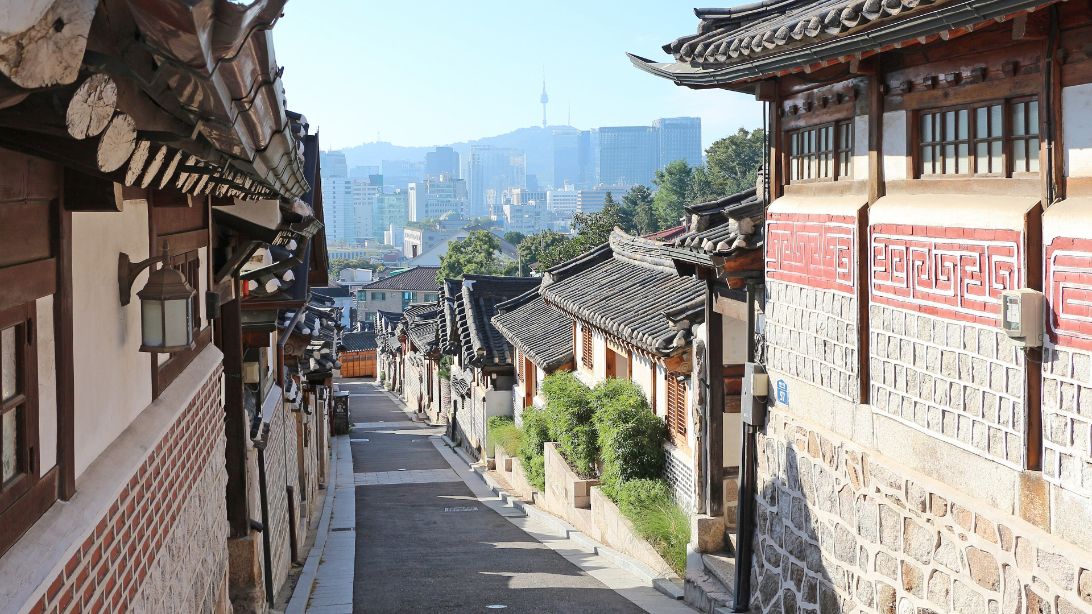
That lane is also where the crowds gather, especially from late morning, and at its busiest it can feel less like a neighbourhood than a queue. The quieter Bukchon is in the lanes on either side, towards Gahoe-dong and Gyedong-gil, where you are more likely to meet a delivery rider or a resident with shopping than a tour group.
The lanes are shared: visitors in rented hanbok photographing each other against the walls, tour groups, and the residents of a working neighbourhood going about their day among them. That mix is part of the place, and it is the reason for the rules.
Leave the main lane and climb one of the side lanes slowly, until the slope makes you breathe. Stop there. Feel the stone under your feet, cool in the shade of the walls. Listen: the road you left is already faint, and the lane holds only what you bring into it — your footsteps, your voice. Listen past them for the sounds of a street where people live, on the other side of the walls. Then turn round, and let the roofs fall away below you towards the city.
In high summer the climb is hot and humid, and after rain the stone can be slippery; in winter the lanes are cold and often clear. In spring and autumn the gardens behind the walls show over the tops of them, and the walk is at its easiest.
How to visit
The lane everyone comes to photograph is open to sightseers from 10am to 5pm, every day. Outside those hours, tourists visiting it can be fined ₩100,000. Residents, their guests, people staying in its guesthouses and shoppers are exempt. Plan to arrive after ten and be off the lane by five.
The rule covers the residential core, which the city calls the Red Zone. Two surrounding areas, the Orange and Yellow zones, have no curfew but are monitored, and the same courtesy applies everywhere: keep your voice down, do not open gates or step into courtyards, do not photograph people's doorways at close range, and take your litter with you. Tour coaches have also been restricted on Bukchon-ro; published dates for when that became permanent differ, which matters only if you are booking a coach tour.
Getting there
Take Seoul Subway Line 3 to Anguk Station. Exits 2 and 3 both lead towards Bukchon; the Bukchon Traditional Culture Center, a good first stop, is about 400 metres from Exit 3. From the station, Bukchon-ro climbs north, and the lanes of hanok open off it on both sides. Allow 10 to 15 minutes' walk, uphill, to Bukchon-ro 11-gil.
Where the lanes are
Bukchon sits north of Anguk Station in Jongno-gu. Gyeongbokgung lies to the west and Changdeokgung to the east, each 10 to 15 minutes' walk away. Bukchon-ro runs uphill from the station through the middle of the district, with Gyedong-gil parallel to the east. Bukchon-ro 11-gil branches off to the east near the top, and its steepest section, with the famous view, runs down towards Gahoe-dong.
| Start from | The walk in | The climb | Best for |
|---|---|---|---|
| Anguk Station | Up Bukchon-ro or Gyedong-gil, 10 to 15 minutes | Steady, then steep in the lanes | A first visit by subway |
| Gyeongbokgung | East through Samcheong-dong's cafés and shops | Gentle at first, steep into Gahoe-dong | After a morning in the palace |
| Changdeokgung | West across the ridge by the side lanes | Short and steep | After the Secret Garden tour |
| Insadong | North across Yulgok-ro, past Anguk Station, then up Bukchon-ro | Flat to the station, then steady | After lunch or tea in Insadong |
A route up
Start at the Bukchon Traditional Culture Center on Gyedong-gil, a hanok complex with exhibitions and classes that is free to enter, open Tuesday to Sunday and closed on Mondays. Walk up Gyedong-gil and into the lanes of Gahoe-dong, reaching Bukchon-ro 11-gil from the top rather than climbing it from the bottom. The city has named eight viewpoints through the district, the Bukchon Eight Views, and following them gives the walk a shape. Come down towards Samcheong-dong or the palaces rather than back the way you came.
How long to allow
Two to three hours covers the main lanes, the Eight Views and a coffee on the way down, at a pace slow enough to enjoy them. Add an hour or two for the Culture Center, a museum or a craft class. Combined with one of the palaces, which each deserve two to three hours of their own, Bukchon fills a full day without hurrying, and the visiting hours fit neatly around it: a palace in the early morning, Bukchon from late morning, and the lanes left before five.
Cost, facilities and access
Walking the lanes is free, and there is no ticket or gate. The small private museums, craft studios and workshops charge their own fees, and a number of hanok offer tea or short cultural classes. Cafés and shops are plentiful on Bukchon-ro and around Samcheong-dong, and far fewer inside the residential lanes. We could not confirm published public toilets within the lanes themselves; plan on the station and the streets at the foot of the hill.
Access is the real limitation. The lanes are steep and narrow, several have steps, and the stone can be uneven, so Bukchon is hard going with a wheelchair or pushchair. The city's barrier-free route for the area is based on the Seoul Museum of Craft Art, at the foot of the district, which has step-free access, lifts and accessible toilets.
Making the most of it
The visiting hours and the crowds point the same way. At 10am on a weekday the famous lane is quiet enough to walk rather than queue; by midday, and all day at weekends, it is full. If you can only come later, spend the busy hours in the side lanes and the Culture Center, and walk 11-gil last.
Bukchon lies between Gyeongbokgung and Changdeokgung, and a morning in one of the palaces followed by the walk across the ridge makes a full, unhurried day. Changdeokgung's Secret Garden can be visited only on timed guided tours, so book that first and fit Bukchon around it.
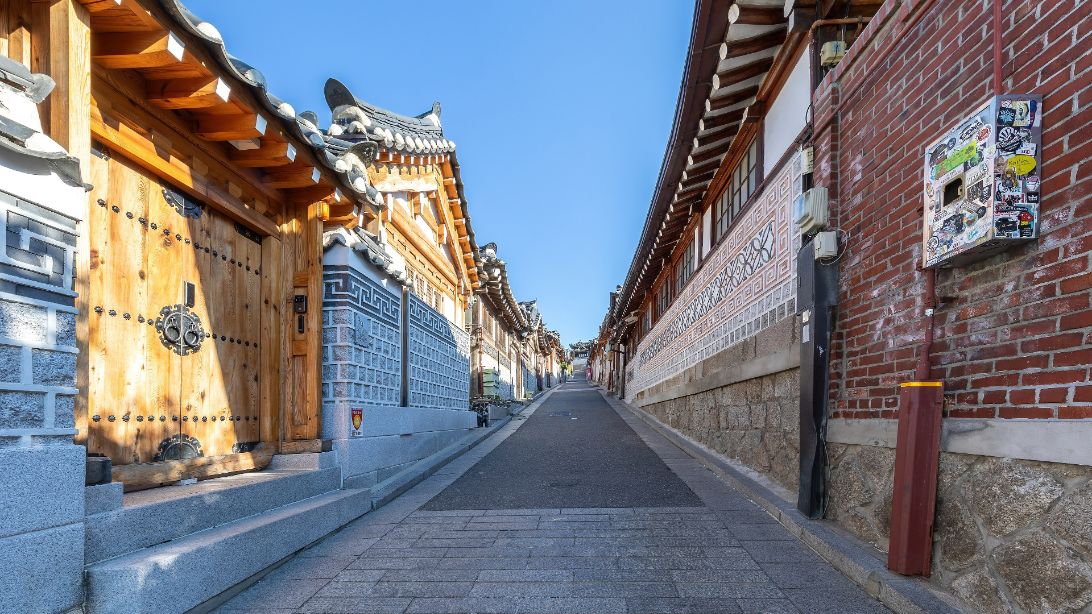
Much of the pleasure is small: the curve of a roof end, the patterns set into a wall, a wooden gate with its brass fittings, the way one house steps down to the next. Slow down enough to notice them, and resist the urge to cover the whole district. Two or three lanes walked properly are worth more than ten walked through.
The lanes are public; the houses are not. Photograph the lane, the roofs and the view, but not into open gates, windows or courtyards, and not residents without asking. Keep tripods and long photo sessions for the wider streets, move aside for people who live here, and do not sit on doorsteps to pose. The best pictures of Bukchon are the long views down the lanes, which need none of that.
Rental shops around Anguk Station hire hanbok, the traditional dress, by the hour, and many visitors wear one for the walk. It is popular, and it has a practical benefit: people wearing hanbok are admitted free to the royal palaces nearby. Bear in mind that a long skirt and soft shoes make the steep lanes harder going.
Some of Bukchon's houses take guests, and staying in one lets you see the lanes in the evening and early morning, when the visiting-hours rule does not apply to you as a guest. Our guide to accommodation in Korea explains what a hanok stay involves.
Nearby
Gyeongbokgung, the main palace, lies just west of Bukchon, and Changdeokgung and the Secret Garden just east; either pairs naturally with the walk. South of Anguk Station, Insadong is the obvious place for lunch and for tea, galleries and craft shops. Samcheong-dong, the valley road on Bukchon's western side, has cafés and small shops and leads towards the palace. At the foot of the district, the Seoul Museum of Craft Art shows Korean crafts old and new and has step-free access. At the top of Bukchon-ro, Samcheong Park offers a short, shaded walk in the woods of the hillside above the houses.
If Bukchon leaves you wanting more of the old domestic architecture, the Jeonju Hanok Village, south of Seoul, is larger and flatter, and takes a night to see properly. For the rest of Seoul, start with our Seoul guide.
A final word on Bukchon
Bukchon is beautiful, and it is someone's home. Go early, go slowly, keep to the hours, and spend more time in the quiet lanes than on the famous one. You will see more, and you will leave it as you found it. It is near the top of our own list, and this is how we mean to see it.
Andrew + Margaret
- Seoul Overview
- Gyeongbokgung Highlight
- Changdeokgung and the Secret Garden Highlight
- Where to stay in Seoul Decide
- Jeonju and its hanok village Highlight
- Accommodation in Korea, including hanok stays Decide
- Korean etiquette Culture
- Getting around South Korea Practical
Is there a time limit for visiting Bukchon?
Yes. The residential core around Bukchon-ro 11-gil is open to tourists only between 10am and 5pm; visiting for tourism outside those hours can bring a fine of around ₩100,000. Residents, their guests and shoppers are exempt. Checked September 2026; confirm before you go.
Is Bukchon Hanok Village free?
Yes — the lanes are public and free to walk. Some craft workshops, museums and tea houses charge for their own activities, but there is no admission to the village itself.
How do I visit respectfully?
Remember people live here: keep your voice down, stay on the public lanes, don't photograph private doorways or enter courtyards, take litter with you, and observe any signs asking for quiet. Coming early on a weekday helps everyone.
What's the nearest subway station?
Anguk station on Line 3, exit 2 (or exit 3 for the craft streets). It's a short uphill walk into the lanes, and the village sits directly between Gyeongbokgung and Changdeokgung palaces.