Hongdae
Seoul's art-school quarter, where the pavement is painted red and anyone with a guitar can draw a crowd
Hongdae is the neighbourhood around Hongik University, one of Korea's best-known art schools, in the west of Seoul. Its name is simply a contraction of the university's, and for thirty years it has been the city's young, loud and creative quarter: the place where Korean indie music began in basement clubs in the 1990s, where street performers play to crowds every evening, and where Seoul's students and twenty-somethings go out. It is the least formal night in the city, and a view of present-day Seoul rather than its past.
Come in the evening, and give it time. Leave Hongik University Station by exit 9 and follow the red-painted street to the busking zone; stay for a whole set; then find a live club, or a late table in one of the side streets. By day, walk north into Yeonnam-dong's cafés and the long green strip of the Gyeongui Line Forest Park, and on a Saturday afternoon between spring and autumn, look in at the Free Market.
How this page was madeWe have not yet been to South Korea. With Japan, it is one of the two places at the top of our list, and this guide is researched rather than remembered: from the Korea Tourism Organization, Seoul's tourism office, Korean press reports and published sources, checked on the date below. When we go, we will say so here.
Last updated 27 September 2026
Why it matters
Most of what visitors hear from Korea arrives polished: the idols, the choreography, the global hits of the big entertainment companies. Hongdae is where the other Korean music lives. In the mid-1990s bands began playing in small clubs around the art school, drawn by cheap basements and an audience of students, and a scene grew up that owed nothing to the big labels. Crying Nut, one of its best-loved punk bands, began playing the Hongdae clubs in 1995, and in December 1996 released Our Nation Vol. 1, a split album with Yellow Kitchen that is often described as the first record of the Korean indie scene.
It was not an easy start. In the late 1990s live clubs, registered as ordinary restaurants, were raided under the food sanitation laws for putting on shows; a campaign of concerts in 1999 helped change the rules and allow live venues in the district. Some of those venues are still going. Rolling Hall, which began in 1995 as a small club in neighbouring Sinchon and moved to Hongdae, has hosted many of the rock bands that later filled bigger halls, and Club Evans has put on jazz since 2001.
What followed was success, and its cost. As the district grew famous, rents rose, and small venues and studios were squeezed out by chain cafés, cosmetics shops and big bars. Korean newspapers have written for years about Hongdae losing the character that made it; large corporate culture spaces opened alongside the old basements. The scene has moved outward, into Yeonnam-dong, Sangsu and Hapjeong, but it has not gone. On any evening the busking street, the clubs and the Free Market still show what the neighbourhood is for.
The red street
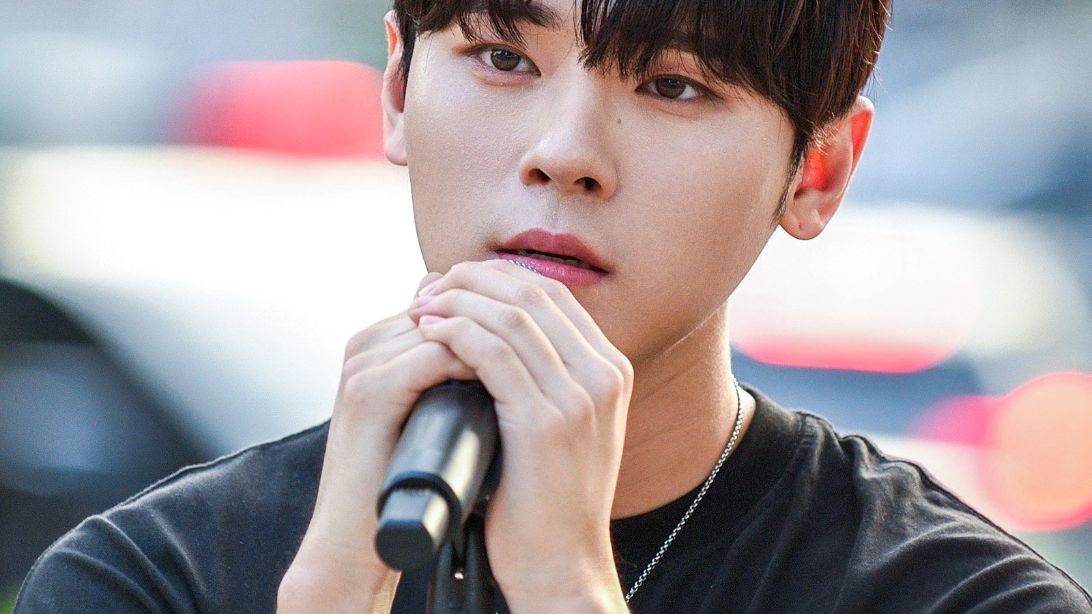
The heart of Hongdae is now officially Red Road: a pedestrian route of about two kilometres, its paving painted red, divided by the district into numbered sections from R1 to R10. The busking zone is R2, reached directly from exit 9 of Hongik University Station. Here, from dusk, singers, bands and K-pop dance crews set up one after another, some very good, some just beginning, all free to watch.
The street's future is not settled. Construction of a new metro line from Bucheon to Hongdae, the Daejang–Hongdae Line, formally began in December 2025, and the plans reported by the Korea Times place its final station in the central plaza of Red Road, with building work of six years or more. Local merchants have campaigned against it, arguing that a cultural street that formed by itself cannot be rebuilt once broken. What that means for the busking zone in the years ahead is not yet clear; if you are planning a visit around the street performers, check recent reports before you go.
From what we have read, this is where Seoul's unpolished music still lives — come in the evening, and come while Red Road is still a street rather than a building site.
— Andrew + MargaretWhat it's like
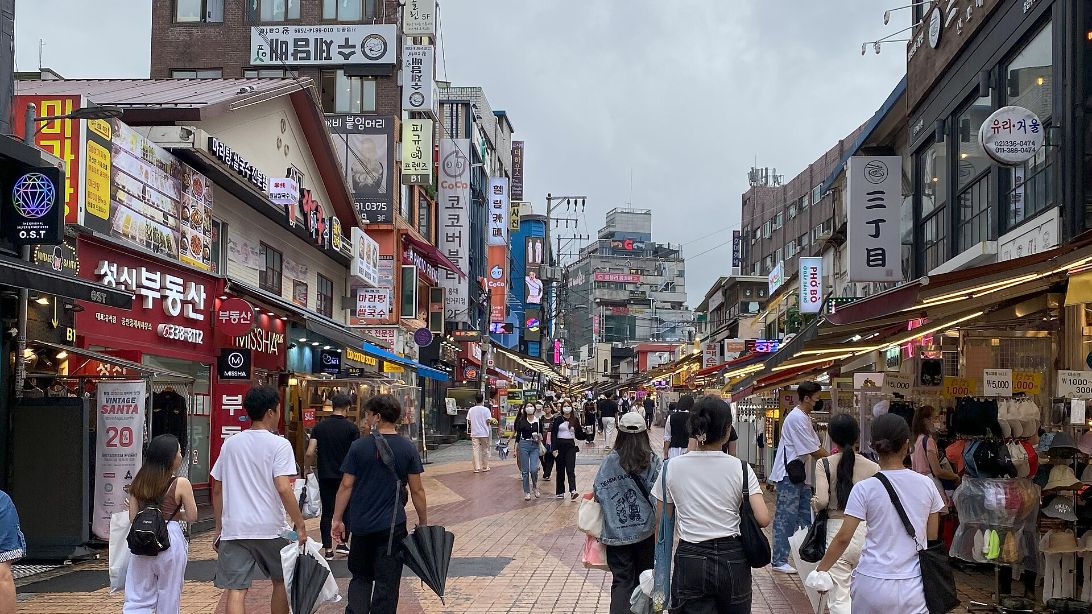
By day Hongdae is a shopping district for the young, and it looks it: narrow streets of clothes shops, cosmetics chains, vintage stores, photo booths, themed cafés and cheap restaurants, with the university's gates at the top of the hill. Murals and graffiti run along the walls of the side streets, and small galleries and design shops hide on upper floors. It is busy, a little scruffy and constantly changing.
After dark it becomes something else. The street lights come on against a wall of neon signs, the crowds thicken, and music begins to come from every direction: from the busking zone, from open bar doors, from basements where a band is sound-checking. Food stalls fry and grill along the pedestrian lanes. At the weekend the crowds on Red Road can be dense enough that the district monitors them; Mapo-gu has designated the area a high-density crowd management zone, and watches foot traffic in real time.
The pleasure of Hongdae is mostly in moving through it: stopping when something catches you, moving on when it doesn't. A good evening might mean half an hour with a singer on the street, an hour in a club for one band, and a long, late meal of barbecue or fried chicken in a side street.
Come after dark on a weekend and walk up from exit 9 until the paving turns red. Follow the loudest sound, then leave it for a quieter one. Stand where you can see the performer's hands. Feel the bass through the soles of your shoes, the warm press of the crowd, the smell of frying from the stalls behind you. Stay for the whole song, then the next. When the set ends, drop a note in the case, and walk on slowly.
Hongdae changes with the hours more than with the seasons, and a day there can be planned around that.
| When | Where | What you'll find |
|---|---|---|
| Late morning | Yeonnam-dong and the forest park | Coffee, bakeries and a walk under the trees |
| Afternoon | Side streets around the university | Vintage shops, design shops, galleries, street art |
| Saturday afternoon | Hongik Children's Park | The Free Market, March to November |
| Dusk | Red Road, R2 | Buskers and dance crews begin to set up |
| Evening | Live clubs and venues | Indie, rock, punk, electronic and jazz |
| Late night | Bars, pubs and dance clubs | Busy into the small hours, especially at weekends |
How to visit
Hongdae is free to wander at any hour, and the busking and crowds are at their biggest on Friday and Saturday evenings. The Free Market runs on Saturday afternoons, about 1pm to 6pm, from March to November. Club shows usually begin in the evening; check each venue's own listings, because line-ups, times and prices change from night to night.
Getting there
Hongik University Station sits on three lines: Line 2 of the Seoul Metro, the Gyeongui–Jungang Line, and AREX, the airport railway. Exit 9 puts you straight onto Red Road and the busking zone. Because AREX runs directly from Incheon International Airport, Hongdae is one of the easiest parts of Seoul to reach on arrival, and a practical base for a first or last night in the city. Sangsu Station on Line 6 is closest to the Free Market, and Hapjeong, on Lines 2 and 6, serves the southern side.
The district spreads downhill from the university towards the station and the river, and it is all walkable. The neighbourhoods around it each have their own character.
| Area | Where | What it's like |
|---|---|---|
| Yeonnam-dong | North, along the forest park | Low-rise streets of cafés, bakeries and small restaurants |
| Sangsu | South, towards the river | Quieter bars and the Free Market's park nearby |
| Hapjeong | South-west | Cafés, studios and the Line 2/Line 6 interchange |
| Mangwon | West, one stop from Hapjeong | A traditional market and a slower, residential feel |
Live music
Hongdae's clubs range from small basements to mid-sized halls, and between them they cover rock, punk, indie, hip-hop, electronic music and jazz. Rolling Hall is one of the longest-running live venues; Club FF puts on bands in the evening and turns into a club later at night; Club Evans is the district's jazz club. Venues open and close often in Hongdae, so treat any list, including ours, as a starting point, and check a venue's current listings before you set out. Tickets are sold on the door or in advance, and prices depend on the show.
For some years the clubs have joined together for Live Club Day, when one ticket admits you to many venues on the last Friday of the month. It has stopped and restarted more than once since it began, so check whether it is running before you plan a night around it.
The Free Market
Since 2002, young artists and makers have sold their own work in Hongik Children's Park, on the edge of the district: jewellery, prints, illustration, ceramics, clothing and small crafts, all made by the people behind the tables. It is not a flea market, and the point is that the work is original. There is usually live music on a small stage in the afternoon. The market runs on Saturday afternoons from March to November.
KT&G Sangsangmadang
On Eoulmadang-ro, a striking building opened in 2007 holds a small theatre, a concert hall, a gallery, a design shop and cafés, run as a cultural space by the Korean tobacco and ginseng company KT&G. It shows independent film, exhibitions and concerts, and its design shop is a good place for gifts by Korean designers. It is open from late morning into the evening.
Eating and drinking
Hongdae eats like the student quarter it is: cheaply, late and in company. The side streets are full of Korean barbecue restaurants with a grill in every table, fried-chicken-and-beer places (the pairing Koreans call chimaek), noodle bars, and stalls selling tteokbokki, spicy rice cakes, to eat standing up. Many places stay open late into the night, and at the weekend the busiest have queues. For something quieter, walk north to Yeonnam-dong, where the restaurants are smaller and the pace slower.
Access
The streets rise gently towards the university and are crowded after dark, especially at weekends, when Red Road can be hard to move through with a wheelchair or pushchair. Daytime and weekday evenings are much easier. Many clubs are down steep stairs in basements, so ask before you go.
Staying safe in the crowds
Hongdae is lively rather than rough, but it is crowded and late. At weekends Red Road can be packed; keep to the edges of a busking crowd, keep your belongings close, and avoid the densest points late at night. Drinking is a large part of the night out here, and taxis are in heavy demand after the last trains; the metro stops running around midnight, so check the time of your last train home.
Making the most of it
The busking street works best if you stop moving. Choose one performer, stand where you can see them, and stay until they finish. Tipping is welcome; many buskers have a case or a card with a way to pay.
Even an hour in a basement club tells you more about Hongdae than a night on the street. Pick a band whose genre you like, arrive early, and expect a small, close room.
The Gyeongui Line Forest Park follows a disused stretch of the old Gyeongui railway, whose trains now run underground; it opened in full in 2016 and runs for about six kilometres across the city. The busiest part, beside Yeonnam-dong, is a lawned promenade of trees, benches and a little stream, known locally as Yeontral Park, where people picnic and sit on the grass until late.
Yeonnam-dong, just north of the station, is quieter than Hongdae and full of small cafés and restaurants. It is the best place in the area for a slow morning coffee, before the crowds arrive.
If you fly out of Incheon early, a last night in Hongdae means the airport train leaves from the station at the bottom of the street. Check AREX's timetable for the first trains of the morning.
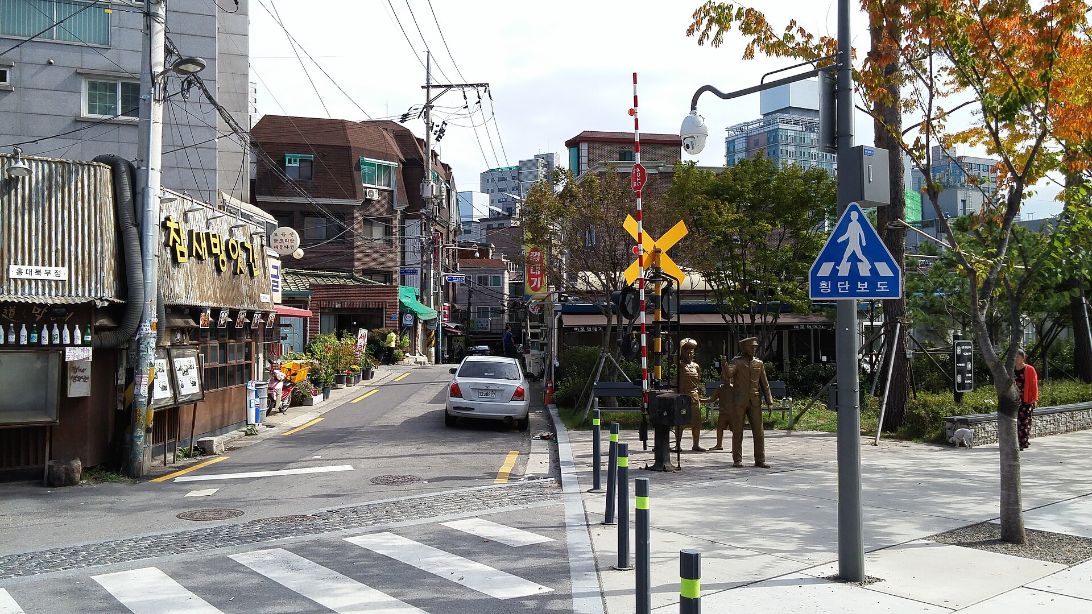
Hongdae's side streets have long been a canvas for the art school next door. Murals, graffiti and posters for coming shows cover the walls and shutters, and they change constantly. Wander the lanes around the university gates by day, when you can see them properly.
Much of Hongdae happens above street level or below it: galleries and studios on upper floors, clubs in basements. Signs at the door or on the stairs are worth reading.
Nearby
From Hongdae, Line 2 runs east to the centre of Seoul, and a short ride takes you across the city to the shopping and street food of Myeongdong. Mangwon, a stop or two west, has a traditional market and a slower, local feel, and the Han River parks lie a short walk south of Hapjeong and Mangwon. For the palaces, tea houses and history that Hongdae deliberately is not, go to Gyeongbokgung and Insadong. For the rest of the city, start with our Seoul guide.
A final word on Hongdae
Hongdae is not a sight to tick off; it is a night to join. Walk up the red street as the light goes, stop for a stranger with a guitar, go down the stairs into one small, loud room, and come out late into streets still full of music. It is near the top of our own list, and this is how we mean to see it.
Andrew + Margaret
- Seoul Overview
- Myeongdong Highlight
- Insadong Highlight
- Where to stay in Seoul Decide
- Getting around South Korea Practical
- K-culture and hallyu Culture
- Visit Seoul — Hongdae Free Market Official
- Visit Korea — KT&G Sangsangmadang Official
What is Hongdae known for?
Youth and creative culture around Hongik University, one of Korea's best-known art schools: the street performers of Red Road, the live-music clubs where Korean indie music began in the 1990s, cafés, vintage shops, street art and a late, lively night out.
When is the best time to see the buskers in Hongdae?
From dusk into the evening, in the R2 busking zone of Red Road by exit 9 of Hongik University Station. It is busiest and liveliest on Friday and Saturday nights. Watching is free; tips are welcome.
How do you get to Hongdae from Incheon Airport?
Take AREX, the airport railway, to Hongik University Station, which is also on Line 2 and the Gyeongui–Jungang Line. It is a direct journey, which makes Hongdae a practical base for a first or last night in Seoul.
When is the Hongdae Free Market?
On Saturday afternoons, about 1pm to 6pm, from March to November, in Hongik Children's Park near Sangsu Station. Young artists and makers sell their own work, often with live music. Checked September 2026.