Insadong
Seoul's street of tea houses, craft shops and galleries, where even the coffee chains write their names in Korean
Insadong is a single main street, Insadong-gil, and a warren of alleys either side of it, in the old centre of Seoul between the palaces and the city's commercial heart. For generations it has been the city's quarter for antiques, art and traditional crafts, and it is still where Seoul comes to buy hanji paper, ceramics and calligraphy brushes, to look at galleries and to drink tea. It is known too for its shop signs, written in Hangeul, the Korean script, rather than in the Roman letters of the rest of the city.
Go in the afternoon, and leave time for tea. Walk Insadong-gil from end to end, turn into the alleys where the tea houses and small galleries are, and sit down in one for an hour. Look in at Jogyesa, the head temple of Korean Buddhism, a few steps from the street. Weekday afternoons are best for browsing in peace; weekends bring buskers and crowds, and the main street is closed to cars at busy times.
How this page was madeWe have not yet been to South Korea. With Japan, it is one of the two places at the top of our list, and this guide is researched rather than remembered: from the Korea Tourism Organization, Seoul's tourism office and published sources, checked on the date below. When we go, we will say so here.
Last updated 27 September 2026
Why it matters
The name joins two old neighbourhoods, Gwanin-bang and Daesa-dong, and for some five hundred years this was a residential quarter of the capital, home to government officials in the shadow of the palaces. Under Japanese rule, as its old families were displaced, it became a place to trade antiques, and in the decades after the war it grew into the centre of Seoul's art and antiques trade. By one often-quoted estimate it once held some forty per cent of the country's antique shops and art galleries.
Today it is the city's most visited street for traditional Korean culture: galleries of painting and ceramics, shops of hanji paper and calligraphy materials, traditional restaurants and tea houses, all on a human scale. The Korea Tourism Organization notes that its streets are wider and easier to walk than those of nearby Ikseon-dong, and that buskers perform along them in the evenings and at weekends.
The signs, and the Starbucks
Insadong's most recognisable detail is its lettering. Shop signs here are written in Hangeul, the Korean alphabet, and that includes international brands. The Starbucks on Insadong-gil, which opened in 2001, was the first in Korea to put up its sign in Korean: local merchants had opposed an English sign as out of keeping with the street, and the company responded with Hangeul lettering and a traditional-style frontage. The sign was redesigned in 2018 and it is now a sight in its own right, photographed by visitors from Korea and abroad.
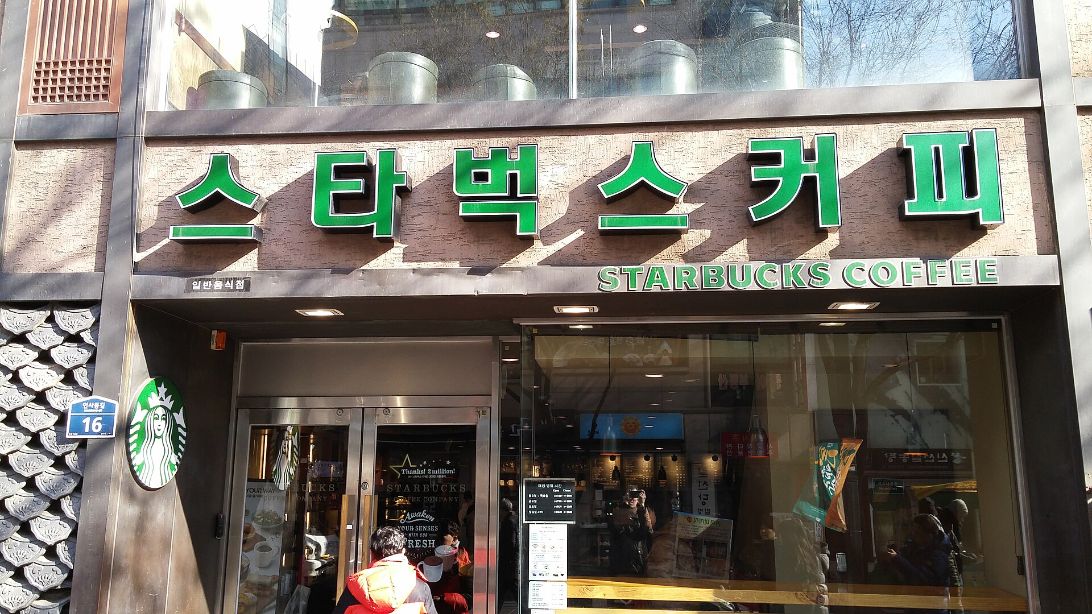
The choice of script matters in Korea. Hangeul was created at the court of King Sejong in the fifteenth century, at Gyeongbokgung, so that ordinary people could read and write their own language, and Koreans celebrate it with a national holiday, Hangeul Day, each October. On a street devoted to Korean tradition, a sign in Hangeul is a quiet statement of what the street is for.
It is a small thing, but it says something about the street. Insadong is a commercial street, full of souvenirs as well as art, and not everything sold here is old or handmade. What it has kept is a sense of itself: a place where Korean craft, script and taste are the point, not the decoration.
From what we have read, Insadong is worth an unhurried afternoon for its tea houses and galleries, not its souvenirs — sit down somewhere for an hour.
— Andrew + MargaretWhat it's like
Insadong-gil runs roughly north to south for several hundred metres, a paved street lined with trees, low buildings and shopfronts. At its busiest it is full: tour groups, families, couples in rented hanbok, stalls selling street snacks, and at weekends buskers and performers. The shops along the main street sell a mixture of the fine and the cheap, from celadon and lacquerware to fridge magnets.
The alleys are where it changes. Turn off the main street and the lanes narrow between old houses and small buildings, and the noise drops. Here are most of the traditional tea houses, some in hanok with courtyards, and small galleries, framers and restaurants. It is worth getting a little lost, and every alley leads back to the main street in a few minutes.
Ssamziegil, near the middle of the street, is the district's best-known building: a shopping complex opened in 2004, in which a continuous ramp spirals up around an open courtyard past small studios and design shops to a rooftop. It is a modern building made for the street's crafts, and walking it from bottom to top is a pleasure in itself.
In the evening the street changes again. The day's tour groups thin out, the lamps come on in the tea houses and restaurants, and on busy nights buskers play along the main street. It is a good time to eat: the alleys hold restaurants serving hanjeongsik, the traditional set meal of many small dishes, and simpler places for noodles and pancakes.
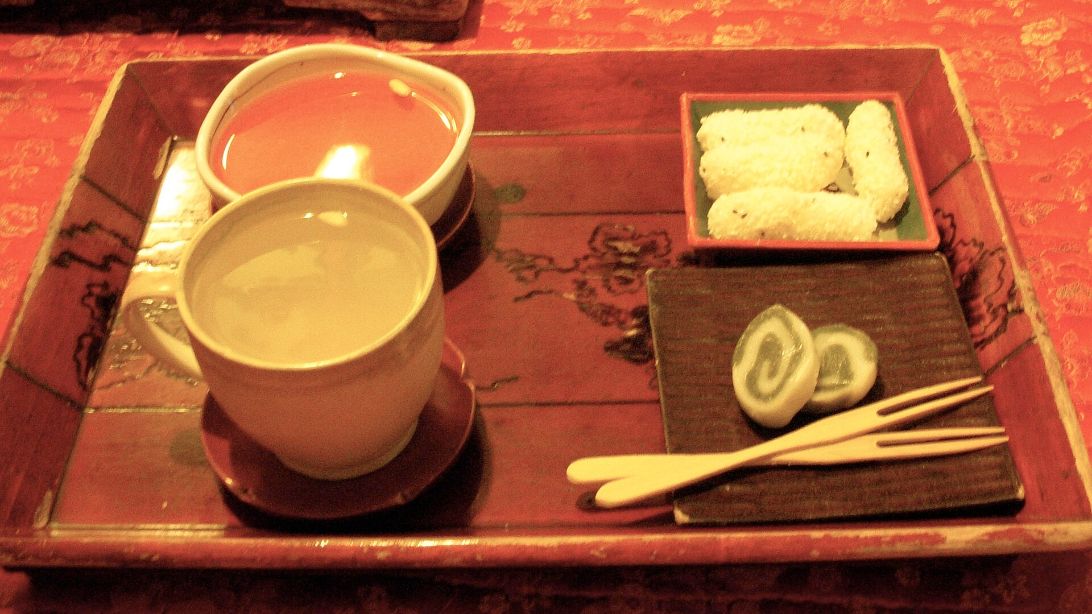
Leave the main street for a tea house down one of the alleys, and take off your shoes if the floor asks you to. Sit on a cushion by a paper-screened window. Order jujube or citron tea, and wait while it comes. Hold the cup in both hands; feel its heat, smell the fruit before you taste it. Listen: the street is still there, but the paper and the wood soften it to a murmur. Drink slowly, and let the afternoon lengthen.
The seasons suit the street in different ways. Spring and autumn are the most comfortable for walking the alleys; in winter the tea houses come into their own, warm and steamy against the cold outside; and on a wet summer afternoon there are few better places in Seoul to wait out the rain than a tea house by a paper window.
Tea houses serve a range of traditional teas, most of them not made from tea leaves at all but from fruit, roots, flowers and grains, often with small traditional sweets alongside.
| Tea | What it is | What it tastes like |
|---|---|---|
| Daechu-cha | Jujube tea, made from dried red dates | Sweet, deep and warming; a winter favourite |
| Yuja-cha | Citron marmalade stirred into hot water | Bright, sharp and sweet; good for a cold |
| Omija-cha | Tea of the five-flavour berry, served hot or cold | Sweet, sour, salty, bitter and pungent at once |
| Ssanghwa-cha | A dark herbal tonic, often topped with pine nuts | The traditional restorative, and an acquired taste |
| Nokcha | Korean green tea | Light and grassy; the tea for a slow hour |
How to visit
Insadong is open all day, every day; individual shops and galleries set their own hours, and most are open from late morning into the evening. The main street is closed to cars when it is busiest, which usually means weekends, when buskers and stalls fill it. For quiet browsing and a seat in a tea house, come on a weekday afternoon.
Getting there
Take Line 3 to Anguk Station, which is at the northern end of Insadong-gil, a couple of minutes' walk away. From the southern end, Jonggak Station on Line 1 and Jongno 3-ga on Lines 1, 3 and 5 are both within walking distance, with Tapgol Park at the foot of the street.
Insadong-gil runs south-east from near Anguk Station on Yulgok-ro to the Jongno end by Tapgol Park. Jogyesa temple lies just to the west of the street, Ikseon-dong's hanok lanes a short walk to the east, and Bukchon and the palaces to the north across Yulgok-ro.
What to buy
The street's shops mix fine craft with souvenirs, and the best buys are the things Insadong has always sold.
| Item | What it is | Tip |
|---|---|---|
| Hanji | Paper made from mulberry bark, plain or dyed and printed | Light to carry; notebooks, cards and lampshades |
| Ceramics | Celadon, white porcelain and buncheong stoneware | Ask whether a piece is handmade; prices vary widely |
| Calligraphy | Brushes, inkstones, ink sticks and paper | Good shops will show you how to choose a brush |
| Antiques | Furniture, ceramics and paintings | Export rules apply to older pieces; buy with a certificate |
| Tea and sweets | Teas, citron preserve and traditional confections | Easy gifts that survive the journey home |
For antiques in particular, go to an established dealer, ask about age and provenance, and keep the paperwork: Korea restricts the export of cultural property, and older items may need clearance to leave the country.
Jogyesa
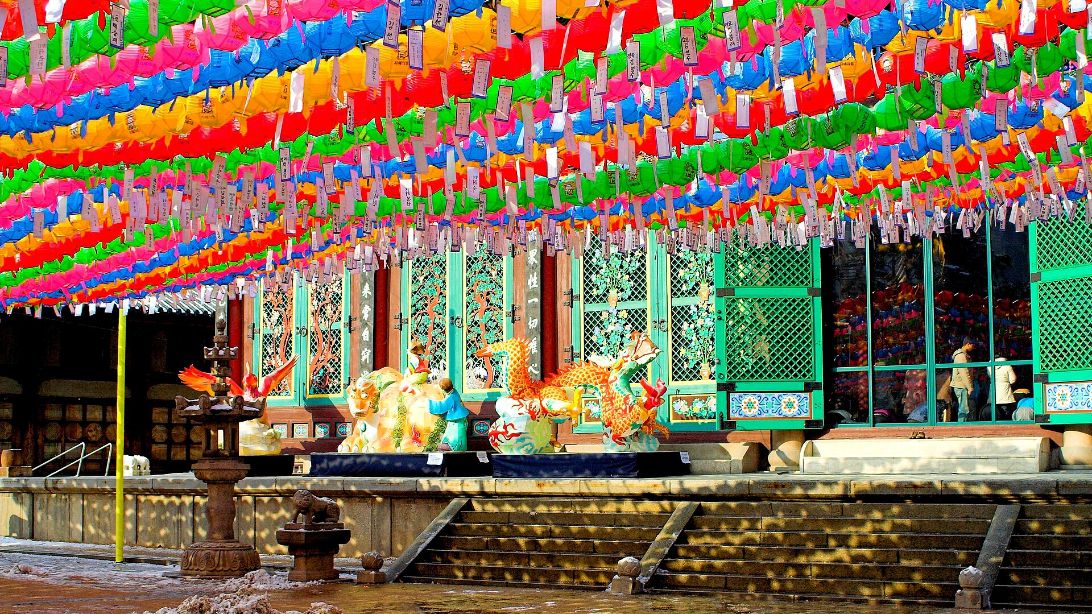
A few steps west of Insadong-gil, Jogyesa is the head temple of the Jogye Order, Korea's largest Buddhist order, and the centre of Korean Buddhism in the capital. A temple on the site dates back to the late fourteenth century; the present one was rebuilt in 1910 and took its current name in 1954. It is free, open all year, and a working temple, so visitors should keep their voices low and not photograph people at prayer. Its courtyard is hung with lanterns for much of the year, and at the Buddha's Birthday it becomes the heart of Yeondeunghoe, the lantern festival inscribed by UNESCO in 2020, with a lantern parade through Jongno.
In the tea house
Many traditional tea houses have floor seating on cushions, and you take off your shoes before stepping up onto the floor. The custom is for each person to order a drink. Tea houses are places to talk quietly and stay a while; nobody will hurry you, and a pot of tea is often topped up with hot water.
Wearing hanbok
Many visitors to Insadong wear hanbok, rented by the hour from shops in the area, and the street makes a natural backdrop for it. The practical bonus is that visitors in hanbok are admitted free to the royal palaces nearby, including Gyeongbokgung and Changdeokgung, provided the outfit follows the palaces' rules. Allow for the long skirt on the steps of tea houses and temple halls.
Street snacks
Along the main street, stalls sell snacks made to be watched as much as eaten. The best known is kkultarae, sometimes called dragon's beard candy: a block of honey and malt stretched and folded by hand into thousands of fine threads, wrapped round nuts. Vendors often put on a show as they make it.
Access
Insadong-gil is paved and nearly level, and easy with a wheelchair or pushchair outside the busiest hours. The alleys are narrower and some tea houses are up steps or on floor seating, so ask before you go in.
Making the most of it
Walk the main street once to see it, then again through the alleys to either side. The first walk shows you the souvenirs; the second shows you the tea houses, galleries and workshops that are the reason the street exists.
Many of the galleries are free to enter, and the smaller ones in the alleys often show contemporary Korean painting, ceramics and craft. Step in wherever the door is open.
The temple's lanterns are at their most beautiful as the light goes and they begin to glow against the dark roofs. From the tea house to the temple is a walk of a few minutes.
Insadong sits between Gyeongbokgung and Changdeokgung, with Bukchon just north. A palace in the morning, lunch and tea in Insadong, and Bukchon's lanes in the afternoon make one of the best days in the city.
If you buy a painting or a piece of ceramics as art rather than as a souvenir, buy from a gallery rather than a street stall, ask about the artist, and ask for a receipt that describes the work. Good galleries are happy to talk about what they show.
A few minutes east of Insadong-gil, Ikseon-dong is a small neighbourhood of hanok lanes that has become one of Seoul's most fashionable, full of cafés, bakeries and small shops. Its alleys are narrower and busier than Insadong's, and they make a lively contrast after the quiet of a tea house.
Some shops and studios in and around Insadong offer short classes in crafts such as hanji or calligraphy. They are an unhurried way to understand what you are looking at in the shops, and something to take home that you made yourself.
Nearby
At the southern end of Insadong-gil, Tapgol Park holds a ten-storey stone pagoda and the pavilion where the Korean Declaration of Independence was read on 1 March 1919. East, Ikseon-dong's narrow hanok lanes are full of cafés and small restaurants. Just north of Anguk Station, Unhyeongung is the former residence of the Heungseon Daewongun, where King Gojong grew up, and further east lies Jongmyo Shrine, the royal ancestral shrine. North across Yulgok-ro, Bukchon Hanok Village climbs the ridge between the palaces. For food of a different kind, Gwangjang Market is a short ride east. For the rest of the city, start with our Seoul guide.
A final word on Insadong
Insadong is a street to take slowly. Walk it once for the shops, once more through the alleys, and then sit down: a cushion, a cup of jujube tea, the street softened to a murmur behind a paper window. It is near the top of our own list, and this is how we mean to see it.
Andrew + Margaret
- Seoul Overview
- Bukchon Hanok Village Highlight
- Gyeongbokgung Palace Highlight
- Gwangjang Market Highlight
- Where to stay in Seoul Decide
- Korean etiquette Culture
- Visit Korea — Insadong Cultural Street Official
- Visit Korea — Jogyesa Temple Official
What is there to do in Insadong?
Walk Insadong-gil and its side alleys for galleries, craft shops and antiques; climb the spiral ramp of Ssamziegil; sit down in a traditional tea house; look for hanji paper, ceramics or calligraphy materials; and walk a few steps to Jogyesa, the head temple of Korean Buddhism. It is a place to browse and slow down.
What is Ssamziegil?
A craft-shopping complex opened in 2004 in the middle of Insadong-gil, where a continuous ramp spirals up around an open courtyard past small studios and design shops to a rooftop. The building itself is as much the attraction as the shops.
When is the best time to visit Insadong?
Weekday afternoons are best for quiet browsing and the tea houses. Weekends are the liveliest, with buskers and stalls, and the main street is closed to cars at busy times, but they are also the most crowded. Checked September 2026.
What's the nearest subway station?
Anguk Station on Line 3, at the northern end of Insadong-gil. Jonggak Station on Line 1 and Jongno 3-ga Station serve the southern end, near Tapgol Park.