Gyeongbokgung Palace
Seoul's first royal palace, burned, stripped and rebuilt: how to see it at its quietest, and how to read what you are looking at
Gyeongbokgung was founded in 1395, three years after the Joseon dynasty came to power, as the principal palace of its new capital. It sits at the head of the city's great ceremonial avenue with the mountain Bugaksan rising behind it, and it is the most visited palace in Korea. It has also been destroyed twice, and what you walk through today is largely a reconstruction, some of it finished within the last few years and some of it not yet begun.
Go, at nine o'clock, and walk it from south to north. Enter through Gwanghwamun, the great gate, and follow the line of gates and courtyards to the throne hall before the day's crowds build, then drift to the pond pavilion and the quieter rear of the palace. Come back to the front for the changing of the guard at ten or two. Avoid Tuesdays, when it is closed. And do not let the rebuilding put you off: it is part of the story, not a flaw in it.
How this page was madeWe have not yet been to South Korea. With Japan, it is one of the two places at the top of our list, and this guide is researched rather than remembered: from the Korea Heritage Service, which runs the palace, Seoul's tourism office and published reporting, checked on the date below. When we go, we will say so here.
Last updated 27 September 2026
Why it matters
Gyeongbokgung was the first and principal palace of the Joseon kings, who ruled Korea from 1392 until 1910. Its name expresses the hope that the new dynasty would have good fortune and prosper, and its site was chosen with care: the mountain behind to the north, and in front of the main gate a broad avenue, Yukjo Street, lined with the offices of the six ministries of state. That avenue is now Gwanghwamun Square, and the line from the mountain through the palace and down the square is still the spine of central Seoul.
It was here, in the 1440s, that King Sejong's court created Hunminjeongeum, the alphabet now called Hangeul, so that ordinary Koreans could read and write their own language. Every sign you read in Korea descends from what was made in these halls.
Twice destroyed, still being rebuilt
The palace burned in 1592, during the Japanese invasions, and lay in ruins for some 270 years. It was rebuilt on a grand scale in the 1860s under King Gojong, and it was here, in 1895, that Empress Myeongseong was assassinated by Japanese agents. After Japan annexed Korea in 1910, most of the palace was pulled down, much of it to make way for an industrial exhibition in 1915, and in 1926 the Japanese Government-General building was completed directly in front of the throne hall, hiding it from the city.
By one count, 93 per cent of the palace was gone, and only 36 buildings survived in their original form. Restoration began in 1990. The Government-General building was demolished in 1996, the first phase of rebuilding finished in 2010 with about 89 buildings restored, and a second phase is planned to run to 2045. Gwanghwamun itself, moved and then destroyed in the twentieth century, was rebuilt on its original site only in 2010.
So most of what you see is new wood on old foundations, built from records, excavation and surviving examples. The throne hall and the pond pavilion are among the buildings that survive from the 1860s. The rest is a nation putting back what was taken from it, and seeing it in that light is what makes the visit more than a walk past pretty roofs.
From what we have read, this is the palace to see if you see only one — at nine, south to north, knowing most of it was put back.
— Andrew + MargaretWhat it's like
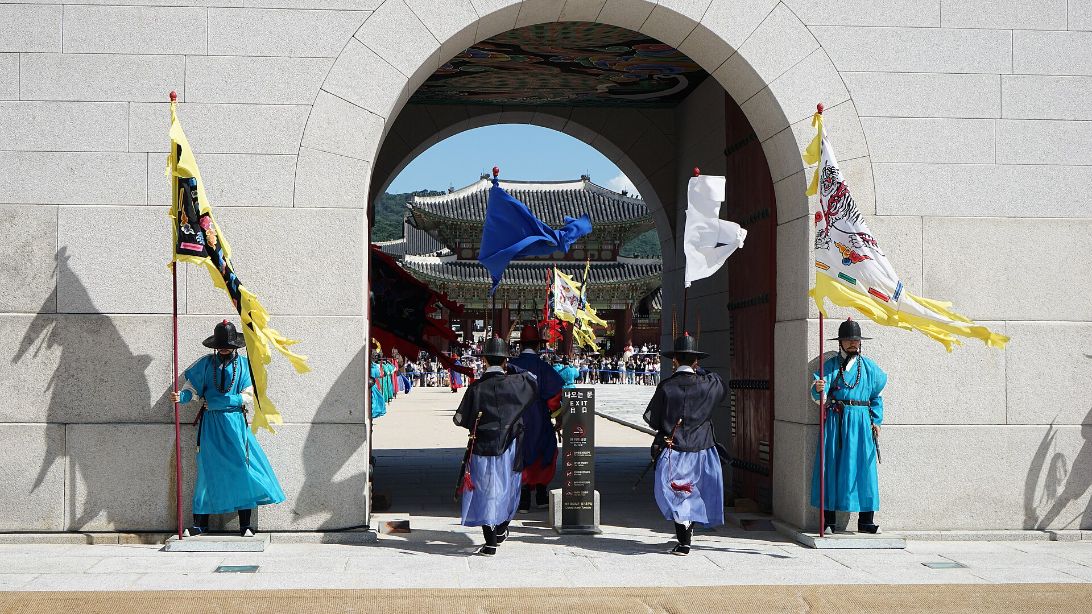
You come to it from Gwanghwamun Square, a wide open space of traffic, statues and fountains, with the great gate at its head and the mountain behind. The gate is a stone platform pierced by three arched passages, with a two-storey timber pavilion on top; the guards stand in the arches, and the ceremony takes place on the forecourt in front of them.
Through the gate the palace opens as a sequence of courtyards, each entered through its own gate, each a little more enclosed than the last. The noise of the city falls behind you with every one. Heungnyemun, the second gate, leads to a court crossed by a small stone bridge over a stream channel; beyond it, Geunjeongmun opens onto the largest and most formal space in the palace, the courtyard of the throne hall.
Geunjeongjeon, the throne hall, stands on a two-tiered stone terrace at the far end of that courtyard, its double roof dark against the mountain. The court in front of it is paved with granite slabs dressed deliberately rough, to cut the glare of the sun, and two lines of small stone markers run up it towards the hall: the rank stones, showing where each grade of official stood at court ceremonies. Inside, behind the throne, is a painted screen of five peaks with the sun and moon.
Come through Geunjeongmun at nine, before the groups, and stop at the edge of the court. Look down first. The granite was left rough so it would not glare, and you feel every ridge of it through your soles. Walk slowly up between the rank stones. Let the roof rise as you come, and the mountain rise behind it, until the two fill the sky. At the foot of the steps, turn round, and look south, the way the throne looks, down the line of gates to the city.
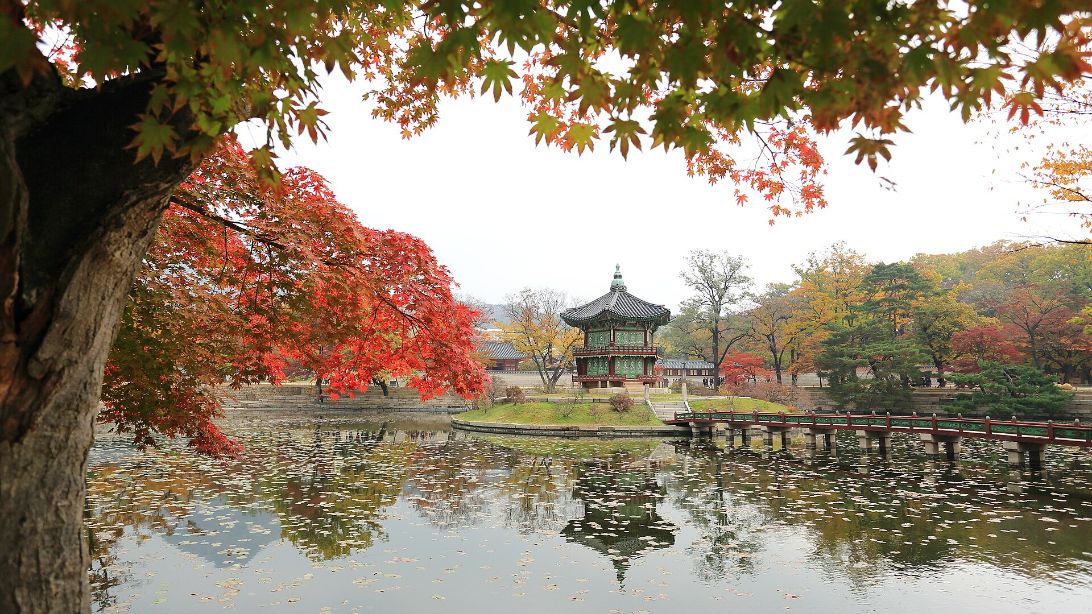
Beyond the throne hall the palace changes character. To the west, Gyeonghoeru, the banqueting pavilion, stands on forty-eight stone pillars in a square pond, its reflection laid out on the water below it. North of the formal halls are the royal living quarters, lower and more domestic, and at the back of the palace, beneath the mountain, a second pond holds Hyangwonjeong, a small hexagonal pavilion reached by a wooden bridge.
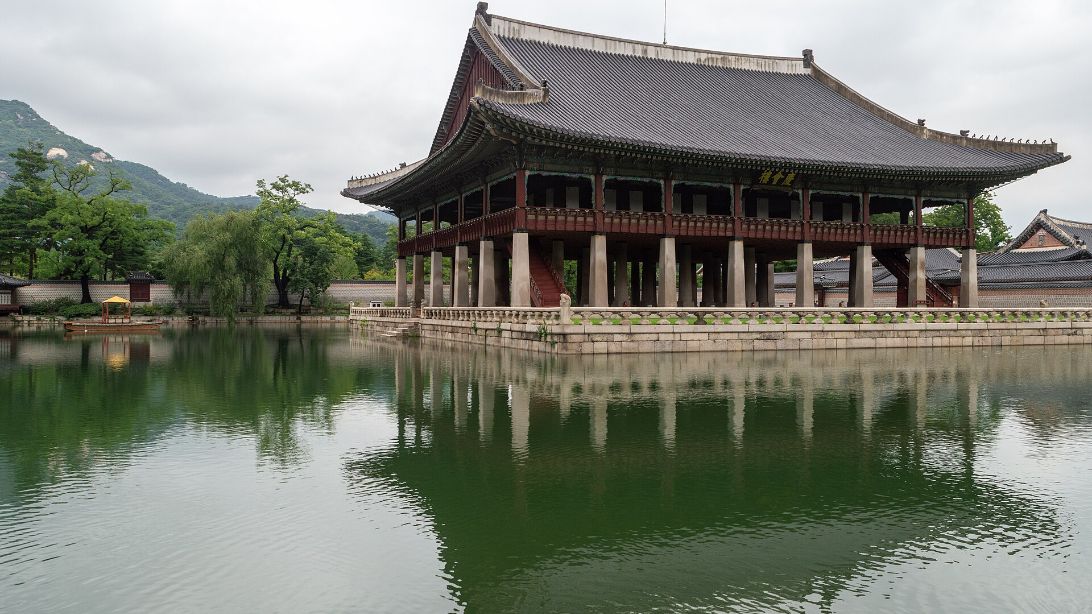
The rear of the palace is where it is quietest. Most visitors walk the central line to the throne hall and back, and the further north and west you go, the more room there is: paths under trees, walled courtyards, and the mountain close above the roofs.
How to visit
Gyeongbokgung closes every Tuesday, and so does the changing of the guard. When a public holiday falls on a Tuesday the palace opens and closes the following day instead. The guard ceremony may also be cancelled in heavy rain or snow.
Opening hours
The palace opens at 9am all year. It closes at 5pm from November to February, 6pm from March to May and in September and October, and 6.30pm from June to August. Last entry is an hour before closing.
Tickets
Adult admission is ₩3,000. Entry is free for anyone aged 18 or under or 65 or over, for everyone on Culture Day, the last Wednesday of each month, and for anyone wearing hanbok. A Royal Palace Pass, ₩6,000, covers Gyeongbokgung, Changdeokgung (but not its Secret Garden), Changgyeonggung, Deoksugung and Jongmyo Shrine, and any of their ticket offices sells it. The Korea Heritage Service's own pages disagree on how long it is valid, three months on one and six on another, so check when you buy it.
The hanbok rule
Free entry in hanbok is no longer a matter of a costume jacket. The palace's rules require both an upper garment and a skirt or trousers, worn properly, with ties and buttons fastened; modern designs qualify as well as traditional ones, but an overcoat alone does not. Rental shops around the palace hire complete sets by the hour.
The changing of the guard
The full ceremony takes place in front of Gwanghwamun at 10am and 2pm, and a gate guard-on-duty ceremony at 11am and 1pm, every day except Tuesday. The full ceremony opens with a great drum struck three times; the relieving guard marches to the gate, the two watches salute and identify themselves, a bugler sounds the change, and the old guard marches away, with a military band playing. It is free, and you watch it from the square without a ticket.
| Time | What happens | What to do |
|---|---|---|
| 09:00 | Gates open | Enter at once and walk straight up the central line to the throne hall |
| 10:00 | Changing of the guard | Back at Gwanghwamun, or skip it for the afternoon one |
| 11:00 | Free English tour | From the information centre inside Heungnyemun, about an hour |
| 13:00 | Gate guard-on-duty ceremony | At Gwanghwamun; the English tour runs again at 13:30 |
| 14:00 | Changing of the guard | The second full ceremony; the busiest time at the gate |
| Late afternoon | Last entry an hour before closing | Spend the end of the day at the ponds and the rear of the palace |
Getting there
Take Seoul Subway Line 3 to Gyeongbokgung Station and use Exit 5, which comes up close to the palace's western side, or Line 5 to Gwanghwamun Station, Exit 2, and walk up the square to the main gate. Either is a walk of about 500 metres. Arriving through the square and the main gate is the better way in, because it shows you the palace as it was meant to be approached.
The palace fills a large walled rectangle north of Gwanghwamun Square. Gwanghwamun is in the middle of its southern wall; the throne hall lies on the same line, three gates in, with Gyeonghoeru to its west and Hyangwonjeong towards the northern wall. The National Palace Museum stands just inside the palace's western side near Gyeongbokgung Station, and the National Folk Museum in the north-east corner, towards Samcheong-dong.
Free guided tours
Free tours in English leave from in front of the information centre inside Heungnyemun at 11am, 1.30pm and 3.30pm, every day the palace is open. They last an hour to an hour and a half, and individuals can simply turn up. Tours in Japanese and Chinese run daily too, and in Spanish and French on some days.
Night openings
For a few weeks each spring and autumn the palace opens in the evenings, lit up, with tickets sold online in advance and, by published accounts, a small number held back each evening for foreign visitors with passports. Dates, prices and the booking channel change each season and our sources for them are not official, so check the Korea Heritage Service's notices before planning around one.
Access and facilities
The palace is on level ground, but the raised stone thresholds of the gates and the deliberately uneven granite of the throne-hall court make a wheelchair or pushchair hard going in places. There are toilets in the grounds, and the two museums make a good place to shelter from heat or rain.
Making the most of it
Gyeongbokgung had nearly 6.9 million visitors in 2025, more than any other palace in Korea. Most of them walk the same central line, and most of them arrive after the gates have opened. Be there at nine, walk the courtyards to the throne hall first, and you will have the formal heart of the palace at its emptiest. Then watch the ten o'clock guard change on the way out, or come back for the one at two.
Once you have seen the throne hall, turn off the axis. Gyeonghoeru to the west and the royal quarters and Hyangwonjeong to the north are where the palace slows down, and they reward a slow walk more than the ceremonial core does. Leave by the northern or eastern side if you are heading on to Bukchon or Samcheong-dong.
Many visitors, Korean and foreign, hire hanbok for the day, and it gets you in free. It also changes the look of the place, filling the courtyards with colour. If you do, allow time for the fitting, check the rules above, and choose shoes you can walk in: the palace is large, and the granite is rough.
Much of the palace's meaning is in what is no longer there, and a free guided tour, or a little reading beforehand, makes sense of the gaps. The National Palace Museum, free and inside the grounds, shows the royal objects that the halls themselves no longer hold.
Seoul has five royal palaces, and Gyeongbokgung is the grandest but not the most complete. Changdeokgung, to the east, keeps more of its original buildings and has the Secret Garden, visited only on timed tours; it is the one listed by UNESCO. If you have time for two, see Gyeongbokgung for the ceremony and the scale, and Changdeokgung for the garden.
Nearby
East of the palace, the hillside lanes of Bukchon Hanok Village climb towards Changdeokgung; walk there through Samcheong-dong, the café-lined valley road along the palace's eastern wall. Changdeokgung and the Secret Garden is a 20-minute walk further east. South-east, Insadong is the place for lunch, tea and craft shops. To the west, across the road from Gyeongbokgung Station, the older streets of Seochon have small restaurants and galleries. And Gwanghwamun Square itself, in front of the gate, has the statues of King Sejong and Admiral Yi Sun-sin, with a museum about Sejong beneath the square. For the rest of the city, start with our Seoul guide.
A final word on Gyeongbokgung
Gyeongbokgung is not old in the way a ruin is old. It is old in the way a promise is kept: burned, stripped and hidden, and put back, gate by gate, within living memory. Go early, walk up the middle to the throne, then wander to the back where the mountain comes close. It is near the top of our own list, and this is how we mean to see it.
Andrew + Margaret
- Seoul Overview
- Bukchon Hanok Village Highlight
- Changdeokgung and the Secret Garden Highlight
- Insadong Highlight
- Where to stay in Seoul Decide
- Korean etiquette Culture
- Getting around South Korea Practical
How much is entry, and is it free in hanbok?
Adult admission is ₩3,000. Entry is free for anyone aged 18 or under or 65 or over, for everyone on Culture Day (the last Wednesday of each month), and for anyone wearing hanbok, provided it includes both an upper garment and a skirt or trousers. Checked September 2026.
What day is Gyeongbokgung closed?
Tuesdays. It opens from 9am, closing between 5pm and 6.30pm depending on the season, with last entry an hour before. If a public holiday falls on a Tuesday, it opens that day and closes the next instead.
When is the changing of the guard?
The full ceremony is at 10am and 2pm in front of Gwanghwamun, the main gate, with a gate guard-on-duty ceremony at 11am and 1pm, every day except Tuesday. It may be cancelled in heavy rain or snow.