Where to Eat in Sydney
A city fed by the people who moved to it.
Sydney's best food is not in its famous places but in its suburbs, each built by a community that brought its cooking with it: Vietnamese in Cabramatta, Korean and Cantonese in Eastwood, regional Chinese in Burwood, Thai in Haymarket. Start in Haymarket on your first evening, and give one morning to a train ride out. The harbour's own contribution is seafood, and the new Fish Market is the place to eat it.
Areas, places and prices reviewed 24 September 2026.
First, how Sydney eats
Sydney's food follows its migrations. Chinese Sydneysiders have been here since the gold rushes of the 1850s, and their Haymarket became the city's first food quarter. Post-war Greek, Italian and Lebanese families changed what the city ate next. From the late 1970s Vietnamese refugees settled in the south-west, and Korean, Thai, Indian and newer Chinese communities followed.
The result is a city where the most interesting meal is often a train ride from the harbour. Destination NSW's list of Sydney's eat streets names fifteen, and most are suburban: Harris Park for Indian food, Lakemba for Middle Eastern and halal cooking, Marrickville for Vietnamese and Greek, Chatswood for Japanese and Malaysian. We have profiled seven below.
Sydney's other food culture is the café. A morning here usually starts at a neighbourhood café rather than a hotel buffet: a flat white, eggs or fritters, eaten outdoors and finished by eleven. It is a local ritual rather than a tourist one, and the best cafés are rarely in the centre.
Go to the Fish Market on a weekday morning, not long after the doors open at seven, and before you buy anything, walk the length of the counters once. Notice who else is shopping, and what they choose, and how long they take over a single fish. Then look out at Blackwattle Bay. This is still a working harbour, and here, for once, you can eat from it.
Two things are less visible than they should be. Aboriginal food knowledge, the oldest cuisine on this coast, appears mostly as native ingredients on restaurant menus: finger lime, wattleseed, lemon myrtle, saltbush. We could not document a place where it is served as its own tradition, and we would rather say so than invent one. And fine dining exists here, but it is not why Sydney is worth eating in.
What to eat in Sydney
Eight dishes and ways of eating that tell you something about the city. Few began here; most became Sydney's by being cooked well for a long time.
Native to the estuaries of New South Wales and farmed here since the nineteenth century. Smaller and creamier than the Pacific oyster, with a long mineral finish. Eat them freshly shucked, ideally at the Fish Market.
Not a dish but a way of eating: choose prawns, sashimi or a cooked plate from the counters, then find a table by the water. Sydney does this better than any other Australian city.
Well represented rather than local, but Sydney’s version is better than most: flathead or barramundi, not cod, and eaten outdoors. Watch the gulls, which are bold and quick.
Cantonese dim sum, brought by the Hong Kong and southern Chinese families who shaped Haymarket and Eastwood. Trolleys or tick-sheets, tea refilled when you leave the pot lid ajar. A late-morning meal, best shared.
Campbell Street has been Thaitown since the late 1980s. Boat noodles and som tam are the reason to go: small bowls, sharp, sweet and hot, and cheaper than almost anything else in the centre.
Vietnamese families who arrived from the late 1970s made Cabramatta Sydney’s pho heartland. Beef pho for breakfast, a crusty pork roll to take away. Marrickville and Newtown carry good versions closer in.
Strathfield, Eastwood and Lidcombe are Sydney’s Korean centres. Grill-at-the-table barbecue and Korean fried chicken are the draws, with banchan side dishes arriving unasked and refilled without charge.
Sydney has a fair claim to the modern café breakfast: sweetcorn fritters, ricotta hotcakes, avocado on toast. Who invented the flat white is argued between Sydney and Wellington, and we will not settle it here.
Where to eat: the most useful neighbourhoods
| Area | Best for | Best time | Main catch |
|---|---|---|---|
| Haymarket & Chinatown | A first evening | Friday night market | Tourist-facing menus on Dixon Street |
| Surry Hills & Darlinghurst | Dinner out | Weekend brunch; weeknight dinner | Weekend dinners need booking |
| Newtown | Cheap and late | Evenings, every day | Loud and crowded on weekends |
| Pyrmont | A seafood lunch | Weekday mornings | Weekend crowds |
| Eastwood | Yum cha and Korean | Weekend late morning | Half an hour out by train |
| Burwood | Regional Chinese | Evenings | Hard to choose; menus vary |
| Cabramatta | Vietnamese breakfast | Morning, Thursday to Monday | About an hour from the centre |
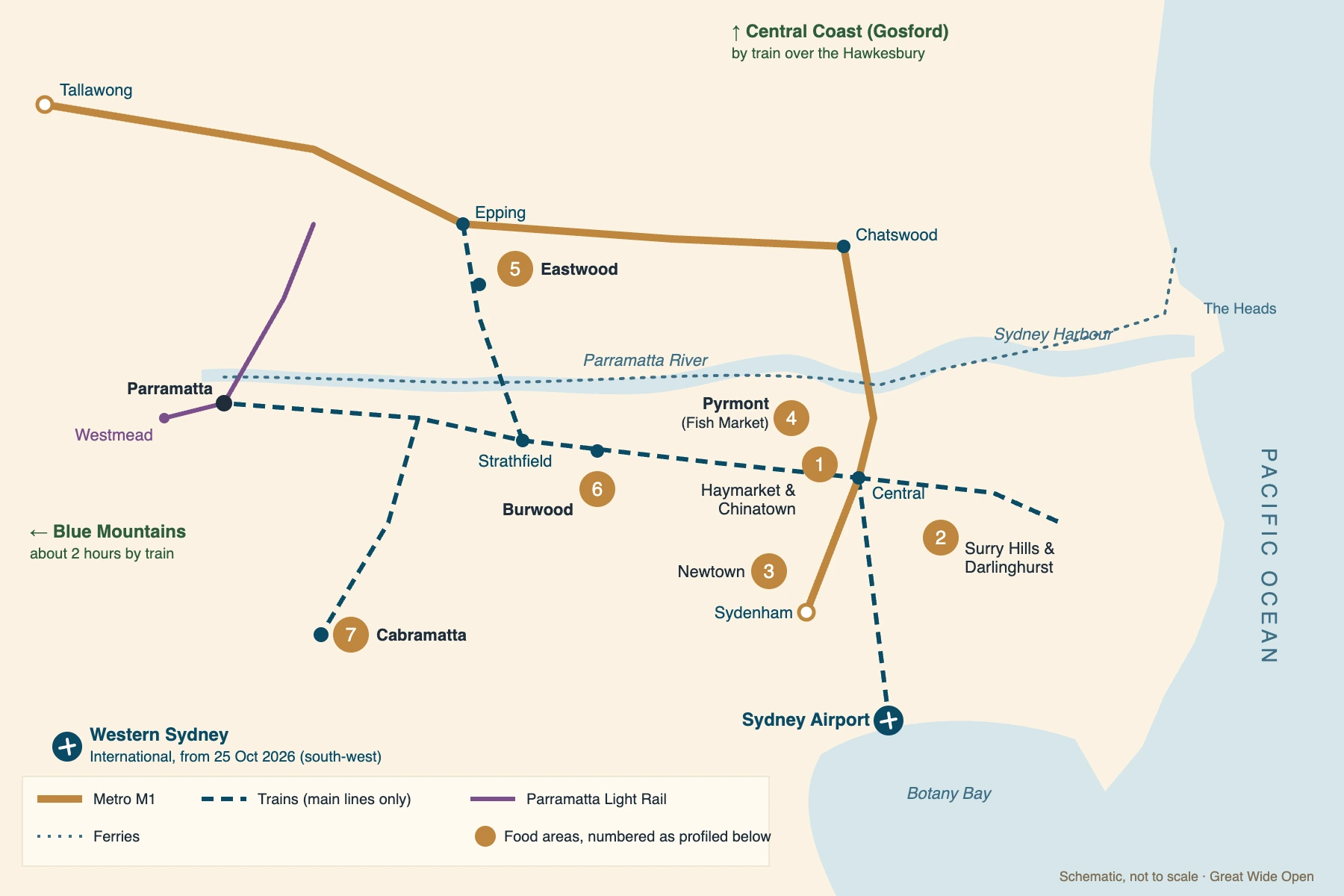
Four areas are in or next to the centre: Haymarket and Chinatown and Surry Hills and Darlinghurst on foot from Central, Pyrmont by light rail, and Newtown five minutes by train. Three are journeys. Burwood is a quarter of an hour west by train, Eastwood about half an hour north-west, and Cabramatta about an hour to the south-west.
Haymarket & Chinatown — the easy first evening
$15–45The centre’s food quarter, between Central and Darling Harbour. Dixon Street is the old Chinatown; Campbell Street, a block east, is Thaitown and the more useful of the two. It stays busy late, it is walkable from most hotels, and on Friday evenings the Chinatown Night Market fills Dixon Street with stalls. The grand yum cha halls that made its name have mostly closed; for yum cha, Eastwood is the better journey.
Eat here for: Thai noodles on Campbell Street, Friday night market snacks, a late bowl of noodles after a show.
Surry Hills & Darlinghurst — where Sydney goes out
$25–90The terrace streets south-east of Central hold the city’s densest run of independent restaurants, wine bars and cafés, along Crown and Bourke Streets and up to Oxford Street. This is the Sydney locals book for a birthday, and where the café breakfast was refined into the form the world copied.
Eat here for: The café breakfast, a long dinner with natural wine, Middle Eastern and modern Australian cooking.
Newtown — cheap, late, everything
$15–45King Street and Enmore Road, five minutes by train from Central, are the Inner West’s main strip: Thai, Vietnamese, West African, Mexican, vegan, and a student crowd that keeps prices down. It is less polished than Surry Hills and more fun on a weeknight.
Eat here for: Thai at a fraction of city prices, vegan and vegetarian food, a late meal after the pub.
Pyrmont — the new Sydney Fish Market
$20–60The new Fish Market opened on Blackwattle Bay in January 2026, and we went in its first weeks. It is a place to spend a lunchtime: fishmongers selling to the public and restaurants under one wide roof, with tables by the water. It opens daily from seven in the morning until ten at night, and individual counters keep their own hours.
Eat here for: Oysters and prawns to eat on the spot, sashimi, a cooked seafood plate by the water.
Eastwood — Korean and Cantonese
$15–45A north-western suburb where Rowe Street and the streets around the station are lined with Korean and Cantonese kitchens. We know it through family, and we think it does Chinese and Korean food better than the city’s Chinatown. It is about half an hour from the centre by train.
Eat here for: Yum cha, Korean barbecue and fried chicken, Hong Kong-style café food.
What to look for: We could not independently verify a long-running restaurant here to our standard, so we name none. Walk Rowe Street and the plaza by the station, and choose the busiest room at lunchtime.
Burwood — regional Chinese
$15–40Burwood Road, a quarter of an hour west of Central by train, is Sydney’s second Chinatown, and its cooking is regional rather than Cantonese: Shanghainese dumplings, Sichuan heat, northern noodles and hotpot. It is where Sydney’s newer Chinese arrivals eat, and it changes quickly.
Eat here for: Soup dumplings, Sichuan dishes, hand-pulled noodles, hotpot.
What to look for: Burwood's restaurants turn over quickly, and none we checked could show five years under one name, so we name none. Look for a queue of Mandarin speakers, and a short menu that does one region well.
Cabramatta — pho and bánh mì
$10–30The south-western suburb built by Vietnamese refugee families from the late 1970s. John Street and the arcades off it are the best place in Sydney for pho, bánh mì, fresh herbs and Vietnamese sweets, at prices the centre cannot match. Come in the morning, when the broth is fresh and the bakeries are busy.
Eat here for: Beef pho for breakfast, a pork bánh mì to take away, sugarcane juice.
How much does it cost to eat in Sydney?
| Meal or occasion | Typical spend | What that buys |
|---|---|---|
| A café coffee (flat white) | $5–7 | One cup, takeaway or at the counter |
| A bánh mì | $9–14 | A filled roll; a quick lunch |
| A bowl of pho | $16–24 | Breakfast or lunch, with herbs and tea |
| A noodle or food-court lunch | $15–25 | One dish and a drink, Haymarket or a food court |
| Yum cha | $35–60 | Several baskets shared, with tea |
| A seafood lunch at the Fish Market | $25–50 | Oysters or prawns and a cooked plate, shared |
| Dinner at a mid-range restaurant | $60–100 | Two courses and a glass of wine |
| A tasting menu | $150–300+ | A special-occasion dinner, before drinks |
Australian dollars per person, including GST, as at September 2026. These are indicative ranges drawn from menus and press reports, not a survey, and Sydney prices move quickly. Tipping is not expected. For a whole-trip food allowance, see our guide to the cost of visiting Australia.
Does Sydney have street food?
Not in the form many visitors expect. There are no permanent street stalls on the Asian model: the City of Sydney licenses food trucks by permit and location under its mobile food vending policy of December 2022, which keeps them few and occasional. Sydney's street food lives indoors and in markets instead.
The best version is the Chinatown Night Market on Dixon Street, on Friday evenings from five until ten. After that come the food courts of Haymarket and Chatswood, where a dozen counters cook for one crowd of tables, and the Fish Market. Cabramatta's bakeries and juice bars are the closest thing to a street-food morning.
Pay the way locals do: most counters take cards, the night market and some older suburban kitchens prefer cash, and seating at market tables is shared. There is no etiquette to learn beyond clearing your own tray in a food court and not saving a table while you queue.
Building food into one day
This day works best on a Friday, for the night market, and from Thursday to Monday for the pho. It uses trains and the light rail throughout.
Breakfast — Cabramatta, pho while the broth is fresh
Take the train from Central to Cabramatta, about an hour, and eat pho on John Street soon after the kitchens open. This beat fails on Tuesday and Wednesday, when several pho kitchens close; check before you go.
Mid-morning — a bánh mì for later
Walk the bakeries on John Street and buy a pork roll and a sugarcane juice to take back. Then take the train back towards the centre and the light rail to the Fish Market; allow an hour and a quarter.
Lunch — the Fish Market, oysters by the water
Choose oysters, prawns or sashimi from the counters and eat outside on Blackwattle Bay. Weekends are crowded from late morning; a weekday lunch is calmer.
Afternoon — Surry Hills, coffee and a rest
Walk or take a bus to Surry Hills for a flat white and nothing else. The point is a pause: the day has one more meal in it, and it is the best one.
Evening — Haymarket, the night market and Thaitown
On a Friday, walk the Chinatown Night Market on Dixon Street from five o’clock, then eat boat noodles on Campbell Street. On other days, go straight to Campbell Street, where the Thai kitchens stay open late.
Practical advice for eating in Sydney
Booking and queues
Book weekend dinners in Surry Hills, Darlinghurst and Newtown. Many of the best cheaper places take no bookings at all, so arrive before seven in the evening or after half past eight. Yum cha is busiest from eleven on weekends.
Meal times and closing days
Sydney eats early by European standards. Dinner service in most suburbs runs from about six until half past nine, later in Haymarket and Newtown. Many independent restaurants close on Mondays, some on Tuesdays too, and market and suburban kitchens keep daytime hours. Check a place's own page before a special trip.
Ordering at yum cha and Korean barbecue
At yum cha, dishes come by trolley or from a tick-sheet, each one is marked on a card at your table, and you pay at the end. At Korean barbecue, staff will often cook or turn the meat for you; let them. Both meals are made for sharing, so go with three or more if you can.
BYO, surcharges and tipping
Many smaller and Asian restaurants let you bring your own wine and charge a small corkage fee; ask when you book. From 1 October 2026 card surcharges on eftpos, Mastercard and Visa are banned, but weekend and public-holiday surcharges remain legal if they are shown before you order. Tipping is not expected; ten per cent for good service is generous.
Dietary needs
Vegetarian and vegan food is easy in Newtown and Haymarket, and halal food in Lakemba and across the south-west. Restaurants must tell you about allergens in a dish if you ask, but they are not required to print them on the menu, so ask every time.
A final word on eating in Sydney
Eat one meal by the water and every other meal where Sydney's communities cook for themselves. A train to Cabramatta or Eastwood will teach you more about this city than a table with a view of the Opera House.
Andrew + Margaret
- Sydney Overview
- Where to stay in Sydney Decide
- Sydney Harbour Highlight
- Cost of visiting Australia Practical
- Getting around Australia Practical
- Sydney Fish Market — opening hours and retailers Official
- Chinatown Night Market — Friday times Official
- Destination NSW — Sydney’s eat streets Official
- Transport for NSW — trip planner Official
Is Sydney’s Chinatown worth it?
For a first evening, yes, and Campbell Street’s Thai kitchens especially. For Chinese food at its best, we think Eastwood and Burwood are better.
Where can we eat with a harbour view without paying for the view?
The Fish Market, with a plate of seafood bought at the counter and eaten outside on Blackwattle Bay.