New Zealand Itineraries
Four New Zealand itineraries, each worked day by day — what each one gives you, and which one fits your trip
This page has four New Zealand itineraries, each worked out day by day. Three of the four we would call “focused”. Each is two weeks in length, but they are busy, and there is little slack: you see a lot, but travelling is the cost. The fourth is a three-week itinerary that we would describe as “comfortable”.
The cards below set them side by side. Pick the one that fits, and its card takes you to the day-by-day plan.
If you have a fortnight, this is your first visit, and you don’t mind the travelling, start with the both-islands route: it reaches most of what people picture of New Zealand before they arrive. But the cost is moving more than we would like.
Alternatively, take the South Island fortnight if you would rather stop than drive, the North Island fortnight if Waitangi or Māori culture is the reason you are coming, and three weeks if you are only ever going to do this once.
All four are based on our view of what is realistic in visiting a country such as New Zealand (see Getting around New Zealand): a country where distance is measured in hours, and the hours are longer than the map says. So no day on any of these itineraries involves a drive of more than 350 km, a mountain pass gets half a day, the Cook Strait ferry gets a day of its own, and no route drives on the day you land. That page makes the argument; this one shows what it did to our routes. And because the commonest mistake is not too few days but too much driving, the shorter answers here see one island rather than compressed versions of two.
How this page was madeAuckland, Northland, the Coromandel and Rotorua are ours: we drove them in March 2026 and wrote them up at the end of each day. Taupō, the Tongariro Crossing, Napier and Wellington are researched, and each route page labels them where they appear. The South Island is researched throughout. We have been, but before the Christchurch earthquake. Every South Island claim on these pages names its source, and none of those sources is a drive time we measured ourselves.
Last updated 2 October 2026
Choose your itinerary
Our four routes, set out the same way. Each card opens its day-by-day page.
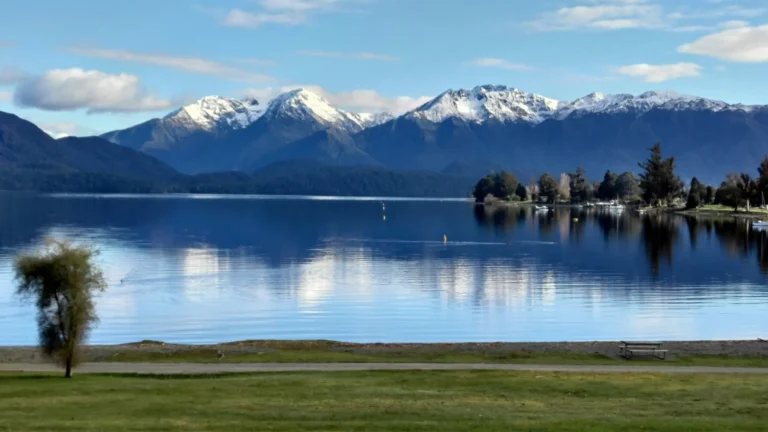 Both islands
New Zealand in two weeks
Both islands
New Zealand in two weeks
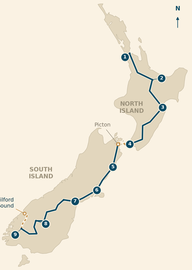
- 14 days
- 9 bases
- 5 one-night stops
- Auckland in, Queenstown out
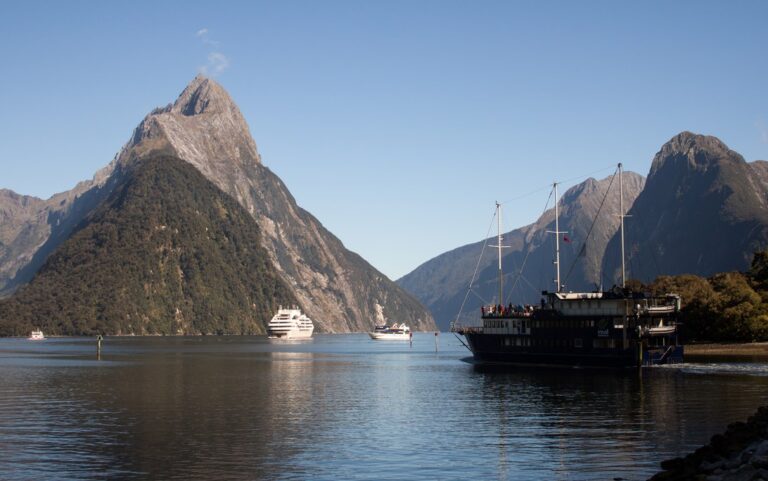 South Island
 itinerary
South Island
South Island itinerary
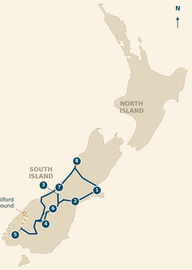
- 14 days
- 8 bases
- 3 one-night stops
- A loop from Christchurch
 North Island
The North Island in two weeks
North Island
The North Island in two weeks
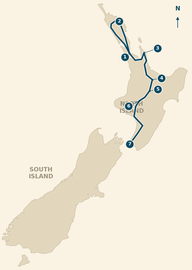
- 14 days
- 7 bases
- 3 one-night stops
- Auckland in, Wellington out
 Both islands
New Zealand in three weeks
Both islands
New Zealand in three weeks
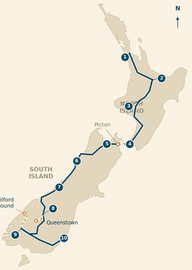
- 21 days
- 10 bases
- 2 one-night stops
- Auckland in, Dunedin out
Swipe for all four. Every card is a link.
Days are days on the ground. On all four, day one is the day you land, and none of them drives on it, which is the Transport Agency’s own advice rather than ours. Each ends on a travelling day, so build the flight home into it, or add a night. Three are open-jaw bookings; the South Island fortnight is a loop that starts and finishes at Christchurch.
What we have not written. There is no one-week itinerary here, and none of four weeks or more. A week across both islands would cross the strait and still drive most days, so we would not publish it. If a week is what you have, the North Island and South Island pages each show what to keep.
How to choose
A first visit, a fortnight, and you want both islands
It runs in one line, never backtracks, and gives the ferry its own day. You accept five single nights and no glaciers. If either matters more than seeing both islands, take an island fortnight instead.
Take New Zealand in two weeks → If this is youA fortnight, and you would rather stop than drive
One island, one car, no ferry, and two nights in most places. It is the only fortnight here that reaches Milford, Aoraki and the glaciers on one trip, and the one we would defend hardest.
Take South Island itinerary → If this is youWaitangi, Māori culture or the north is the reason you are coming
Of thirty-six published both-islands fortnights we read, exactly one reached the Bay of Islands. Within three weeks, Northland is bought by giving up the South Island, not by adding days.
Take the North Island in two weeks → If this is youYou are only ever going to do this once
The extra week is not for adding places. It buys the West Coast and the glaciers alongside Milford, the Tongariro Crossing with a spare day for weather, and five days on which the car does not move.
Take New Zealand in three weeks →Four weeks or more. Join the North Island and South Island fortnights. The North Island route ends in Wellington, the ferry crosses to Picton, and a long day down the coast reaches Christchurch, where the South Island loop begins. It is the only way on this site to see both islands and Northland on one trip, and how many days you need shows how.
How practical is each route?
We think (see Getting around New Zealand) that seeing New Zealand involves driving, that public transport joins the towns and little else, that flying is how you see both islands in limited time, and that the commonest mistake visitors can make is wanting to drive too far. So our itineraries and their routes have been based on this.
We tested each: the longest day against a 350 km cap, how each handles the mountain passes and the ferry between the islands, and how often it requires movement from one base to another. Pace means moves, not places, and one move every other day is the rhythm we aim for.
| Route | The daily cap | Passes | The ferry | Pace |
|---|---|---|---|---|
| New Zealand in two weeks | 317 km. Napier to Wellington. The 482 km Christchurch–Queenstown run is split at Tekapo | The Lindis Pass, given half of day 11 | Day 8, then 156 km to Kaikōura | 9 bases, 8 moves, 5 single nights. Moves more often than every other day |
| South Island itinerary | 286 km. Over the Haast Pass | The Haast, a day to itself at six hours. The Crown Range and Arthur’s Pass on shorter days | None. One island | 8 bases, 7 moves, 3 single nights. One move every other day |
| The North Island in two weeks | 345 km. Day 3. Inside the cap, on the slowest road of the four | No alpine pass. The volcanic plateau takes snow in winter | None. One island | 7 bases, 7 moves, 3 single nights. One move every other day |
| New Zealand in three weeks | 314 km. National Park to Wellington | The Haast, a day to itself at six hours | Day 10, then 107 km to Nelson | 10 bases, 9 moves, 2 single nights. Under one move every other day |
New Zealand in two weeks moves more often than we would like: eight moves in fourteen days is the price of both islands in a fortnight, and it is why three weeks is the better trip if you can find the time. The North Island’s 345 km day three runs through Waipoua on SH12: inside the cap, and still the hardest driving on any of the four.
Before you commit to a route
The ferry, if your route has one. Two of the four cross Cook Strait, and on both the ferry is the constraint, not the car. Not every hire company permits its cars on the boat, and at least one charges the full relocation cost if a car ends on the wrong island. Book the crossing before you book the vehicle. Getting around New Zealand carries the permitted and prohibited lists.
State Highway 6 is the only direct link between Otago and the West Coast, and both routes that use it depend on it. In August and September 2026 it ran under convoy control after slips at more than twenty places. That may have changed in either direction by the time you read this. Check before you book the glacier nights, because those are the ones a closure strands.
When you go changes which route works. The Milford Road and the alpine passes close for weather in winter, and a route built around them in July is a different trip. Late February to April is when everything is open and the summer traffic has gone. Best time to visit New Zealand has the month-by-month position.
How you fly in and out. Three of the four are open-jaw bookings and will cost more than a return into one city. Price the flights before you commit to a route shape.
Entry. Most visitors need an NZeTA and the International Visitor Levy before travelling, and they are bought together. We do not yet have a New Zealand entry guide, so take the requirement from Immigration New Zealand directly, and allow seventy-two hours.
With a fortnight we would take one island and stop often; both islands deserve the third week and, from what we have driven and read, repay it.
— Andrew + MargaretA final word on choosing a route
The commonest mistake is not too few days but too much driving, and too many places inside the days you have. Every route above was built by taking places out, and the one you should follow is whichever one takes out the things you were not really coming for.
Andrew + Margaret
- How many days do you need in New Zealand Decide
- North Island or South Island? Decide
- Getting around New Zealand Practical
- Best time to visit New Zealand Practical
- Accommodation and campervans Practical
- A North Island road trip, as it happened Journeys
- Visiting New Zealand Overview
- NZTA highway conditions Official
- Interislander timetable Booking
- DOC, the Milford Road Official
- DOC, Fiordland Official
Can I do both islands in ten days?
You can, and we would not. Ten days across both islands means moving almost every day, and the ferry takes one of the ten. Ten days on one island is a better holiday than ten days on two.
Do I need to book the ferry before the car?
Yes, on either route that crosses. Vehicle space is the thing that runs out, not hire cars. Not every hire company permits its vehicles on the crossing, so the sailing you can get decides which car you book.
Which island should I choose if I can only take one?
South for fiords, glaciers and alpine walking; North for Māori culture, geothermal country, Northland and a warm sea. Each island fills a fortnight well. If you already know which set of images made you want to come, that is your answer.