Dunedin
A Victorian city at the head of a harbour, with albatross, penguins and sea lions at the end of the road
Dunedin is a stone-built Victorian city at the head of a long harbour, and at the far end of that harbour, an hour’s drive away, royal albatross glide over the headland where they nest. Few cities anywhere have wildlife like this on their doorstep: penguins, sea lions and fur seals live along the Otago Peninsula’s beaches.
The city itself was built by Scottish settlers and paid for by gold, and it shows: a railway station like a wedding cake, a castle on the hill, churches and banks in dark stone, and Robert Burns sitting in the middle of the Octagon. It is a university town, full of students in term, and New Zealand’s only UNESCO City of Literature. Give it two days at least, and three if you can.
How this page was madeWe last travelled in the South Island before 2011, too long ago to describe Dunedin from memory. So this page is researched: from Enterprise Dunedin, newzealand.com, the Department of Conservation, the Otago Regional Council, the attractions’ own sites and the other sources named at the end, checked on 18 October 2026. We also read what travellers ask about Dunedin, and tried to answer it. Where sources disagree or say nothing, we tell you. When we go, we will say so here.
Last updated 18 October 2026
A little background
Long before the city, the harbour was Kāi Tahu country, and it still is: Te Rūnanga o Ōtākou, on the peninsula, and Kāti Huirapa Rūnaka ki Puketeraki, to the north, are the people of the land here. The Māori name for Dunedin is Ōtepoti. The Otago Deed of 1844 covered about 400,000 acres of Kāi Tahu land, and the first Scottish settlers arrived in 1848.
They were Presbyterians of the Free Church of Scotland, and they named their town after Edinburgh, Dùn Èideann in Gaelic. Then, in 1861, gold was found at Gabriel’s Gully, inland. Miners and money poured through the port, and by 1865 Dunedin was the largest city in New Zealand. The wealth built what visitors come to see now: the banks and churches in dark stone, the mansions on the hills and, in 1869, the country’s first university.
The money and the people later moved north, and Dunedin settled into being a university city of about 130,000. That is why so much of the Victorian and Edwardian city survives: newzealand.com calls it “one of the best collections of Edwardian and Victorian architecture in the southern hemisphere”. See our guide to understanding Māori New Zealand for more on the iwi of the south.
A city of writers
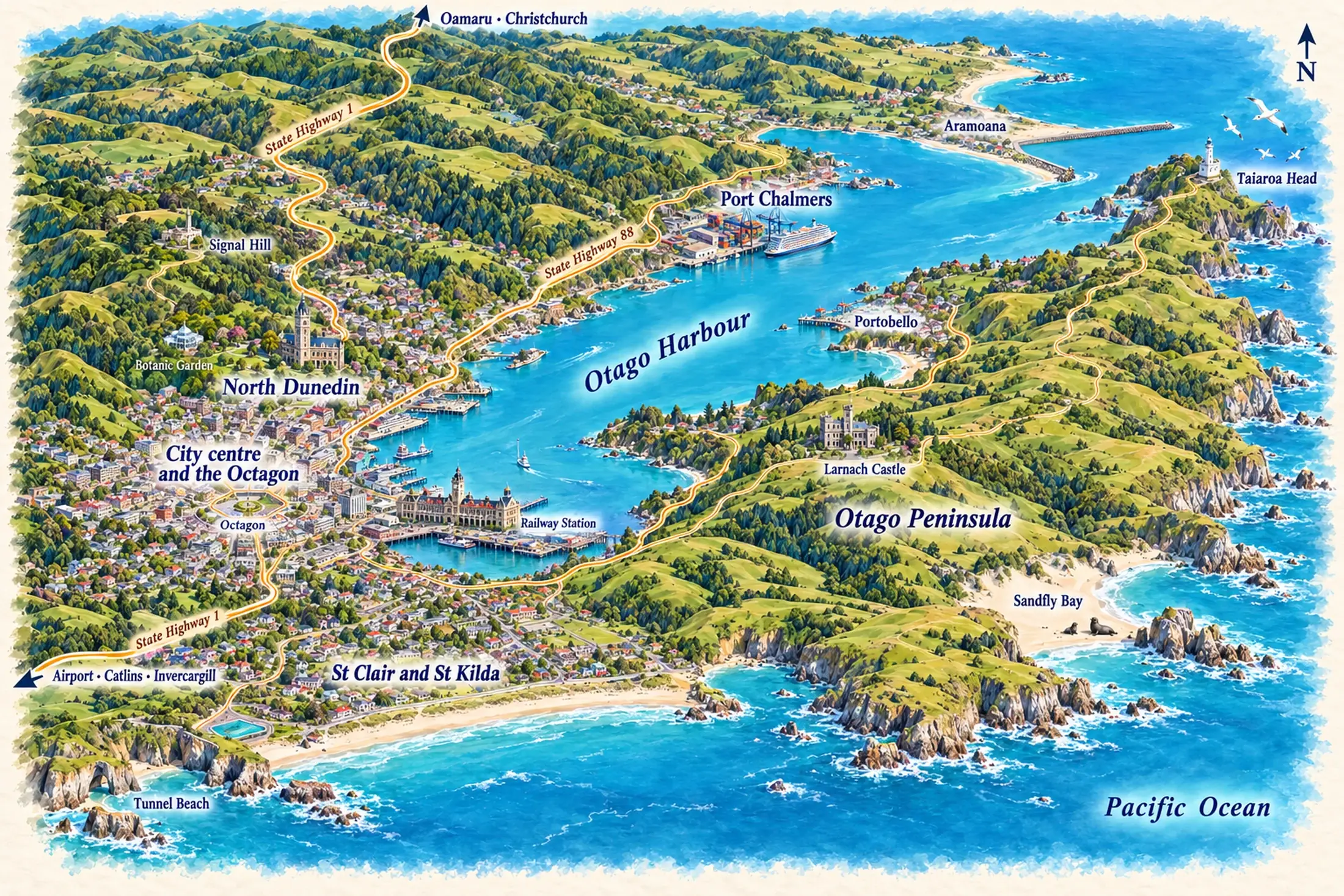
In 2014 Dunedin became New Zealand’s only UNESCO City of Literature, and it wears the title in public. Robert Burns sits in the Octagon, though he never came here: his nephew, the Reverend Thomas Burns, was one of the city’s founders. In the paving around him, the Writers’ Walk carries plaques to 29 writers with a link to the city, each with a few lines about it: Janet Frame, Charles Brasch, James K. Baxter and Hone Tuwhare among them. The painter Frances Hodgkins was born here in 1869, and in the 1980s bands like The Clean and The Chills made the “Dunedin sound” famous far beyond the city.
How Dunedin fits together
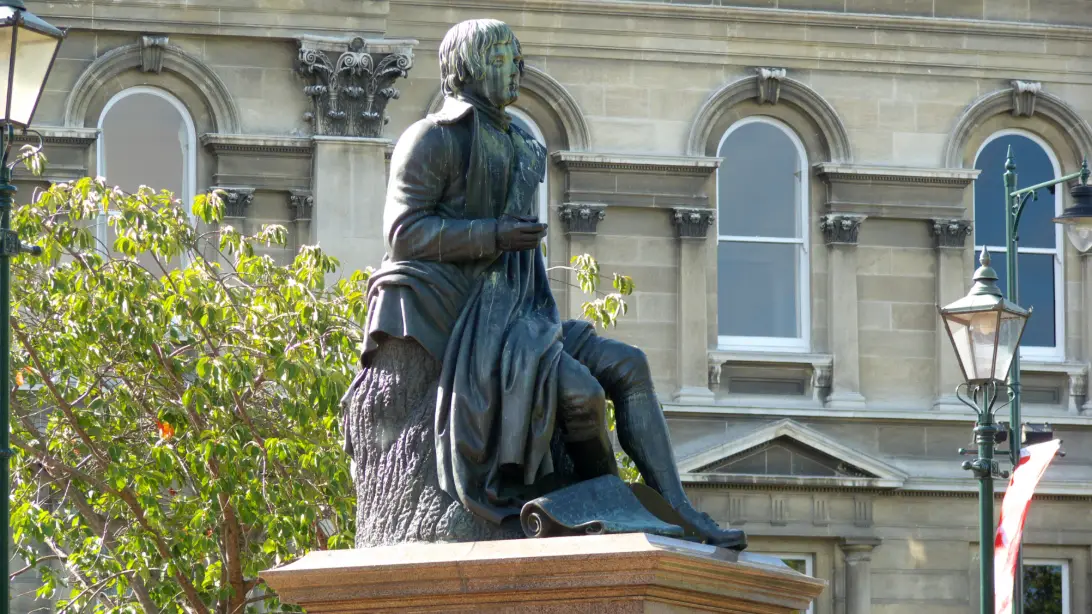
Dunedin fills a bowl of hills at the head of the Otago Harbour. The centre is on the flat by the water, and the streets climb steeply on three sides, with a green belt of bush along the hilltops above. The harbour runs north-east for about 20 km to the sea, sheltered by the Otago Peninsula on one side; Port Chalmers sits on the other. South of the centre, over a narrow neck of flat land, the city ends at the ocean beaches.
That shape decides your visit. The centre is compact and walkable, if hilly; the beaches are ten minutes away; but the peninsula’s wildlife is at the far end of a long, winding road, about an hour from the Octagon to Taiaroa Head. The five areas below cover the choices.
City centre and the Octagon
the heart of the cityThe Octagon sits in the middle of the city, with Robert Burns on his plinth, the cathedral and the town hall around it, and George Street running north with the shops. Downhill towards the harbour are the Exchange and the Warehouse Precinct, the Railway Station and Toitū. Most first visits are spent here.
North Dunedin
the university quarterThe University of Otago, founded in 1869 and the oldest in the country, fills this side of the city with its Gothic clock tower and its students. Here too are the Botanic Garden, New Zealand’s oldest, and Tūhura Otago Museum. Baldwin Street is in North East Valley, just beyond.
St Clair and St Kilda
the ocean beachesAcross the narrow neck of flat land south of the centre, the city meets the open ocean. St Clair, at the western end, has the surf, a promenade of cafés and a hot salt-water pool; St Kilda runs east from it. Tunnel Beach is a short drive beyond.
Otago Peninsula
wildlife at the end of the roadThe long arm on the far side of the harbour is the reason many people come. A low road follows the shore through Portobello to Taiaroa Head, where the albatross nest; a high road runs along the ridge past Larnach Castle. Sandfly Bay and its sea lions are on the ocean side.
Port Chalmers and the harbour
the port townHalfway down the harbour, Port Chalmers climbs the hill above its wharves, where the cruise ships berth from October to April. Its old stone buildings hold galleries, cafés and antique shops; the painter Ralph Hotere made his home here. Aramoana, at the harbour mouth, is ten minutes further on.
Places you don’t want to miss
Nine places: three on the peninsula, four in the city, and two by the sea. Beyond them, Dunedin has plenty more for a second or third day: Olveston, an Edwardian house kept as its family left it, due to reopen on 1 October 2026 after an electrical upgrade (confirm before you go); the Botanic Garden, New Zealand’s oldest, free and open every day; the Dunedin Public Art Gallery on the Octagon, which holds work by Frances Hodgkins; Orokonui Ecosanctuary, a fenced forest of native birds north of the city, open Thursday to Monday; Signal Hill for the view; and a street art trail of more than 50 murals, free, with a map from the i-SITE.
The Royal Albatross Centre, Taiaroa Head
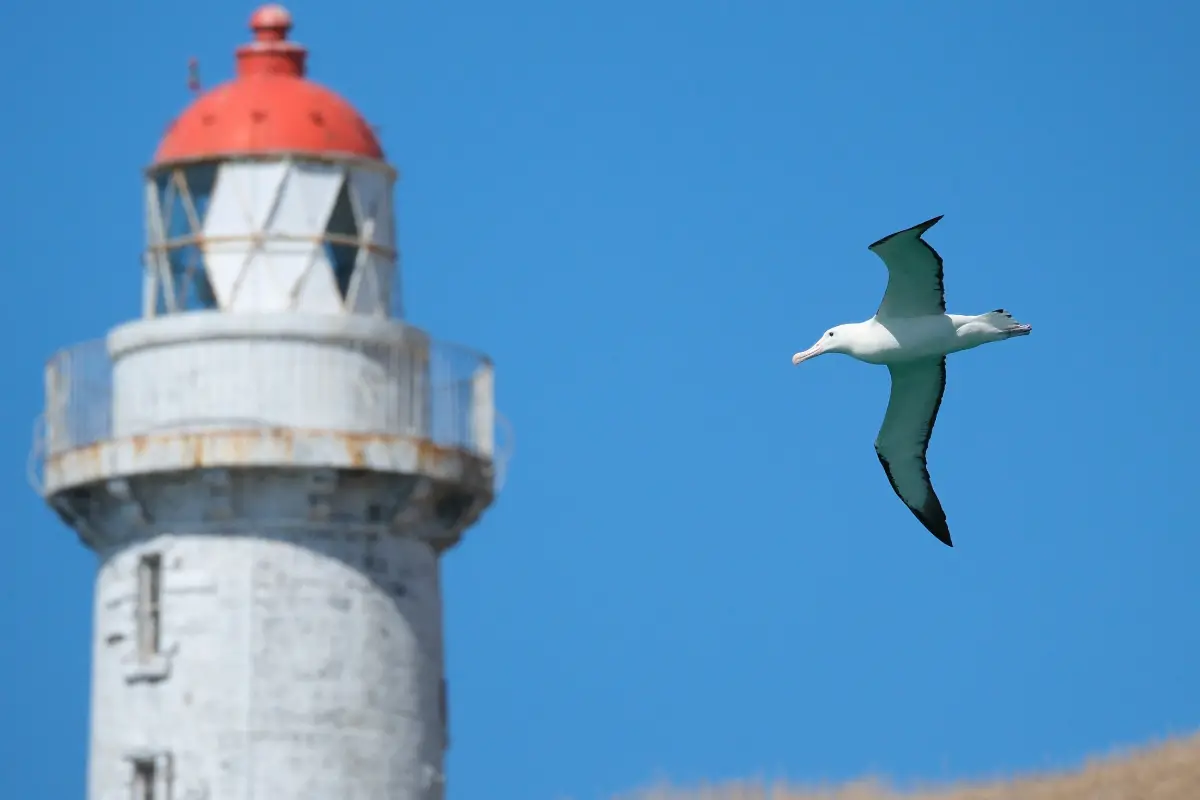
At the tip of the Otago Peninsula, Dunedin’s tourism board claims, is the world’s only mainland breeding colony of royal albatross. Guided tours take you to a hilltop observatory to watch the great birds on their nests and in flight; book ahead. Blue penguins come ashore below the headland at dusk.
Sandfly Bay
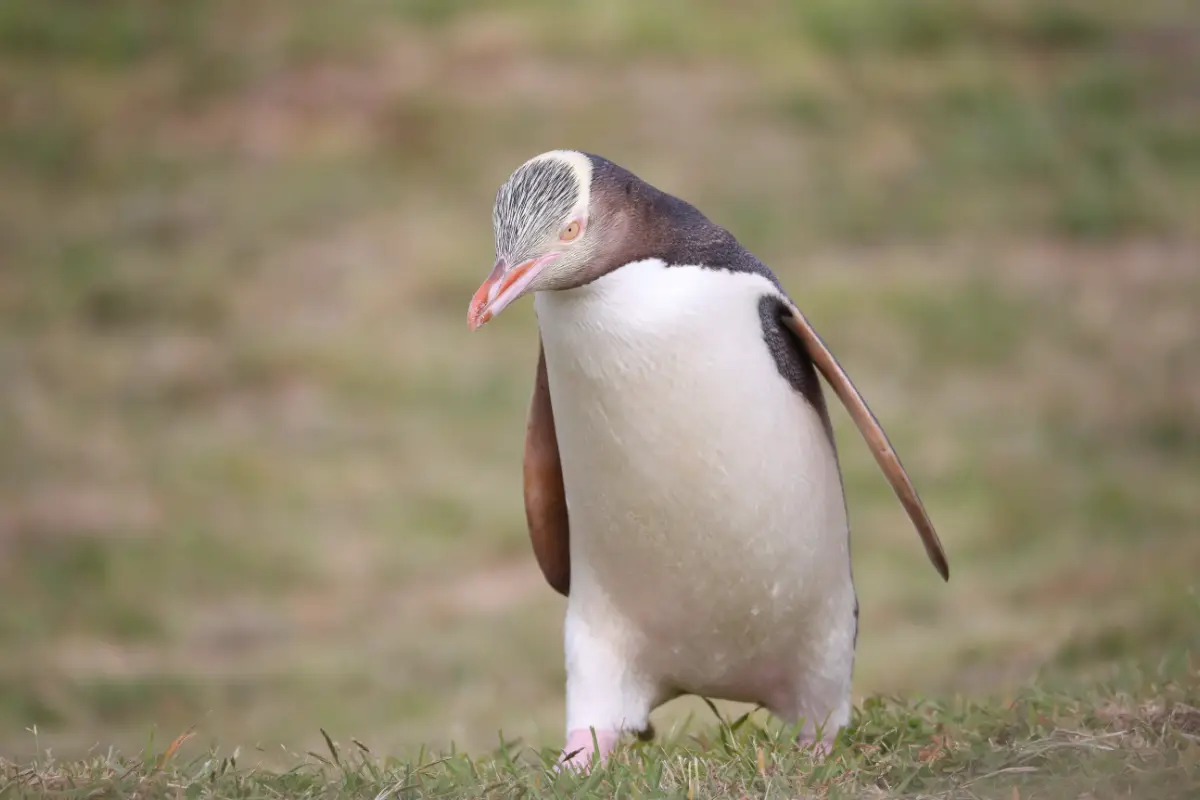
On the peninsula’s ocean side, a 15-minute walk from the car park leads to a viewing platform above a wild beach where sea lions haul out and yellow-eyed penguins, hoiho, come ashore. It is free; the sandhill down to the beach is steep, and nothing is promised. For closer, surer sightings, take a guided tour.
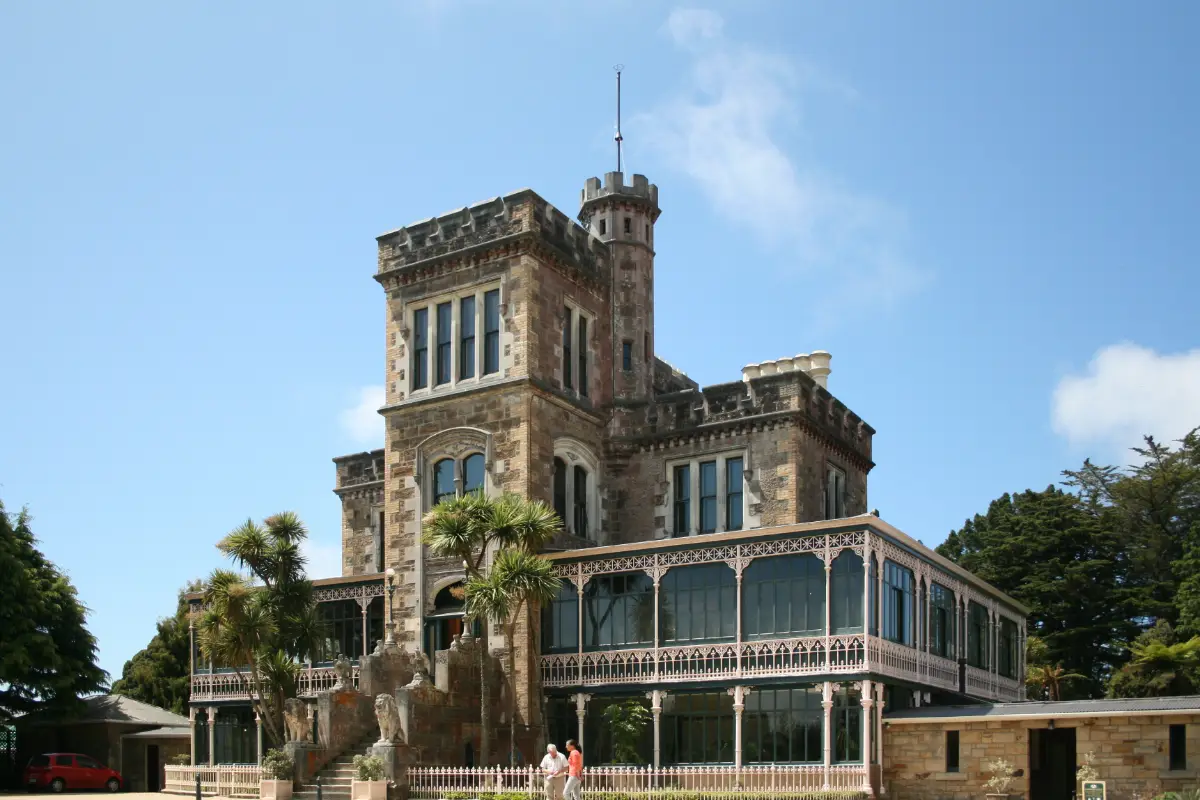
Larnach Castle
A Victorian mansion on the peninsula ridge, with gardens to wander and views over the harbour. It is a grand house rather than a medieval castle, and it is open every day of the year. Adult entry is NZ$50, from 1 October 2026.
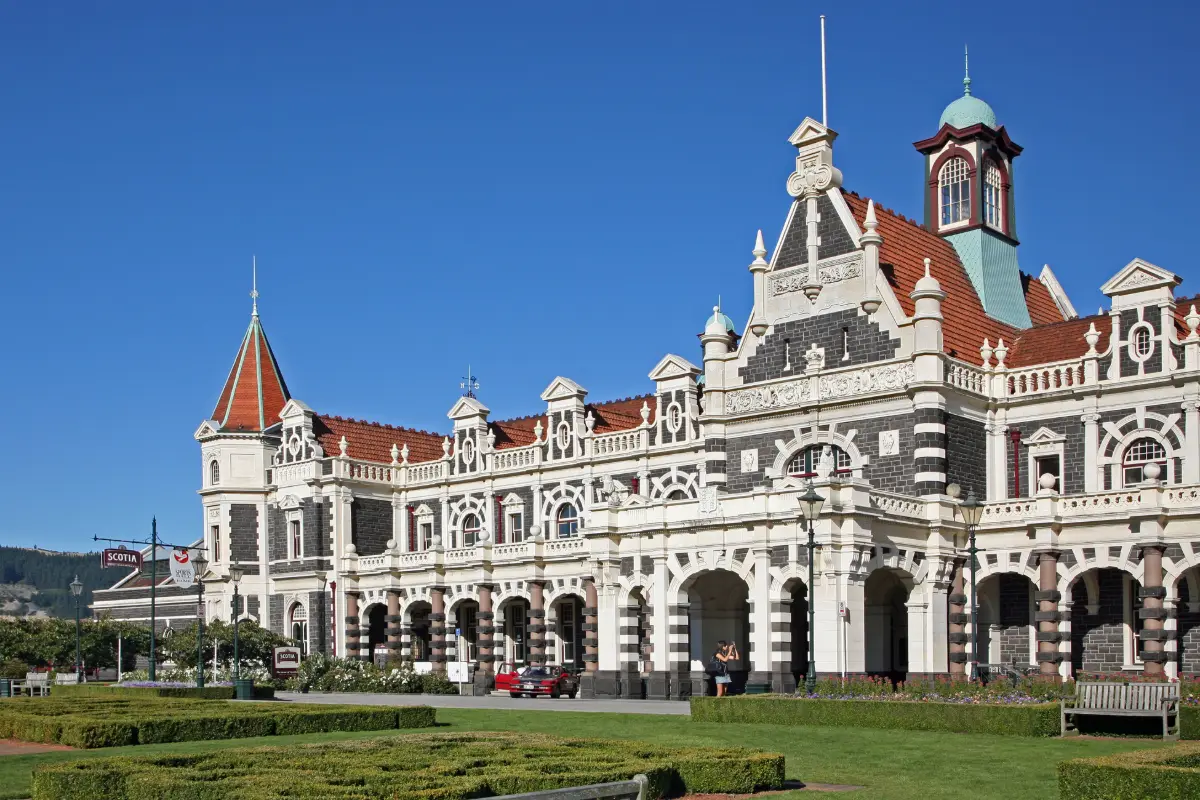
Dunedin Railway Station
George Troup’s station of 1906 is the city’s showpiece, in dark basalt and pale Oamaru stone, with a mosaic floor of about 750,000 tiles. Step inside for free. On Saturday mornings the Otago Farmers Market fills its northern car park, and heritage trains leave from its platform.
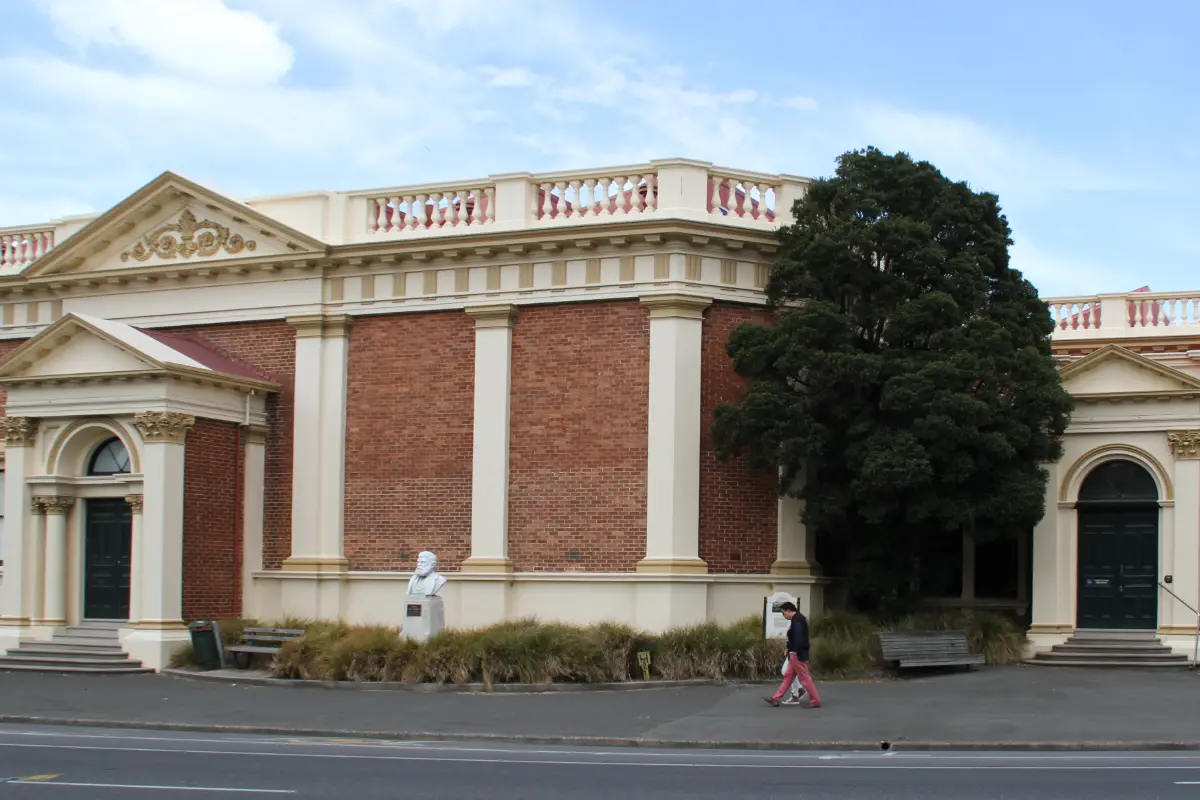
Toitū Otago Settlers Museum
New Zealand’s oldest history museum tells the story of the people who made Dunedin, from Kāi Tahu to the Scottish settlers, the gold-seekers and the city since. Free, and open every day from 10am to 5pm. It sits next to the station.
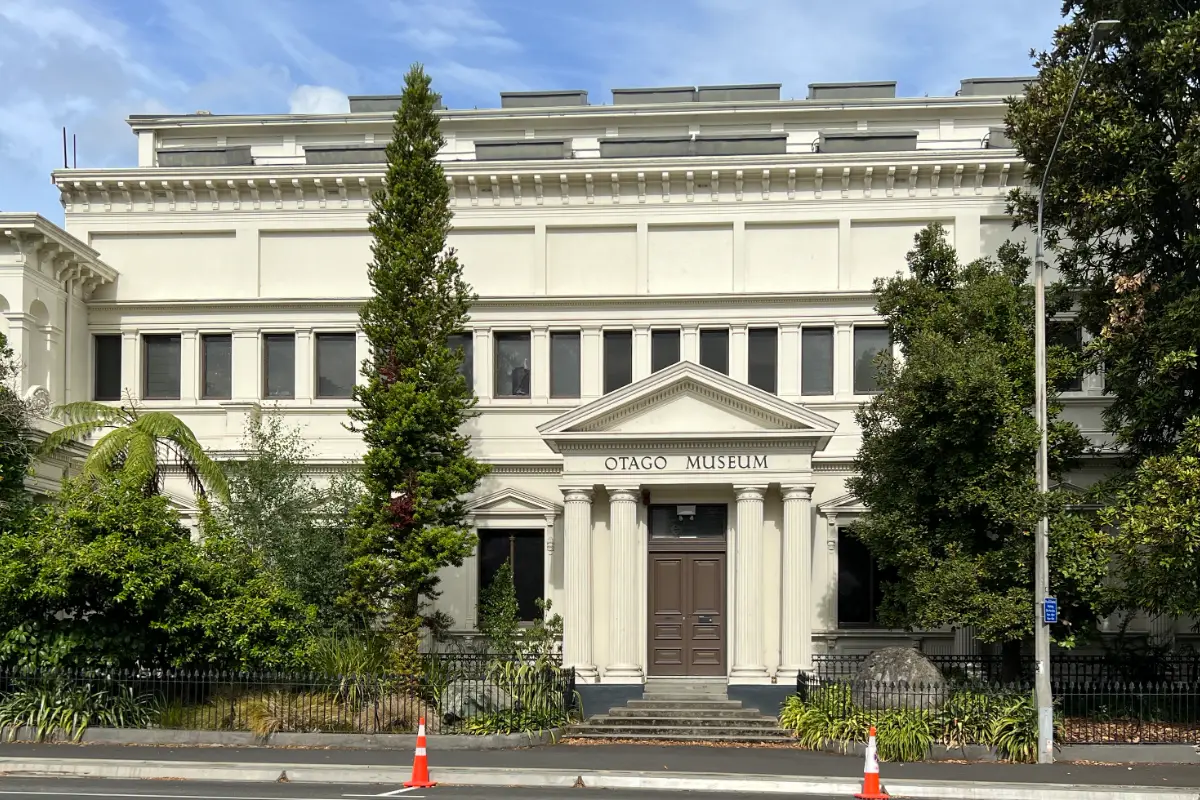
Tūhura Otago Museum
Natural history, Pacific and Māori collections, a hands-on science centre and a planetarium, on the edge of the university. General entry is free for New Zealand residents; check the price for overseas visitors. The answer to a wet day.
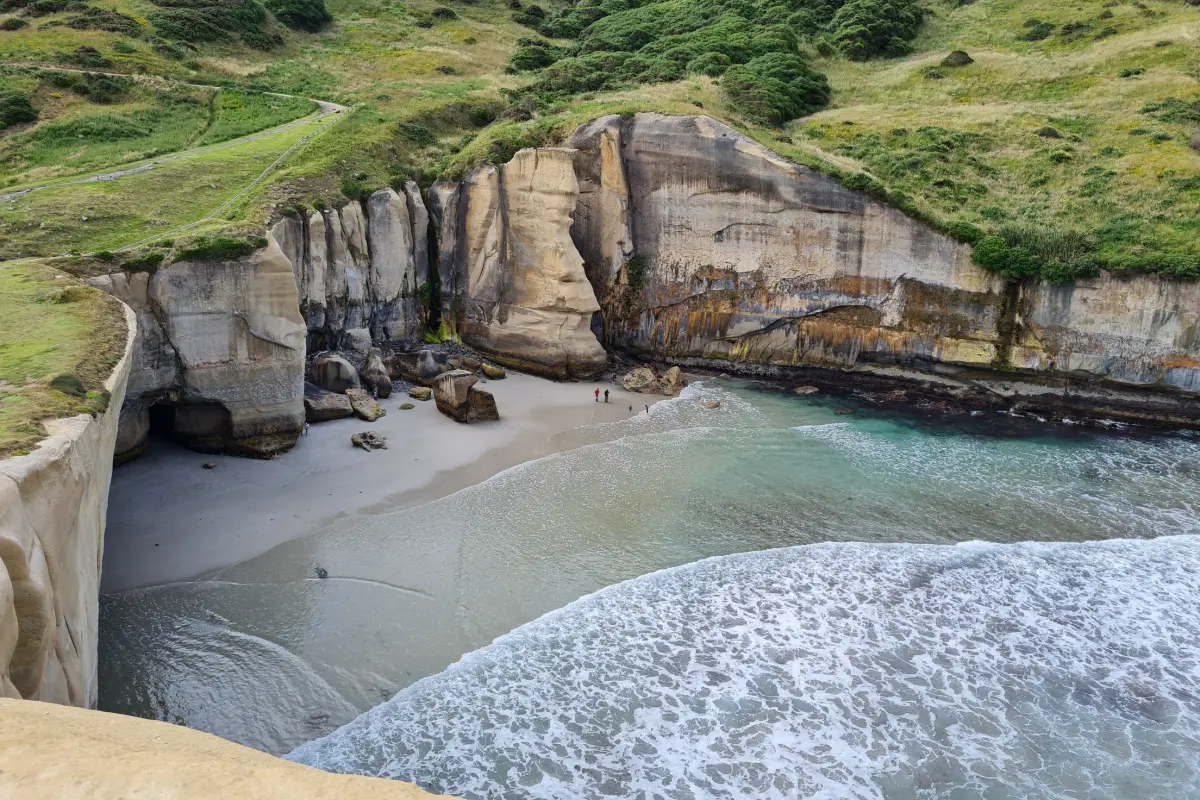
Tunnel Beach
A steep path through farmland to sandstone cliffs, a sea arch, and a tunnel cut by hand in the 1870s down to a hidden cove. newzealand.com allows about an hour there and back; go near low tide. The track reopened in November 2025 after slips, with more repairs to come, so check the Department of Conservation’s page first.
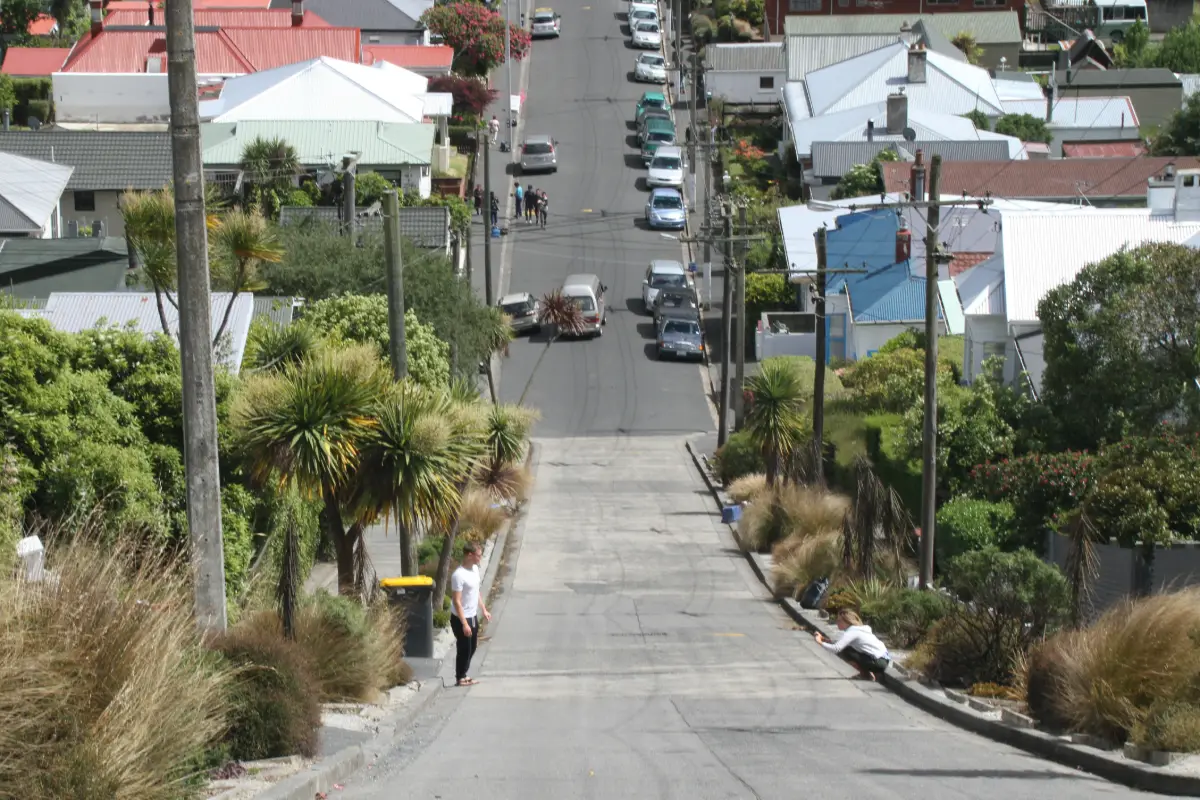
Baldwin Street
Guinness World Records lists it again as the world’s steepest residential street: about 350 metres long, rising at up to 35 per cent. It is just a street of houses in North East Valley, about 3.5 km from the centre, and walking up it is the point. Free.
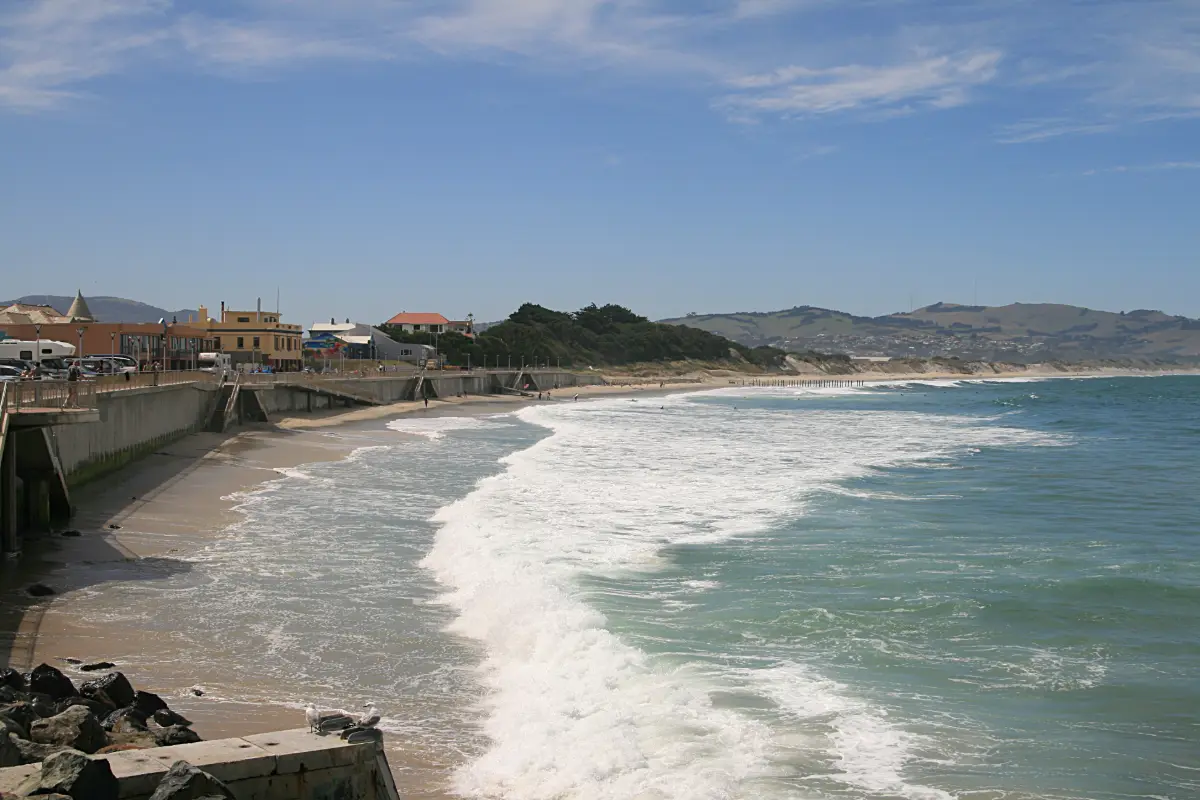
St Clair and the ocean beaches
Ten minutes from the Octagon, the city ends in surf. St Clair has a promenade of cafés, a hot salt-water pool beside the waves and surfers on most days; the sand runs east for kilometres past St Kilda. Come for a walk, a swim or the sunset.
The Department of Conservation asks you to stay at least 20 metres from sea lions and seals and 50 metres from penguins, and bans drones within 150 metres of marine mammals. Sea lions can move fast; never stand between one and the sea. The yellow-eyed penguin is in serious trouble: nests on the northern mainland have fallen by about 80% since 2008, to 143 in 2024–25, and DOC warns it could disappear from the mainland within two decades. Let it come ashore undisturbed.
Walk slowly round the upper Octagon and look down. Set into the paving are the plaques of the Writers’ Walk, each carrying a few lines a writer wrote about this city. Read three or four, then lift your eyes to the city around you: the hills climbing behind the cathedral, the stone fronts along George Street, the harbour light at the bottom of the hill. These are the streets the writers knew.
The four practical questions
Summer days, winter quiet, or albatross chicks?
Mild summers, cool winters and wildlife all year; what each season gives you.
See below ↓
Where to stayThe centre, the beach or the peninsula?
Four areas compared, and why most first visits start near the Octagon.
Read the guide →
Where to eatThe Octagon, the Saturday market or the Esplanade?
Four places to eat, seven things to try, and what a meal costs.
Read the guide →
Getting aroundCan you see the peninsula without a car?
A walkable centre, the bus to Portobello, and where tours take over.
See below ↓
When to visit
November to March gives the longest, warmest days, and the most time for the peninsula. But Dunedin is a year-round city: it is mild, rarely hot and rarely very cold, and its rain, about 720 mm a year, is spread through every month. Pack a warm layer and a rain jacket whenever you come. The wildlife is there all year, though what you see changes with the season.
| Months | By day | What it means |
|---|---|---|
| December to February | About 18–19°C; days of 14–16 hours | The warmest and busiest months; blue penguins ashore at dusk; albatross chicks hatch from late January |
| March to May | About 18°C falling to 13°C | Settled autumn days; albatross chicks on the nest; students back in the city |
| June to August | About 10–11°C; frosty nights | Cool and quiet; the Midwinter Carnival in June; albatross chicks still on the headland |
| September to November | About 13–16°C | Changeable; adult albatross return in September and lay in November, so October sightings are least certain; cruise ships from October |
The University of Otago shapes the city’s year: it is busy in term and quieter in the long summer break. Events worth knowing include the Dunedin Fringe (4–14 March 2027), the Midwinter Carnival in June and the New Zealand International Science Festival in July. Cruise ships call at Port Chalmers from October to April; we could not find a reliable account of how much they add to the crowds, so check the port’s calendar if it matters to you. Our guide to the best time to visit New Zealand sets Dunedin in the national picture.
Where to stay
For a first visit, stay in the city centre, within a walk of the Octagon. You can walk to dinner, to the station and the museums. North Dunedin, near the university and the Botanic Garden, is a short walk away, and busy with students in term. St Clair and St Kilda suit anyone who would rather hear the sea, ten minutes from the centre.
A night or two out on the Otago Peninsula puts you close to the wildlife and saves the long drive back after the penguins at dusk; you will need a car, and few places to eat are open late. Port Chalmers is a small, quiet port town, busiest when a cruise ship is in. Our guide to where to stay in Dunedin compares the four areas and names places to look at.
Where to eat
Most of Dunedin’s restaurants and bars are in and around the Octagon, and in the streets running off it: Moray Place, Stuart Street and lower George Street. On Saturday mornings, from 8am to 12.30pm, the Otago Farmers Market fills the car park beside the Railway Station with about 65 stalls. St Clair’s Esplanade has cafés and restaurants facing the surf, and Port Chalmers has a few of its own.
The city’s own tastes include Speight’s, brewed in the centre since 1876, with tours of the brewery, and blue cod from the southern waters. Out on the peninsula, eat before you go or book: there is little open in the evening. Our guide to where to eat in Dunedin covers the market, the breweries, what to order and what it costs.
Getting around
The centre is walkable, though few streets are flat. For the rest of the city there are Orbus buses; check routes and stops on the Otago Regional Council’s Orbus pages. A trip within one zone costs NZ$2.50 with a Bee Card, or NZ$3 in cash; you cannot pay with a bank card on board. From 1 November 2026 longer trips across zones cost more, from NZ$4 with a card. Parking in the centre is paid from 9am to 6pm every day, Sundays included.
The Otago Peninsula without a car
Route 18 runs from the city along the harbour to Portobello, about 18 km, roughly hourly and every 30 minutes at weekday peaks. Beyond Portobello it is harder: as of late 2025 only two weekday buses continued to Harington Point near the albatross, and we could not confirm any bus back from there; check the route 18 timetable, and whether the new zone fares apply to Portobello. For Taiaroa Head, the penguins at dusk or Sandfly Bay, a car or a guided wildlife tour from the city is the practical answer. Several tours collect you from your accommodation.
Arriving
Dunedin Airport is about 30 km south-west of the city, 20 to 30 minutes by road. We found no Orbus route to the airport; the airport’s own page shows InterCity and Catch a Bus, so check their routes. Shuttles start at about NZ$25 and taxis at about NZ$80, according to Enterprise Dunedin.
Flights connect with Auckland, Wellington and Christchurch, and since June 2025 Jetstar has flown to the Gold Coast in Australia. By road, Christchurch is about 360 km and 5 hours north, Queenstown about 280 km and 4 hours inland, and Te Anau about 290 km. InterCity coaches run from Christchurch in about 6 hours and from Queenstown in about 4 hours 40 minutes. No scheduled passenger train reaches Dunedin. Our guide to getting around New Zealand covers car hire and the routes south.
Day trips
Dunedin sits in the middle of one of the South Island’s richest stretches of coast, and a day out in either direction is worth it.
North: the Moeraki Boulders, huge round stones on the beach at Koekohe, are about 75 km and an hour up the coast. Shag Point, on the same stretch of coast north of Palmerston, has fur seals on its rocks. Oamaru, about an hour and a half away, has a Victorian precinct of white stone, a blue penguin colony that comes ashore at dusk, and Steampunk HQ; Janet Frame grew up there.
South: The Catlins begin about an hour and a half away, with Nugget Point’s lighthouse, waterfalls in the forest and, at Curio Bay, a fossil forest at low tide. A day trip is long; a night there is better.
Inland and on the water: Dunedin Railways’ heritage train runs from the station into the Taieri Gorge; its website gives departures at 9.30am, Thursday to Monday, and NZ$169 return for the trip to Pukerangi, but another of its pages describes a shorter run to Hindon, so confirm the route, days and price when you book. The Seasider runs up the coast.
Middlemarch, about an hour inland, is the start of the Otago Central Rail Trail, about 150 km of cycling to Clyde. Closer in, Port Chalmers and Aramoana, with its saltmarsh birds and long spit beach, make an easy half day.
Drive times are planning estimates in normal conditions, from newzealand.com and other sources named at the end, read 18 October 2026.A few honest limits
The peninsula takes longer than people expect. Taiaroa Head is about an hour from the Octagon on a narrow road beside the water, and an albatross tour, the castle and the penguins at dusk make a full day. Wildlife is wild: albatross fly best on windy days and may sit tight on calm ones, and no free beach guarantees a penguin. The guided reserves give the best odds.
Dunedin is hilly, damp and cool more often than not, and some visitors find it quiet after dark outside term. Larnach Castle is a Victorian mansion, not a medieval fortress, and Baldwin Street is a street of houses. Come for what the city is: grand stone buildings, a strong sense of its own history, a university’s energy, and the wild coast at the end of every road.
A final word on Dunedin
Dunedin is the South Island’s most surprising city: Victorian stone and Scottish names at the bottom of the world, and an hour away, albatross riding the wind over the sea. Walk the Octagon, stand in the station, then spend a whole day on the peninsula and stay for dusk. Two days is the least it deserves.
Andrew + Margaret
- Visiting New Zealand Overview
- Where to stay in Dunedin Decide
- Where to eat in Dunedin Food
- New Zealand in three weeks Journeys
- South Island itinerary Journeys
- Getting around New Zealand Practical
- The best time to visit New Zealand Practical
- Christchurch Overview
- Queenstown Overview
- Understanding Māori New Zealand Culture
- Dunedin NZ — the official visitor site Official
- Royal Albatross Centre Booking
- Department of Conservation — the Otago Peninsula Official
- Orbus — buses and fares Transport
- Dunedin Railways — the Taieri Gorge and Seasider trains Booking
- Dunedin UNESCO City of Literature Reading
- Janet Frame, To the Is-Land (1982), the first volume of her autobiography, of a childhood in Oamaru Reading
Is Dunedin worth visiting?
Yes, above all for the Otago Peninsula’s wildlife, which few places in the world can match so close to a city, and for its Victorian streets and buildings. If you are very short of time and have already seen albatross or penguins elsewhere, it is the kind of place to save for a slower trip.
How many days do I need in Dunedin?
Two at the least: one for the city and one for the peninsula. Three lets you add a day trip to Oamaru, Moeraki or the Catlins.
Do I need a car in Dunedin?
Not in the city. For the far end of the peninsula, the albatross and the penguins at dusk, a car or a guided tour is the practical answer. Route 18 runs to Portobello; only a couple of weekday buses go further, so check the timetable.
When can I see the albatross?
For most of the year, on a guided tour at Taiaroa Head. October is the changeover, when the year’s chicks have flown and the adults are returning, so sightings are least certain then. Adults lay in November; chicks hatch from late January and stay on the headland until they fly in September. Windy afternoons are best for seeing birds in flight.
Dunedin or Queenstown?
They are different trips. Queenstown is mountains, lakes and adventure; Dunedin is a historic city by the sea with extraordinary wildlife. Many South Island routes, ours included, give each a couple of nights.
What can I do in Dunedin when it rains?
Tūhura Otago Museum, Toitū, the art gallery, the Railway Station, Larnach Castle’s rooms and a brewery tour all keep you dry. The albatross observatory has glass between you and the weather.