Where to Eat in Christchurch
Market halls, farmers’ markets, Riccarton Road’s noodle kitchens and the wine of North Canterbury
Christchurch rebuilt its eating along with its streets. The best way into the city’s food is its new market halls and laneway precincts by the Avon, where dozens of small kitchens share one roof. Beyond them are the lamb, salmon and wine of Canterbury, Saturday farmers’ markets, and a long road of Asian kitchens in Riccarton. Plan around two things: many kitchens close early, and the best markets are on Saturday morning.
How this page was madeWe have not eaten in Christchurch. This page is researched, from the official visitor site, the markets’ and restaurants’ own websites, food writing about the city and our own reading of published menus. We name only places we could confirm are trading and have traded for at least five years, or that are public markets. When we eat here, we will say so.
Places, prices and opening times reviewed 30 September 2026.
First, how Christchurch eats
The plains feed the city. Canterbury is farming country, and its lamb, grain, orchards and market gardens reach the city’s tables quickly. The sea and the harbours add fish and the salmon farmed in Akaroa Harbour. Most people eat simply at home and go out for breakfast or brunch at a café, a New Zealand habit, with a flat white.
The earthquakes reset the map. When the centre closed in 2011, restaurants scattered to the suburbs. As the rebuild went up, many came back to purpose-built precincts and market halls, which is why so much of the city’s eating is new and clustered along the river.
Migration shaped the rest. Chinese market gardeners have been part of the city since the nineteenth century. More recent Korean, Chinese, South-East Asian and Indian communities have made Riccarton Road, near the university, the city’s most varied eating street.
For Ngāi Tahu, the land and waters here are mahinga kai, places where food has always been gathered: eels and birds from the Ōtākaro, the Avon, and its estuary, and fish and shellfish from the harbours. Guided experiences on the Avon now share some of that story, with a tasting of kai. We found very few Māori-run places to eat in the city itself, so we cannot point you to one with confidence. See our guide to understanding Māori New Zealand.
And Canterbury drinks well. The Waipara Valley, just under an hour north, grows pinot noir, chardonnay and riesling on limestone soils, and the city’s official visitor site says the Canterbury Plains hold the oldest pinot noir vines in the country. Christchurch also brews its own beer: two of its best-known craft breweries date from 2004 and 2009, and several pour from taprooms in old industrial buildings on the east side.
Go to Lyttelton on a Saturday and walk along London Street a little after ten, when the farmers’ market is in full swing. The street runs along the hillside above the port, so between the stalls you look down the steep side streets to the cranes, the water and the green hills on the far side of the harbour. Buy a coffee and something warm, and find a place to stand where you can see both the market and the harbour. Notice how many people seem to know each other. This is a small town that happens to be twenty minutes from a city.
What to eat in Christchurch
Christchurch’s food is easiest to understand by the kind of place you eat in. Start with the eight below, then use the table to choose what to order.
Dozens of small kitchens under one roof, built since the earthquakes. Order from several counters and share a long table: the easiest first meal in the city.
Pedestrian lanes of restaurants and bars in the rebuilt centre, along the Terrace, New Regent Street and around Little High, with tables outside on warm evenings.
Growers, bakers and cheesemakers at Riccarton House and on Lyttelton’s main street. Eat breakfast on your feet, then buy a picnic for the hills.
The New Zealand breakfast of eggs, sourdough and a flat white, served from early morning. Bakeries sell the pie, the country’s everyday lunch.
A long strip of Chinese, Korean, Cambodian, Vietnamese and Sri Lankan places near the university, many small and family-run: the city’s best value.
Christchurch brews its own. Taprooms in old industrial buildings on the city’s east side pour beer made on the premises, often with pizza from the oven.
North Canterbury pinot noir, chardonnay and riesling by the glass in the city, or at cellar doors in the Waipara Valley, just under an hour north.
Fish and chips wrapped in paper and eaten on the sea wall at Sumner or New Brighton: the city’s beach supper on a warm evening.
| Try | What to expect | Where to look | Typical spend |
|---|---|---|---|
| Canterbury lamb | Lamb from the plains around the city, roasted, or as rack and shoulder on bistro menus | Central City restaurants | $21–50 a restaurant main |
| Akaroa salmon | King salmon farmed in Akaroa Harbour, served raw, cured or hot-smoked | Restaurant and café menus; the farmers’ markets | $25–50 as a main |
| A whitebait fritter | Tiny, translucent young fish bound in egg: a short spring treat | Cafés and markets, while the season runs (1 September to 30 October) | Not sampled; ask the price |
| Lanzhou beef noodles | Hand-pulled noodles in a clear beef broth, with coriander and chilli oil | Riccarton Road | $22–27 a bowl |
| Dumplings | Pork or vegetable dumplings, steamed or pan-fried, by the plate | Riccarton Road; the market halls | About $12 for eight |
| A flat white | The New Zealand espresso with milk, drunk all day | Every café | About $6 |
| Waipara pinot noir or riesling | The two grapes North Canterbury is known for | Wine bars; cellar doors in the Waipara Valley | About $14 a glass |
| Local craft beer | Pale ales, pilsners and darker beers brewed in the city | Brewery taprooms; the market halls | $12–14 a glass |
Spends in New Zealand dollars, per person, read on 30 September 2026 from the menus described under the cost table below.
Where to eat: the most useful neighbourhoods
The five areas are the same as on our where to stay in Christchurch guide. Most eating is in the Central City; Riccarton is a short bus ride west; Sumner and Lyttelton are journeys, by car or bus, and worth making for a morning or an evening.
| Area | Best for | Best time | Main catch |
|---|---|---|---|
| The Central City | Variety, a first evening | Any evening; weekend brunch | Some kitchens close early, and some shut on Sunday or Monday |
| Merivale & Fendalton | A neighbourhood dinner | Friday and Saturday evenings | Few places; book at weekends |
| Riccarton & Addington | Asian food, value | Lunch and dinner; Saturday morning | A busy main road, and plain rooms |
| Sumner & the eastern beaches | Seaside fish and chips | A warm, still afternoon | Weather-dependent, and a drive |
| Lyttelton & the harbour | The market, a night out | Saturday morning; weekend evenings | Steep streets, and small places that fill |
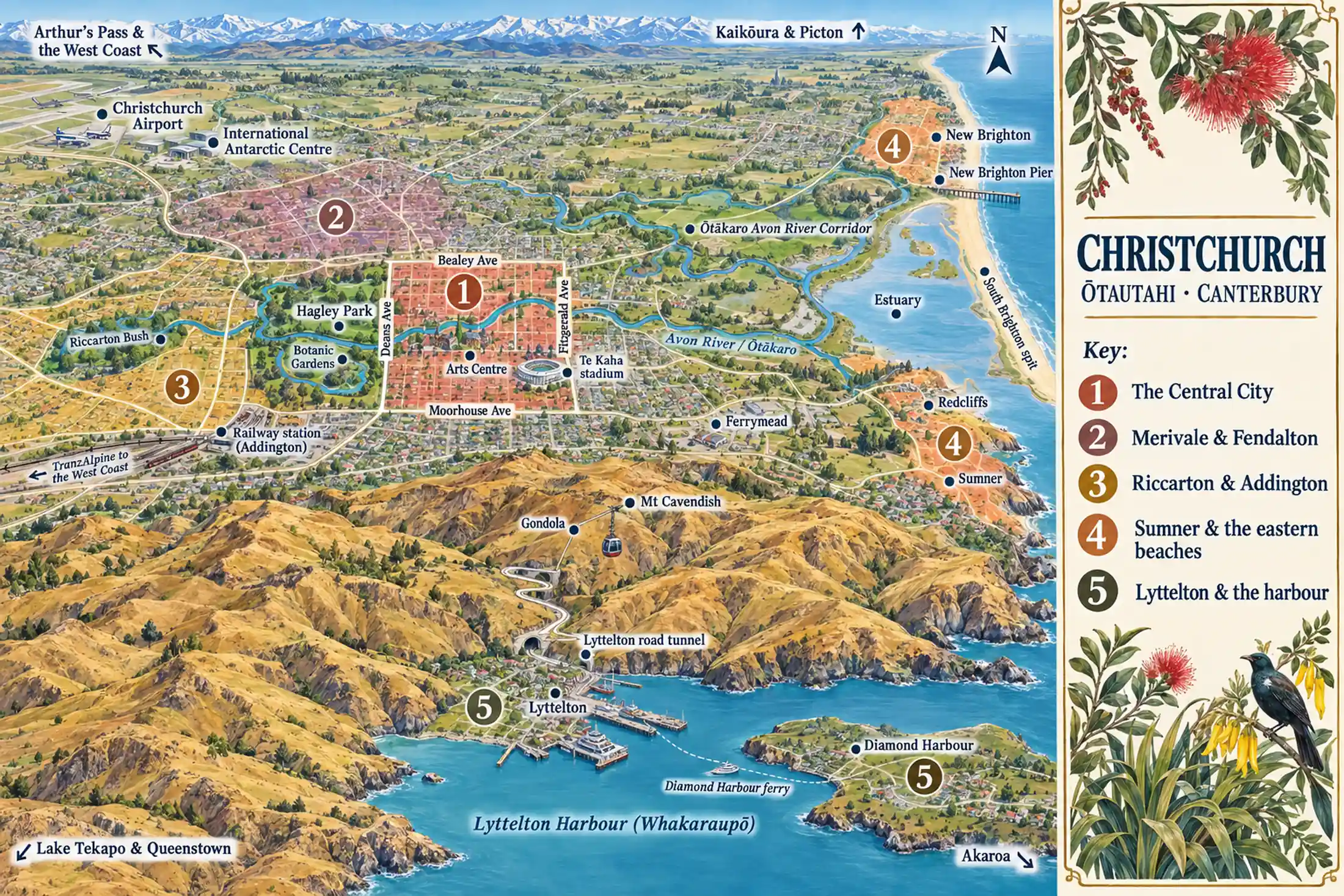
The Central City — variety and a first evening
$6–50Most of the city’s eating is here, and most of it is new. After the earthquakes, restaurants that had scattered to the suburbs came back to purpose-built precincts: the market halls by the Avon, the Terrace along the river, the pastel shopfronts of New Regent Street, the lanes around Little High and the bars of Victoria Street. You can walk between all of them in fifteen minutes.
Eat here for: a first evening, a market-hall lunch, brunch and a drink by the river.
Merivale & Fendalton — a neighbourhood dinner
Prices not sampledNorth of Hagley Park, Merivale’s village has a small cluster of restaurants, wine bars and cafés that serve the leafy streets around them. It is where locals eat out close to home, and it suits anyone staying on Papanui Road who would rather walk to dinner than drive into the centre. Fendalton, to the west, is residential, with little to eat.
Eat here for: a relaxed dinner near your motel, and a weekend brunch.
Riccarton & Addington — Asian food and value
$12–27Riccarton Road, running west from Hagley Park towards the university, is the city’s most varied eating street. Its kitchens reflect the students and migrant families who live nearby: hand-pulled Lanzhou noodles, dumplings and dim sum, Cambodian noodle soups, Vietnamese phở, Korean and Sri Lankan cooking, and a vegetarian Chinese café. Choose by the dish rather than the name. On Saturday morning the grounds of Riccarton House hold the city’s best-known farmers’ market.
Eat here for: a cheap lunch or dinner, noodles and dumplings, and the Saturday market.
Sumner & the eastern beaches — the seaside
Prices not sampledSumner’s esplanade has cafés facing the beach and a fish and chip shop or two, with tables in the sun when the wind is off the land. New Brighton, further north, has its pier, its library and the hot pools, and a handful of places to eat along the front. Come for the setting rather than the cooking.
Eat here for: fish and chips on the sea wall, and a beach-side coffee.
Lyttelton & the harbour — character and the market
Prices not sampledOver the hill, Lyttelton’s steep London Street holds small restaurants, pizza, cafés and bars with a strong local following, and live music at the weekend. It feels like a village rather than a suburb, and eating here is as much about the harbour view and the evening crowd as the food.
Eat here for: the Saturday market, a pizza and a drink, and harbour views.
How much does it cost to eat in Christchurch?
| Meal | Typical spend | What that buys |
|---|---|---|
| A coffee | About $6 | A flat white; plant milk or a takeaway cup adds 70 cents |
| Café breakfast | $15–27 | Eggs on toast at the low end, a big cooked breakfast at the top |
| Café or food-hall lunch | About $25 | A burger with fries, or a bowl |
| Noodles on Riccarton Road | $17–27 | A big bowl of noodle soup; eight dumplings about $12 |
| A drink | $12–14 | A glass of New Zealand wine, or a pint of tap beer |
| Bistro dinner | $21–50 a dish | Small plates to mains at a well-regarded city bistro |
| Tasting menu | About $80 | A chef’s tasting menu at the same bistro, before drinks |
New Zealand dollars, per person, with GST included, as menus in New Zealand show it. Read on 30 September 2026 from three places’ published prices: a central café’s April 2026 menus, a Michelin-listed bistro’s own site and its booking listing, and a Riccarton Road noodle house’s delivery-app menu, which is often dearer than the counter. It is a small sample, so read the figures as a guide rather than a survey. Tipping is not expected, and many places add a surcharge, often 15%, on public holidays.
Does Christchurch have street food?
Not on its streets, but at its markets. You will not find food stalls lining the pavements of the centre. The city council’s Trading and Events in Public Places Policy (2018) does not allow temporary mobile food stalls in the Central City, or in the main business areas of Lyttelton and Akaroa, unless they are part of an organised event or market. So the food trucks gather where the markets are.
On Saturday mornings there are the farmers’ markets at Riccarton House and in Lyttelton. On Sundays, except public holidays, the Riccarton Sunday Market runs from 9am to 2pm, with hundreds of stalls and food trucks; the official visitor site calls it the city’s largest market. On weekend evenings, the Christchurch Night Market has run at Hornby and Ferrymead, with dozens of food stalls; we could not confirm its days for this season, so check before you go. A vegan night market is held on the last Saturday of each month.
The everyday indoor equivalent is the market hall: Riverside Market, open daily, gives you the same pick-and-share eating under a roof.
Building food into one day
This day works on a Saturday, when the farmers’ market runs. On a Sunday, swap the first beat for the Riccarton Sunday Market, from 9am to 2pm.
Breakfast — the farmers’ market at Riccarton House
Arrive soon after 9am and eat as you walk: a coffee, a pastry, something hot. Buy fruit or cheese for later. The market winds down around midday, and the best stalls sell out, so do not leave it late.
Lunch — noodles on Riccarton Road
About ten minutes’ walk away, choose a bowl of hand-pulled beef noodles or a plate of dumplings. Go before half past twelve; many places are small, and the students arrive soon after.
Afternoon — the market halls by the Avon
Take the bus to the Central City and wander Riverside Market and the Terrace. Sit by the river with a glass of North Canterbury riesling or a local beer. Some stalls close mid-afternoon, so arrive by three.
Early evening — a taproom on the east side
A short taxi ride east, a brewery taproom pours beer made on the premises, often with pizza. Skip this beat if you are driving, or swap it for a wine bar in the centre.
Dinner — Canterbury on the plate
Back in the centre, book a table at a bistro in one of the precincts and order Canterbury lamb or Akaroa salmon. Book for Saturday night; many kitchens take last orders early, so aim to sit down by eight.
Practical advice for eating in Christchurch
Eat earlier than you might at home. Many kitchens take last orders by about nine, and some restaurants close on Sunday or Monday. The market halls and food halls keep longer hours, and they are the easiest late meal.
Book at weekends. The better-known bistros fill on Friday and Saturday nights. Food halls and market halls take no bookings; you order at the counter and find a seat.
Paying is simple. Cards and phones are accepted almost everywhere. Tipping is not expected, though a small tip for good service is welcome. Expect a surcharge on public holidays, and check your bill for one.
Whitebait is a spring treat with a story. The season runs from 1 September to 30 October. Ngāi Tūāhuriri, the local hapū of Ngāi Tahu, has placed a rāhui over its customary whitebait season until further notice, after ongoing abuse of its fishers. Respect it, and check the current rules with the Department of Conservation before you think of fishing for whitebait yourself.
Vegetarians and vegans eat well. Riccarton Road has vegetarian Chinese cooking, and the market halls always have plant-based choices. If you have an allergy, say so at the counter: food-hall kitchens are small and share equipment.
If you go to the wineries, share the driving. New Zealand’s drink-drive limits are low, and zero for drivers under 20. The Waipara Valley has a cycle trail linking some cellar doors, or join a tour.
A final word on eating in Christchurch
Christchurch is not a city of famous dishes. It is a city of good produce and new places to eat it, many of them built after the earthquakes by people who decided to stay. Start at a market hall by the river, give a Saturday morning to a farmers’ market, go to Riccarton Road for a bowl of noodles, and raise a glass of Waipara pinot noir to the plains that grew it.
Andrew + Margaret
- Christchurch Overview
- Christchurch nightlife Practical
- Where to stay in Christchurch Practical
- South Island itinerary Journeys
- New Zealand in two weeks Journeys
- Understanding Māori New Zealand Culture
- Visiting New Zealand Overview
What food is Christchurch known for?
Canterbury lamb, Akaroa salmon and North Canterbury wine, above all pinot noir and riesling. The city is also known for its market halls and farmers’ markets, and for the Asian food of Riccarton Road.
Where should I eat on my first night in Christchurch?
In the Central City: Riverside Market or one of the precincts along the Terrace and New Regent Street, all within a short walk of each other.