Where to Eat in Brisbane
Where the eating actually is — and why it is not where you are sleeping
Brisbane's food week is weekend-shaped. Every market of consequence runs on a Saturday or a Sunday morning, not one of them is in the city centre, and the container market at Northshore opens on Friday, Saturday and Sunday evenings only. Arrive on a Tuesday and a third of the eating city is shut.
What is open is better than the city's reputation for it. Moreton Bay puts bugs, prawns and mud crab on menus that treat them as ordinary rather than as an occasion, and the densest concentration of Asian kitchens in Queensland sits twelve kilometres south of the centre, in a suburb most visitors never reach.
Start in Fortitude Valley on a first evening. Then give one lunch to Sunnybank.
Fancy something? Start here
Last updated 22 September 2026
First, how Brisbane eats
Three things shaped what Brisbane puts on a plate, and all three are still working.
The bay and the growing country. The city sits at the head of a large sheltered estuary, and the estuary is on the menu: bugs, prawns and mud crab are local catch rather than imported luxury, which is why a bug turns up in a trattoria pasta as readily as in a seafood restaurant. Behind the city, Queensland grows around 95% of Australia's bananas and peanuts, along with macadamias, finger limes, Davidson plums, strawberries, ginger, mangoes and avocados. Brisbane eats close to where things grow, which is part of why the markets matter here more than the restaurants do.
Migration, and the fact that it moved south. The old Chinatown is in Fortitude Valley. The working one is in Sunnybank, where Chinese kitchens in several regional forms sit alongside Taiwanese, Malaysian, Singaporean, Korean, Japanese, Vietnamese and Halal Uyghur ones, within three shopping centres on a single intersection. Inner West End carries the earlier Vietnamese and Greek layers, and carries them on the same street.
The climate, which writes the timetable. Brunch is a major meal here and cafés open early, because the pleasant part of a summer day is over by ten. Markets start at six.
What we could not establish about Indigenous food here
The macadamia is native to south-east Queensland and northern New South Wales, and Aboriginal people ate it for thousands of years before the first commercial orchard — it is effectively the only Australian native plant to have become a world food crop. The Brisbane River and Moreton Bay supplied fish, shellfish, crab and prawns to the Turrbal and Yugara peoples, and Musgrave Park in South Brisbane is an archaeologically significant site of long habitation.
What we could not establish from published sources is any current, reliable, visitor-accessible Indigenous food experience in Brisbane itself. We would rather say so than fill the space with a general account of bush foods that has nothing to do with this city. If you know of one, we would like to hear about it.
Get to a Saturday market at seven, not at ten. The Jan Powers market at the Powerhouse runs from six until noon and the West End market at Davies Park from six until two, and both are picked over long before they close. At seven the air has not yet turned; coffee is being made faster than it is being drunk; and there is a sound a market makes early — fewer voices, more crates — that it has stopped making by mid-morning. Carry what you buy into New Farm Park and the city's weekend makes sense: by eleven the light is flat and hard and everybody has gone home. Brisbane is not a late city. It is an early one, and the market is where that is most obvious.
What to eat in Brisbane
Seven things worth going out of your way for. Where they came from matters here, because two are genuinely local and one is the subject of an argument the city has not finished having.
Originated here: a slipper lobster named for the bay the city sits on. Tail meat only, no claws to fight. Firm and sweet, closer to scallop than prawn. Grilled with garlic butter, or cold.
Associated with here, from the tidal flats and mangroves along most of the coast. Sweet and moist, and the thing local seafood kitchens are measured by. Steamed, or with ginger, chilli and soy. Messy by design.
Originated here, and contested. Sponge, chocolate, coconut. The curator at Old Government House credits a chef there in 1900; Toowoomba claims it. The first printed recipe ran that December.
Originated here, native to the forests behind the city, and eaten by Aboriginal people for thousands of years before anyone planted a row of them. Now crusted on fish, folded into desserts, sold roasted at every market.
Widely available, and locally distinctive in scale. Brisbane's Vietnamese and Chinese food is not a novelty here, it is infrastructure. Best eaten at a plastic table in a shopping-centre passageway, for the price of a coffee in town.
Widely available, and concentrated. Sunnybank's other language: three centres on one intersection, a dozen drinks shops between them, and a queue that tells you more than any sign does.
Originated here. Mango, lychee, strawberry, finger lime, pineapple. The year is a fruit calendar rather than four seasons. Buy it at a Saturday market and eat it the same day.
Where to eat: the most useful neighbourhoods
Brisbane's food areas are not its accommodation areas, and the gap is wide enough to spoil a trip planned from a hotel map. Four of the districts people sleep in are not eating districts at all, and the city's most significant food precinct is not a place to stay.
| Area | Best for | Best time | Main catch |
|---|---|---|---|
| Fortitude Valley & James Street | A first evening | Thursday to Saturday night | The loudest part of the city; some venues trade to 3am |
| West End | Markets and migrant food | Saturday morning | The market ends at 2pm; buses only, no train |
| South Brisbane & Fish Lane | Laneway bars before dinner | Early evening, any day | It is behind South Bank, not in it |
| Howard Smith Wharves | Riverside eating | Late afternoon into evening | Popular, priced for the view, and no outdoor bookings |
| Teneriffe & Newstead | Breweries and neighbourhood tables | Friday evening | Furthest inner area from the sights; no train station |
| Sunnybank | Cheap, excellent, enormous | Lunch, any day | Twelve kilometres out, and the train is a trap |
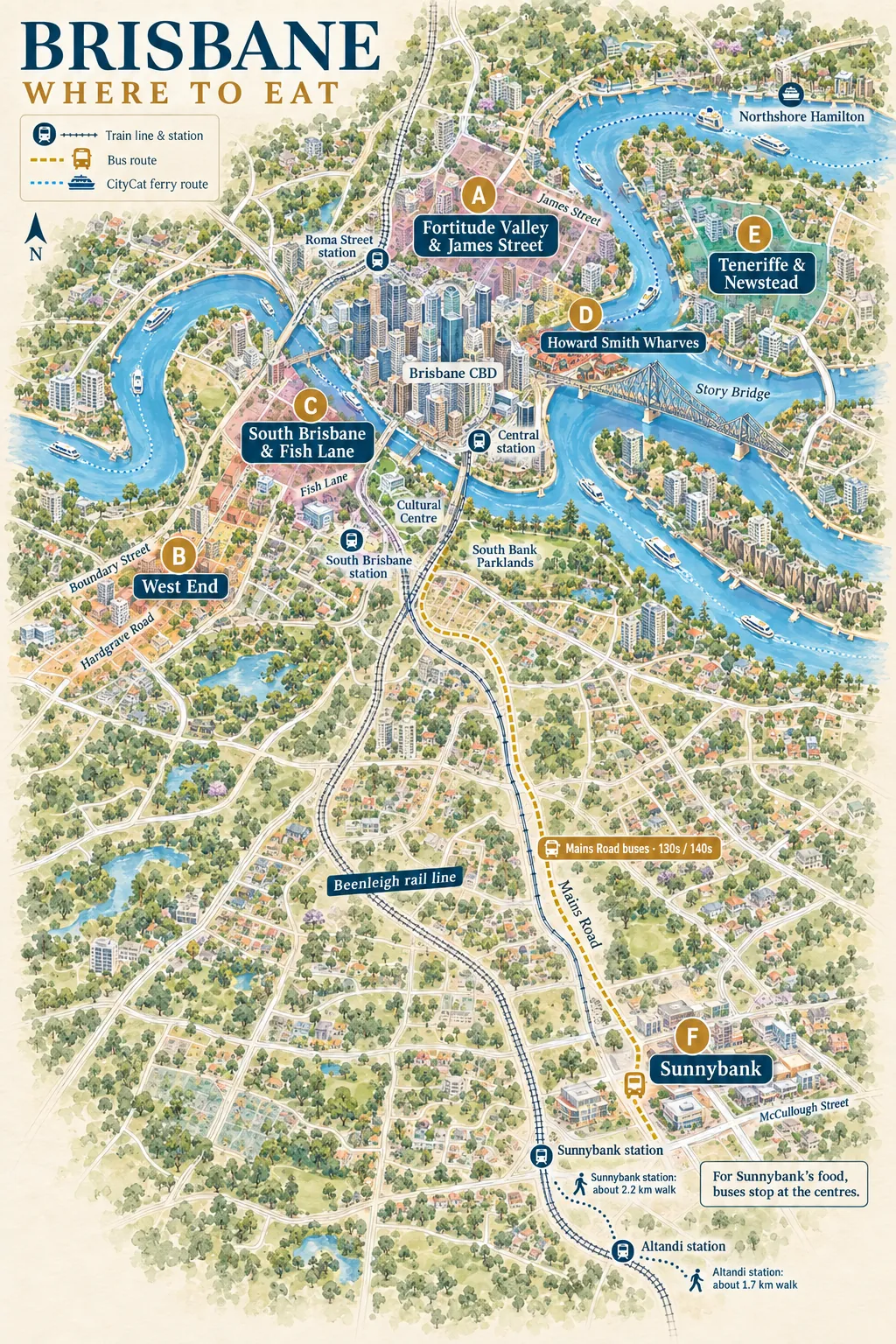
Five of the six sit within about three kilometres of the centre and you can walk between several of them or take a CityCat. Sunnybank is the exception, and how you reach it decides how the day goes. Its railway station is 2.2 kilometres from the restaurants, and Altandi, the next one down the line, is 1.7 kilometres — so the station named after the suburb is the further of the two from the food. The buses down Mains Road, routes 130 and 140 among them, stop at the centres themselves. Take a bus.
Fortitude Valley & James Street — a first evening
$25–95Australia's first Special Entertainment Precinct, and still the densest eating and drinking in the city, with Brunswick Street Mall and Chinatown Mall pedestrianised and James Street at the upmarket end. It is a Safe Night Precinct, so eligible venues may apply to trade until 3am against 2am everywhere else in Queensland — which is why the late food is here and the quiet is not.
Eat here for: a first evening, late food, and the widest single choice in the city.
West End — markets and migrant food
$17–60Boundary Street runs through it and Hardgrave Road climbs away from it, and between them they carry the earlier layers of Brisbane's migration — Greek up the hill, Vietnamese along the flat. The Saturday market at Davies Park, now trading as West End Markets, is the reason to be here.
Eat here for: Saturday morning, and the least processed eating in the inner ring.
South Brisbane & Fish Lane — a drink before dinner
$16–60The laneway behind the Cultural Centre, one street back from South Bank Parklands — and that one street is the whole point, because the Parklands themselves are river-view and largely familiar names. Fish Lane is where the galleries' own crowd eats, and it is a few minutes' walk from QAGOMA and the museums.
Eat here for: a drink in the laneway within walking distance of the galleries.
Howard Smith Wharves — under the bridge
$27–120Restored wharves directly beneath the Story Bridge, held between the cliffs and the river, with their own CityCat terminal and the Riverwalk arriving on foot from New Farm or the city. It is the most photographed eating in Brisbane and priced accordingly, but the setting is not a trick: the bridge really is overhead and the river really is at the table.
Eat here for: eating outdoors on the river with the bridge above you.
Teneriffe & Newstead — the local Friday
$28–77Wool stores and warehouses turned into breweries, small bars and neighbourhood restaurants, on the river bend north-east of the centre. A cross-river ferry runs from Teneriffe to Bulimba and the Riverwalk takes you back to town. There is no train station, which is part of why it stayed a place people live in rather than one they are brought to.
Eat here for: where people who live in Brisbane go on a Friday night.
Sunnybank — worth the journey
$12–43Three shopping centres — Sunnybank Plaza, Market Square and Sunny Park — stand on three corners of Mains Road and McCullough Street, with something in the order of seventy to eighty restaurants between them, and grocers, herbalists, bakers and bubble-tea shops alongside. Parking at the Plaza and Sunny Park is free and plentiful. Lunar New Year here is a city-scale event.
Eat here for: the best value and the widest Asian range in Brisbane, by a distance.
How much does it cost to eat in Brisbane?
| Meal or occasion | Typical spend per person | What that buys |
|---|---|---|
| Flat white | $5.30–6.70 | A standard café coffee; a large sits at the top |
| Café breakfast | $22–32 | The full brunch plate. Add-ons are extra and mount up quickly |
| A Sunnybank rice or noodle plate | $12–21 | One plate, eaten in. The cheapest good meal in the city |
| A cooked plate at a Saturday market | Not published | No operator or stallholder publishes prices. Carry cash |
| Casual pub or bistro lunch | $25–34 | One plate — fish and chips, a schnitzel, a burger |
| Mid-range dinner, two courses | $40–65 | Before drinks. Set menus start at about $60 |
| Moreton Bay bug | $19–34 | $19 in a roll, $34 as a pasta main. Mud crab is sold at market rate |
| A drink in a bar | Beer $11–24 · wine by the glass $16–36 · cocktail $19–25 | Fortitude Valley and Howard Smith Wharves prices |
How we arrived at these. No dated published source covers Brisbane meal prices, so these are our own bands. We read the published menus of twenty venues on 22 September 2026, spread across all six areas and across cafés, casual lunch rooms, pub bistros, mid-range restaurants and shopping-centre plates. Every figure comes from a menu the business or its venue operator publishes itself, never from a delivery app, because those prices are marked up. Amounts are per person and include GST. Drinks and day surcharges are excluded except in the drinks row.
Two rows we could not fill, and we would rather show you the gap than invent a number: neither market operator publishes stallholder prices, and mud crab appeared on exactly one menu in the sample, at market rate with no figure attached. For the whole-trip food allowance, see our Australia cost guide.
Does Brisbane have street food?
Not in the form a visitor from Bangkok or Mexico City would recognise, and the reason is a licensing regime rather than a lack of appetite.
Food sold on a Brisbane street is almost always either a licensed footpath extension of a restaurant, under the Footpath Dining Local Law 2011, or a permitted vehicle in a designated place: trading on a Council road or verge needs consent under the Public Land and Council Assets Local Law 2014, on top of a mobile food licence under the Food Act 2006. The effect is orderly, and it is not accidental.
Eat Street Northshore, at Hamilton, is the city's night market: around sixty traders in repurposed shipping containers, Friday and Saturday 4pm to 10pm and Sunday 4pm to 9pm. The thing visitors do not expect is the gate — entry was $6 a head when we checked, and the operator reserves the right to vary it. The CityCat lands 250 metres from the eastern entrance.
The weekend markets are the real answer: West End at Davies Park and Jan Powers at the Powerhouse on Saturday mornings, Eagle Farm and Northey Street City Farm on Sundays. Sunnybank's food courts and passageways are the third form, and the closest Brisbane comes to eating standing up among strangers.
One thing no guide mentions. Every licensed food business in Brisbane carries an Eat Safe Brisbane food-safety rating from the Council, searchable by name, address or suburb on the Council's own site. Displaying the rating is voluntary, and a business rated below three stars may not display it at all — so an empty window tells you nothing either way, and the search tool tells you plenty.
Building food into one day
This day works on a Saturday. It does not work on a Tuesday, because the market it starts with does not run, and it works only partly on a Sunday — the substitutions are at the end.
Early — the market, while it is still being crated
Jan Powers at the Powerhouse from six, and out before the light turns. Coffee and breakfast from a stall, and produce to carry. The CityCat lands at New Farm Park, three hundred metres away. The market runs until noon and thins from ten.
Mid-morning — the park, then the Riverwalk
Eat what you bought under the figs at New Farm Park, then walk it off along the river towards the city. In summer this is already too hot by ten, so bring the start forward rather than pushing it back.
Lunch — Sunnybank, and the bus rather than the train
The real reason for the day. A rice or noodle plate, a bubble tea, and a wander through the interior passageways. Take a bus down Mains Road: the station named after the suburb leaves you a two-kilometre walk.
Late afternoon — Fish Lane, a drink before dinner
Back into town, and one street behind South Bank rather than in it. The galleries are a few minutes away if the afternoon needs filling.
Evening — Fortitude Valley, and book
Dinner, and music afterwards if you want it. Friday and Saturday are the busiest nights of the week here, and the Valley is the one area where not booking shows.
On a Sunday, start at Northey Street City Farm or the Eagle Farm market instead, and finish at Eat Street Northshore, which runs on Friday, Saturday and Sunday evenings.
Practical advice for eating in Brisbane
Surcharges, and what you will actually pay
Menu prices include GST and are the price you pay, and tipping is not expected — staff are paid a living wage, and a tip is appreciated rather than assumed. What does get added is a day surcharge. Ten per cent on Sundays and fifteen per cent on public holidays is the Brisbane norm, and in our own sample of menus we found one café charging seven per cent on Saturdays as well, and one restaurant charging seventeen on public holidays.
This is legal, but it must be disclosed before you order, in the form “A surcharge of [percentage] applies on [day or days]” — and where a surcharge applies every day of the week, the business has to build it into the displayed price instead. Card surcharges are a separate matter: from 1 October 2026 a business can no longer add one to a Visa, Mastercard, eftpos or American Express payment, under a Reserve Bank decision and the card networks' own rules.
One local trap. The Royal Queensland Show holiday — the Ekka's People's Day — is a public holiday in the Brisbane area only: Wednesday 12 August in 2026 and Wednesday 11 August in 2027. Expect the public-holiday surcharge in Brisbane on a day that is an ordinary Wednesday everywhere else in Australia.
Meal times, closing days and booking
Brisbane eats early, and several of the best rooms in this guide trade four or five days a week rather than seven. Monday and Tuesday close more kitchens here than the size of the city would suggest, and a number of the places named above take bookings through one online system only. Check the day before you plan an evening around an address. Markets are stricter still: they finish by early afternoon and do not run again until the following week.
A final word on eating in Brisbane
Brisbane's food rewards two decisions: eat breakfast early, and go south for lunch at least once. Make those two and the rest of the week looks after itself.
Andrew + Margaret
- Brisbane Overview
- Where to stay in Brisbane Decide
- Where to eat in Cairns Practical
- Eat Safe Brisbane food-safety search Official
- Jan Powers Farmers Markets Official
- West End Markets, Davies Park Official
- Eat Street Northshore Booking
- ACCC, surcharges and price displays Official
Is Sunnybank really worth the trip?
Yes, and give it a lunch rather than a dinner. It is at its best and busiest in the middle of the day, it is entirely indoors when the weather is against you, and it is the cheapest good eating in Brisbane by a clear margin. Take a bus down Mains Road rather than the train, which leaves you a two-kilometre walk.
Can we skip the markets?
You can, but you will be eating in a city whose best food habit you have not seen. If the trip is short, build one morning around a market rather than hoping to fit it in.