Best Time to Visit South Korea
For a first trip, come from mid-October to early November. The summer humidity has gone, the skies are at their clearest, and the maples turn red from the northern mountains down through Seoul to the southern parks, so a week of travel can follow the colour. Most of the country is open and running normally, once the Chuseok holiday and China’s first-week-of-October holiday have passed. The strongest alternative is April to mid-May, for the cherry blossom and then the Buddha’s Birthday lanterns. The answer changes if you want snow, when January and February win, or the sea, when late August does.
- Best overall: mid-October to early November, for clear days and autumn colour.
- Best alternative: April to mid-May, for blossom, then green hills and lanterns.
- For snow and skiing: January and February.
- Plan around: Seollal (6–9 February 2027) and Chuseok (14–16 September 2027), when much closes and trains sell out; confirm the dates before booking.
How this page was madeWe have not yet been to South Korea. Everything here comes from the weather service, the forestry service, the holiday calendar and the reporting named on the page, checked in October 2026. When we go, we will say so here.
Last updated 24 October 2026
The year at a glance
Korea has four sharp seasons, and the south coast runs a few degrees milder than Seoul in winter. Two dates move every year and matter more than the weather: Seollal (6–9 February 2027) and Chuseok (14–16 September 2027), when trains sell out and much closes.
Seoul and the north — Seoul
The south coast — Busan
Temperatures are typical daytime highs from the Korea Meteorological Administration’s 1991–2020 normals. The ratings are ours, for a trip of city sightseeing and walking: “Mixed” months have good days you cannot plan on, March for the spring dust and August for the heat. The busiest months are our reading of when demand peaks, not a measured series. Seoul and Busan stand for the two climates most visitors meet; Jeju is close to Busan, and the mountains of Gangwon are colder than both.
What changes through the year
Korea has four distinct seasons, and the differences between them are sharper than a visitor from Britain might expect: a summer as humid as the tropics, a winter as cold as central Europe, and two short, bright seasons between them that most visitors aim for.
Spring: blossom, then green hills
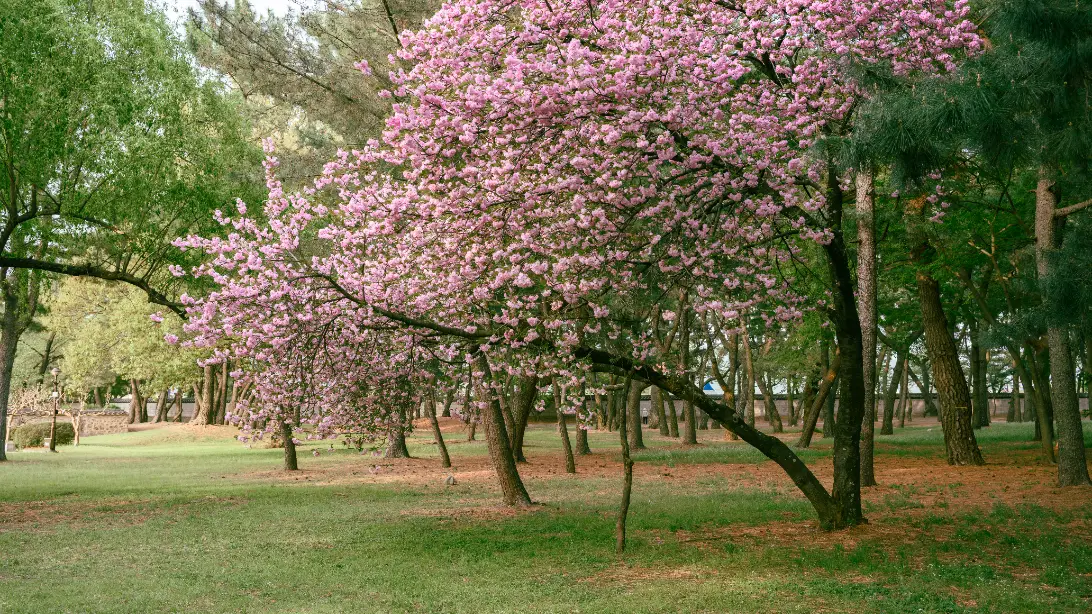
Spring climbs the peninsula from the south. The cherry trees open first on Jeju and along the south coast in late March, and reach Seoul in early April; the weather service’s normal date for Seoul’s first flowers is 8 April, though in 2026 they opened on 29 March. After the blossom come the azaleas on the hillsides, the flower Kim Sowol made into Korea’s best-loved poem in 1925, and by May the country is green and warm, with lanterns strung through the temples for Buddha’s Birthday. The catch is the air. March is Seoul’s worst month for fine dust, and spring brings days of yellow dust blown from the deserts of China and Mongolia. On a bad day, check the air-quality forecast and save the viewpoints for a clearer one.
Summer: the rains, then the sea
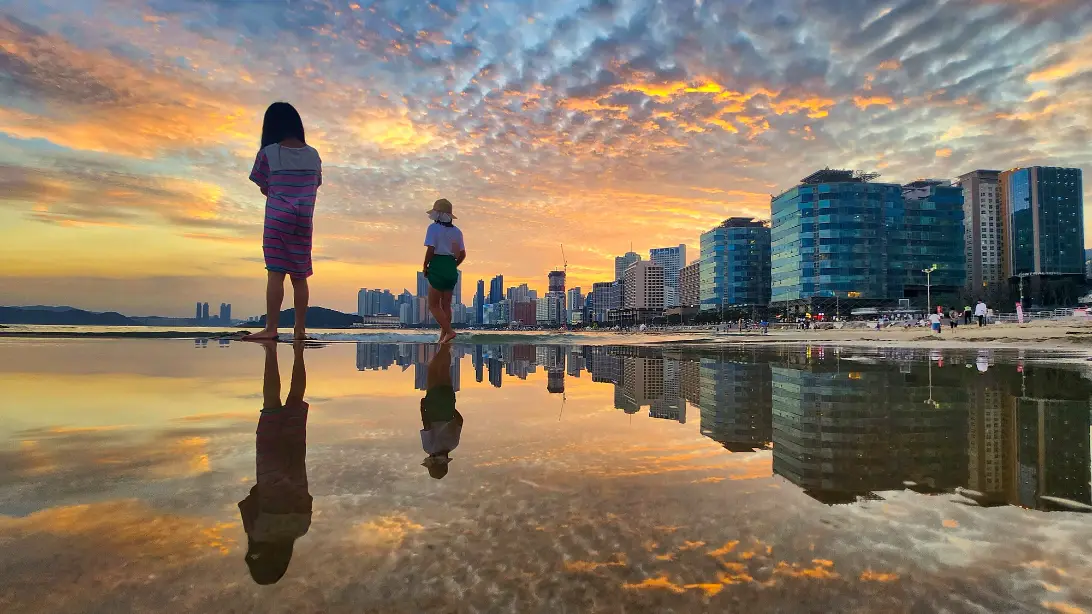
From late June the monsoon, jangma, settles over the country for about a month: the 1991–2020 normal runs from 19 June to 20 July on Jeju and from 25 June to 26 July around Seoul, and Seoul’s July rainfall averages over 400mm. It falls as heavy, humid rain rather than all-day grey, but it makes long sightseeing days hard work. August is hotter still; 2025 had nearly three times the usual number of heatwave days. What summer does well is the coast. Once the rains lift, Busan’s beaches and Jeju fill with Koreans on their summer holidays. July to September is typhoon season: about two or three reach Korea in a typical year, most often in July and August, on figures whose period we could not confirm, and September storms do happen.
Autumn: the season most people mean
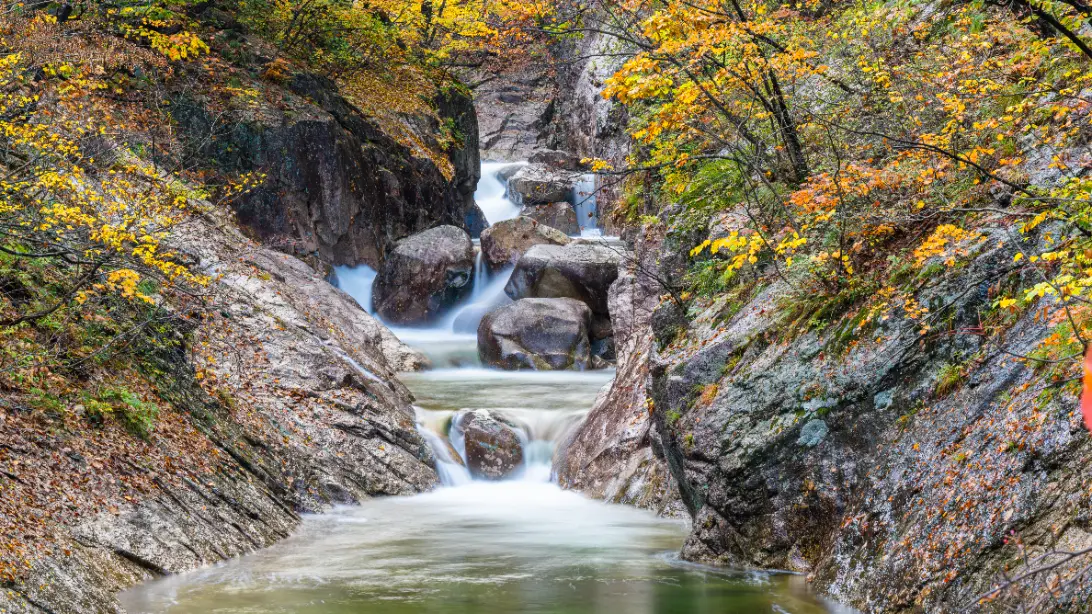
By late September the humidity has gone, and October is far drier and clearer than summer: Seoul averages 52mm of rain, against 414mm in July. The colour runs the opposite way to the blossom, from north to south. In its 2026 forecast the forestry service put the peak at Seoraksan, in the north-east, on 20 October, the central and southern regions at the end of the month, and Naejangsan’s maples, in the south-west, on 4 November; the dates move a little each year. A route that travels south through the second half of October can stay with the colour. It is also high season: China’s National Day holiday on 1–7 October was expected to make October 2026 the peak month for foreign arrivals, after a record August, and Seoul’s hotel rates reached record levels in September 2025.
Winter: cold, clear and quiet
Winter is dry and bright rather than damp, with hard blue skies as often as snow. Seoul’s January days average about 2°C, and nights are well below freezing; in the mountains of Gangwon, where the ski resorts are, it is colder. It is the quietest season, and the palaces and markets are easiest to enjoy without a crowd. The ski resorts east of Seoul open from late November or December; in 2025 the first opened on 21 November. Winter fine dust can return on still days.
Two holidays to plan around
Seollal, the lunar new year, and Chuseok, the autumn harvest festival, are Korea’s great family holidays. For three or four days much of the country travels home: trains and express buses sell out weeks ahead, and many shops, restaurants and smaller sights close. The palaces and big attractions in Seoul usually stay open, and the city is unusually empty, which some visitors enjoy. Both follow the lunar calendar, so their dates move every year.
Seollal: 6–9 February 2027; 26–28 January 2028. Buddha’s Birthday: 13 May 2027; 2 May 2028. Chuseok: 14–16 September 2027; 2–5 October 2028, which overlaps China’s National Day week. These are from the Korea Astronomy and Space Science Institute’s calendar; the official almanac had not been published when we checked, so confirm before booking.
When to go for your trip
| Trip priority | Best window | Why it works | Workable alternative | The trade-off |
|---|---|---|---|---|
| A first trip, Seoul, Gyeongju and Busan | Mid-October to early November | Clear, dry and comfortable, with autumn colour | April to mid-May | High season; book early |
| Cherry blossom | Late March in the south, early April in Seoul | The blossom moves north over about two weeks | Late April for the later double-flowered cherries and azaleas | Brief, crowded, and the date moves year to year |
| Autumn colour and hiking, Seoraksan | Mid- to late October in the north, early November in the south | Peak colour and the best walking weather | Late September for cooler, greener hills | Weekend crowds on the famous trails |
| Beaches and Jeju, Jeju and Busan | Late August to early September | Warm sea, after the monsoon | June, before the rains | Heat, crowds and typhoon risk |
| Snow and skiing | January and February | Reliable cold and snow in Gangwon | December, as the resorts open | Bitter cold; Seollal in early February 2027 |
| Lower prices and quiet cities, Seoul | January, or the second half of November | Few visitors and lower demand | Early March, if dust allows | Cold, and the city’s winter air quality |
Our itineraries set out routes that fit each of these windows, and the regions guide compares the places themselves.
If your dates are fixed
Every month has something worth the journey; the trick is to fit the trip to the season.
- Choose the purpose that suits the month. Cities and palaces in winter, the coast in late summer, walking in spring and autumn.
- Adjust the route. Follow the blossom north in spring and the colour south in autumn; in the monsoon, keep indoor days in hand, such as Seoul’s museums and markets.
- Book the scarce things first. KTX seats and rooms around Seollal, Chuseok and the first week of October, and rooms at the coast in August.
- Keep one flexible day in summer and autumn, when a typhoon or a day of heavy rain can stop ferries and flights to Jeju.
- Recheck close to travel: the weather service’s forecasts and typhoon warnings, the air-quality forecast in spring, and the blossom and colour forecasts.
The failure most likely to change a plan is a typhoon between July and September. When one is forecast, the Korea Meteorological Administration issues warnings days ahead; ferries and flights to Jeju and the south are the first to stop. Put island days early in the trip and leave a day in Seoul before the flight home, so a cancelled flight costs a day rather than the connection; Seoul and Gyeongju make good fallbacks. Our getting around guide covers rebooking trains.
A final word on when to visit South Korea
Come in October if you can choose: the clearest weather of the year, and colour on every hillside. Come in April for the blossom, in winter for quiet and snow, and in late August for the sea. Whatever the month, look up the two lunar holidays before you book.
Andrew + Margaret
- Visiting South Korea Overview
- South Korea regions Decide
- South Korea itineraries Journeys
- Cost of visiting South Korea Practical
- Getting around South Korea Practical
- Kim Sowol, “Azaleas” (진달래꽃, 1925), the spring poem every Korean learns at school Reading
- Korea Meteorological Administration: forecasts and typhoon warnings Official
- AirKorea: air-quality forecast Official
- Korea Astronomy and Space Science Institute: calendar and holidays Official
- VISITKOREA: blossom and foliage forecasts, festival dates Official
- Korea Travel Hotline 1330, in English, around the clock Practical
What is the best month to visit South Korea?
October, for most first visits: clear, dry and comfortable, with autumn colour. Book early, as it is the busiest month.
When is the cherry blossom in Seoul?
Usually early April; the weather service’s normal date for the first flowers is 8 April, but in 2026 they opened on 29 March. The south flowers about a week earlier.
Which months should I avoid?
None outright. July is the wettest, and the days around Seollal and Chuseok are the hardest for travel; plan around them rather than ruling out the month.