Abel Tasman National Park
Golden beaches, granite headlands and clear water along a coast with no road: walked, paddled or reached by boat, in a day or over several
People come to Abel Tasman for a coastline that looks too good to be in a cool country. Bay after bay of golden sand lies between granite headlands, the water runs from pale green to deep blue, and the bush comes down to the beach. There is no road along it, so you meet it on foot, from a sea kayak or off the bow of a water taxi, and you choose how much of it to take on: one beach and a walk back for the afternoon, or the whole Coast Track over three to five days.
It sits in one of the sunniest parts of New Zealand, the walking suits most fitness levels, and fur seals rest on the rocks offshore. It is the country’s smallest national park, and the AA counts it among the best known.
How this page was madeWe last travelled in the South Island before 2011, and not in a way we can describe from memory. So this page is researched from the Department of Conservation, newzealand.com, the park’s boat and kayak operators and the other sources named at the end, checked on 18 October 2026. Where they disagree or say nothing, we tell you. When we go, we will say so here.
Last updated 18 October 2026
Why it matters
This coast was lived on long before it was a park. Māori occupied it for at least five hundred years, gathering seafood and growing kūmara, and the Pitt Head loop track leads to a pā site where the terracing and food pits can still be seen. In December 1642 the Dutch navigator Abel Tasman anchored in Golden Bay, just to the north. The meeting with Ngāti Tūmatakōkiri turned violent, four of his sailors were killed, and he sailed on. The expedition’s artist, Isaack Gilsemans, drew the scene.
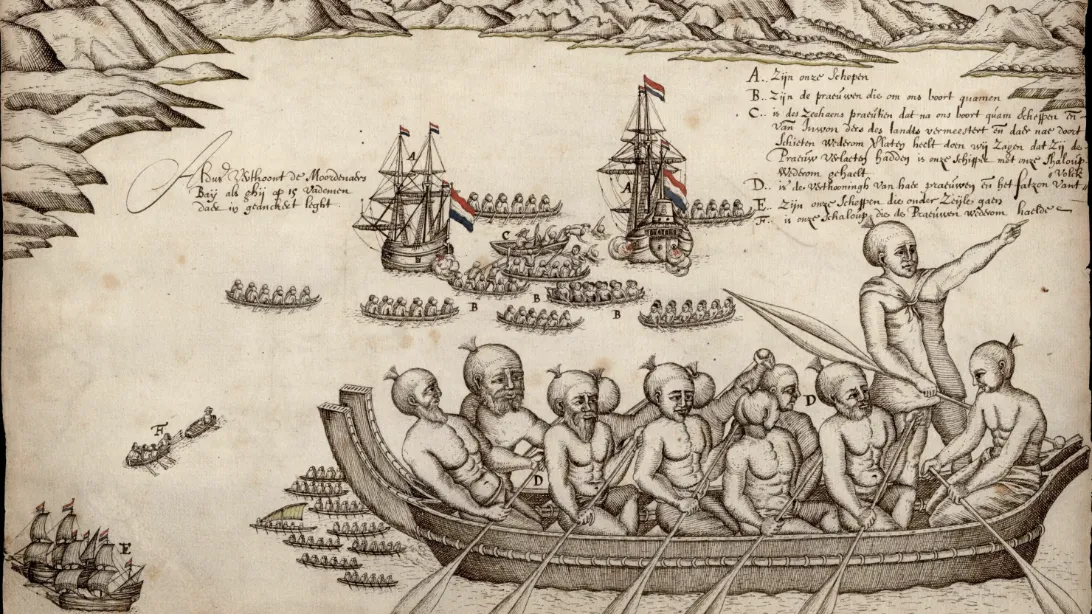
The coast that visitors love today was nearly lost. From the 1850s logging, quarrying, shipbuilding and farming stripped the hills, and gorse and bracken took their place. When more coastal logging threatened in the late 1930s, the Nelson conservationist Perrine Moncrieff led a campaign to protect the land, and the park opened in 1942, three hundred years after Tasman’s visit, carrying his name. At 22,530 hectares it is still New Zealand’s smallest national park.
It is still being brought back. A privately funded project called Project Janszoon is working with the Department of Conservation to restore its birdlife, and in 2016 thousands of New Zealanders crowdfunded the purchase of Awaroa beach and gave it to the park. Offshore, the Tonga Island Marine Reserve, created in November 1993 and covering 1,835 hectares, protects the water and the fur seals that breed on its rocks. Tonga and Pinnacle islands themselves can be landed on only by permit, and Tonga, Adele and Fisherman islands are free of introduced mammal predators.
What it’s like
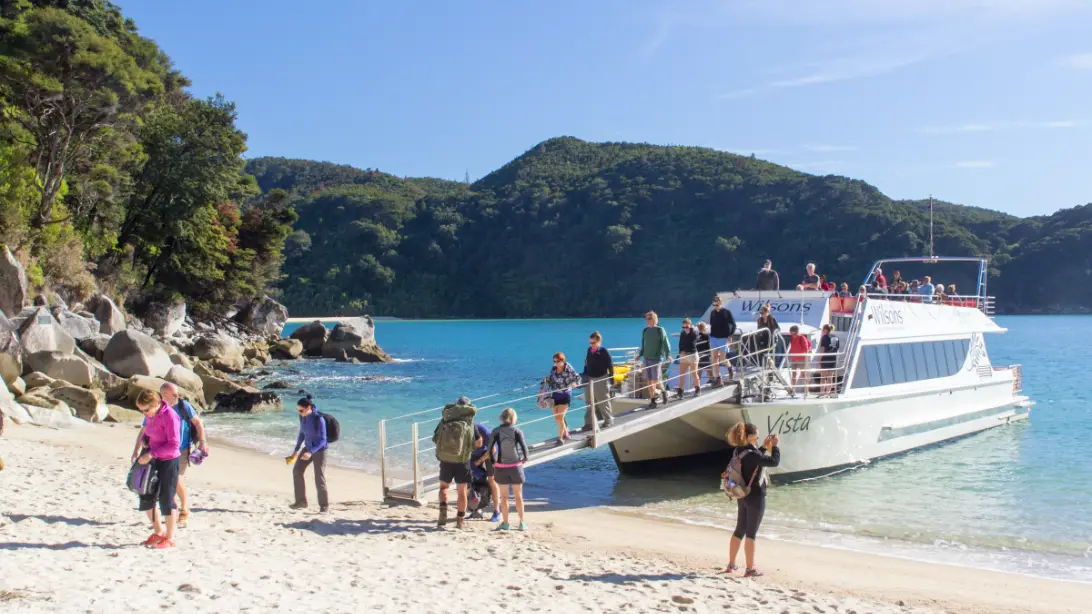
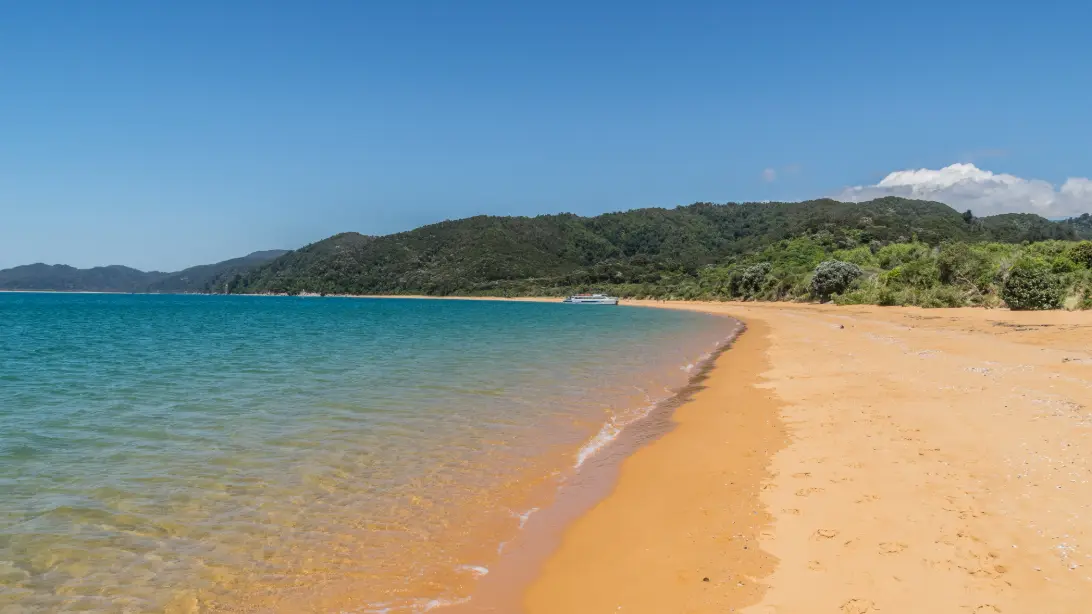
Many visitors arrive by water. The boat runs north from Kaiteriteri or Marahau along a coast of headlands and coves, then noses in to a beach, and you step off onto the sand. From there the Coast Track climbs through bush and drops into the next bay, again and again: Anchorage, with its long curve of sand; Torrent Bay and its estuary; Bark Bay, which the Department of Conservation describes as having idyllic golden sands; Onetahuti, one of the longest beaches in the park.
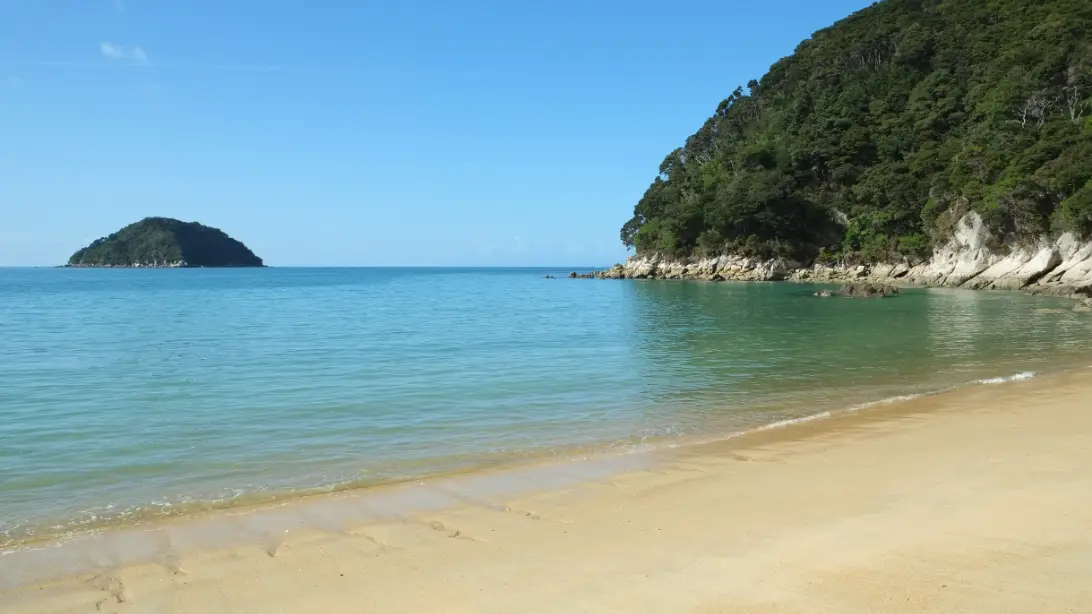
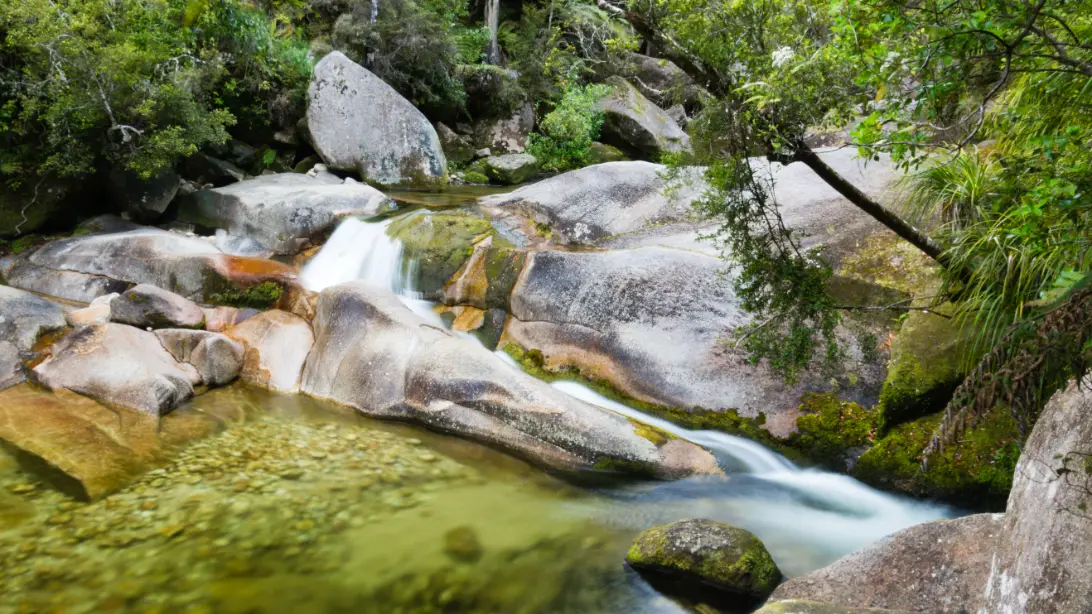
The Department of Conservation grades the track intermediate, with some steep, rough and muddy stretches; the AA calls it suitable for most fitness levels. Between the beaches it passes through forest with tūī and bellbirds, and newzealand.com points to glades of nīkau palms. Along the way are small discoveries: Cleopatra’s Pool, a natural rock pool with a moss-lined waterslide, about twenty minutes off the track near Torrent Bay; the Falls River swing bridge, 47 metres long; and, at the northern end, Whariwharangi, a homestead of about 1896 that is now a hut.
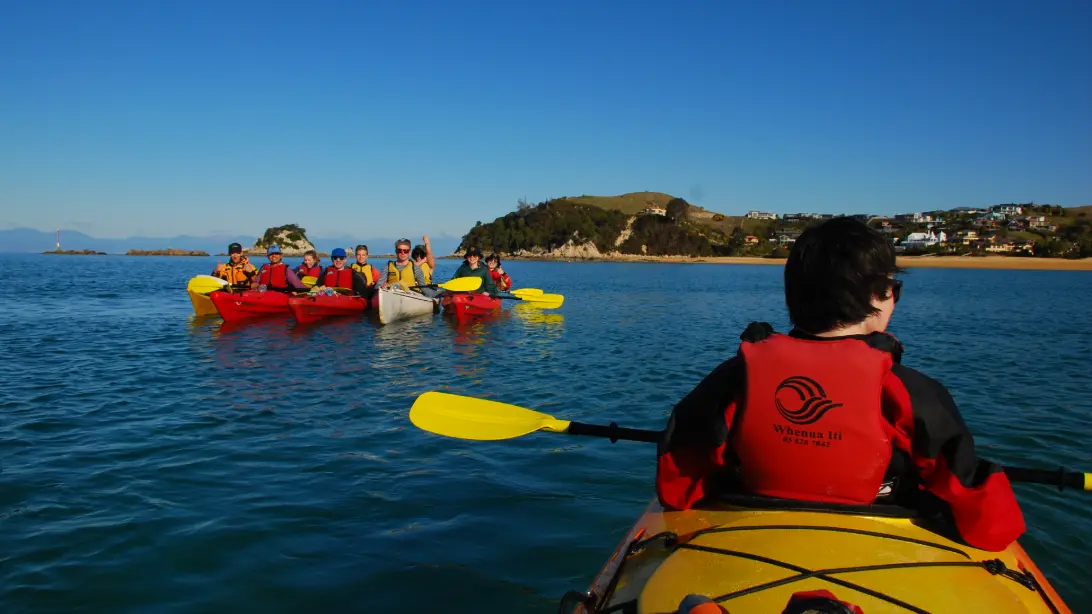
On the water the park is busier and more alive. In summer the bays fill with kayaks, yachts and water taxis, and fur seals lie out on the rocks around Tonga Island. How many people come is uncertain: the AA puts it at about 100,000 a year, and another source at about 200,000.
What writers and artists have made of it
The drawing above was made on Tasman’s voyage by Isaack Gilsemans, at the encounter of December 1642 in Golden Bay: two Dutch ships at anchor and Māori waka on the water, seen from the Dutch side. The ships had arrived on the night of 17 December; on the days that followed, four of Tasman’s sailors were killed by Ngāti Tūmatakōkiri, and he left without taking on water. It is worth a long look before you reach the beaches, as a reminder that the park’s name marks a meeting that went wrong.
When the water taxi has left you on the beach and its engine has faded round the headland, stay where you are for a few minutes before you set off. Face the sea and listen behind you: the forest is close, and the tūī and bellbirds are in it. Look at the colour of the water as it deepens from the shore, and at the sand under your feet, before you turn to find where the track leaves the beach.
What to do in the park
Most people come to do one or more of a few things: walk, paddle, spend the day on a beach, watch for wildlife, or see the coast from a boat. They combine easily, because the water taxis link them: out by boat and back on foot, or out by kayak and back by boat.
| Trip | Time | Cost | Best for |
|---|---|---|---|
| A day walk from a water-taxi drop | Half a day to a full day | From $62 one way by water taxi; the walk is free | Seeing several beaches in a day |
| The whole Coast Track | Three to five days | Huts or campsites, plus a water taxi back | Walkers who want the full coast |
| A guided sea-kayak day | A full day | From about $260 a person | Seals, the marine reserve, and people new to kayaking |
| Freedom kayak hire | One day or more | From $125 a person a day | Experienced paddlers, at least two together |
| A beach day | As long as you like | The water taxi there; the beach is free | Swimming, snorkelling and doing very little |
| A scenic cruise | Set by the operator | From $120 for the full park | Seeing the coast without walking |
Day walks
The simplest day is a water taxi out and a walk back to where you left the car, or to a beach where the boat will collect you. The distances below are the Department of Conservation’s section figures, added together. Bark Bay to Torrent Bay, inside the second walk, is one of the most popular short sections.
| Boat to | Walk to | Distance | Walking time |
|---|---|---|---|
| Anchorage | Marahau | 12.4 km | About 4 hours |
| Bark Bay | Anchorage, then the boat back | 8.4 km at low tide | About 3 hours |
| Awaroa | Tōtaranui, then the boat back | 7.1 km, with the tidal crossing | About 2 hours 20 minutes |
The Coast Track
The whole track is about 60 km, from Marahau to Wainui, and takes three to five days. Many walkers finish at Tōtaranui and take a water taxi back, since none run further north.
| Section | Distance | Time | What you pass |
|---|---|---|---|
| Marahau to Anchorage | 12.4 km | 4 hours | Apple Tree Bay and Te Pukatea; the long curve of Anchorage |
| Anchorage to Bark Bay | 8.4 km at low tide; 11.5 km by the high-tide track | 3 to 4 hours | Torrent Bay estuary and Cleopatra’s Pool; the 47 m Falls River swing bridge; Bark Bay’s golden sand |
| Bark Bay to Awaroa | 13.5 km | 4 hours 30 minutes | Tonga Quarry; Onetahuti, one of the park’s longest beaches; a lookout over Awaroa Bay |
| Awaroa to Tōtaranui | 7.1 km | 2 hours 20 minutes | The Awaroa crossing, at low tide only; Tōtaranui’s beach and campsite |
| Tōtaranui to Whariwharangi Bay | 9.8 km | 3 hours 15 minutes | The quieter north; the hut in an 1896 homestead behind the beach |
| Whariwharangi Bay to Wainui | 5.7 km | 2 hours | The end of the track; Wainui Inlet, for a swim or the rock pools |
Huts and campsites must be booked all year. From October to April, huts cost NZ$84 a night for international adults and campsites NZ$31; from May to September both cost less. You may stay no more than two nights at each site from October to April, and five from May to September; Tōtaranui allows one night all year.
At Torrent Bay and Bark Bay, cross within two hours either side of low tide, or take the all-tide track. At Awaroa there is no alternative route: the Department of Conservation allows the crossing only in daylight, from 1 hour 30 minutes before to 2 hours after low tide, and it takes about 25 minutes. Plan your day around the tide table, not the other way round.
Sea kayaking
Kayaking is the park’s signature way of seeing the coast, and it is often combined with a walk and a water taxi back. The kayak companies are clustered at Marahau, and newzealand.com lists seven. We checked two: Abel Tasman Kayaks offers freedom hire from $125 a person a day and guided trips from $260, up to $410 for a day in the marine reserve; Kahu Kayaks offers guided marine-reserve days from $320 and a family day from $225. Neither published a minimum age we could read.
If you want to paddle on your own, the Department of Conservation says independent kayak hire needs at least two people and previous sea-kayaking experience, and that kayaking is not recommended north of Onetahuti Bay. Mosquito Bay campsite can be reached only by boat. Adele and Fisherman islands can be reached by boat or kayak; they have no toilets and no camping, and the nearest toilets are at Apple Tree Bay. If you are new to sea kayaking, go guided.
Beaches, swimming and snorkelling
For many visitors the beaches are the day. Any bay where the water taxis land will do for an afternoon, and the long sands of Anchorage, Bark Bay, Onetahuti and Tōtaranui are the best known. The Department of Conservation lists swimming and snorkelling in the Tonga Island Marine Reserve, off Onetahuti, where nothing may be taken or disturbed. For fresh water, Cleopatra’s Pool near Torrent Bay has its moss-lined slide. Not every beach has a toilet, so check the list under How to visit before you settle.
Watching wildlife
Fur seals are the surest sighting. They haul out on the rocks around Tonga Island and along the reserve’s rocky shores, and breed there from October to January. On the water the Department of Conservation lists bottlenose, Hector’s, common and dusky dolphins, and occasionally orcas; it names oystercatchers and shags along the shore, and the AA adds gannets and little blue penguins fishing offshore. In the forest behind the beaches, listen for tūī and bellbirds. A kayak or a boat brings you closest; stay at least 20 metres from seals, and further in the breeding season.
Seeing it from a boat
If you would rather not walk or paddle, Wilsons Abel Tasman runs scenic cruises from Kaiteriteri, from $120 for the full length of the park and back, and cruise-and-walk days that leave you on a beach, from $104 for Anchorage.
Other things to do
The park has more than the coast. newzealand.com and other guides list canyoning, tandem skydives and helicopter flights over the park, diving in the marine reserve, the Inland Track through the hills behind the coast, and Harwoods Hole, a deep sinkhole inland. We have not researched these in detail.
How to visit
Getting in is two journeys: by road to a gateway, then along the coast by water taxi, by kayak or on foot.
Getting to the gateways
The southern gateways are Marahau, where the Coast Track begins and the kayak companies are based, and Kaiteriteri, where Wilsons checks in its day trips. Allow about an hour to an hour and a half by car from Nelson: newzealand.com gives 1 hour 5 minutes to Marahau and the Department of Conservation about an hour and a half. Daily buses run from Nelson and Motueka to Marahau. Our Nelson guide sets out the region and where to stay. The northern end, Tōtaranui, is reached by road from Golden Bay: 32 km from Tākaka, the last 12 km unsealed, and about 160 km from Nelson in all.
Water taxis
Water taxis are what make the park easy. They run all year between Marahau or Kaiteriteri and Tōtaranui, landing on the beaches along the way, among them Apple Tree Bay, Anchorage, Bark Bay, Tonga Quarry, Onetahuti and Awaroa; none run north of Tōtaranui. Book ahead. We checked two operators. Abel Tasman AquaTaxi, based at Marahau since 1990, carries one bag of up to 20 kg with each paying passenger. Abel Tasman Kayaks sells seats from Marahau, charges children up to 14 half fare and carries under-fives free. A return is two one-way fares. Wilsons, at Kaiteriteri, runs its water taxis as private charters, priced on request.
| Beach | AquaTaxi, from Marahau or Kaiteriteri | Abel Tasman Kayaks, from Marahau |
|---|---|---|
| Anchorage | $63 | $62 |
| Torrent Bay | $63 | Not listed |
| Bark Bay | $67 | $65 |
| Onetahuti | $69 | $68 |
| Awaroa | $73 | $71 |
| Tōtaranui | $75 | $74 |
Food, water, toilets and rubbish
There are no shops in the park and no bins anywhere in it, so carry in what you need and carry out everything you leave with.
| Need | In the park | Bring or do |
|---|---|---|
| Food | No shops. One place to eat: Awaroa Lodge, reached only by boat or the track. Its restaurant opens daily from October to April; its pizzeria, popular with walkers, from December to March in fine weather | All your food for the day, and spare on the Coast Track |
| Drinking water | Untreated at huts and campsites, and giardia has been found in it. Filtered water only at Tōtaranui | 1 to 2 litres each; boil, filter or treat anything you refill |
| Toilets | At every hut, campsite and car park, and at Goat Bay, Pound Gully, Medlands and Stilwell Bay | Use one when you see one, and have a backup ready, as DOC advises |
| Rubbish | No bins anywhere in the park | A rubbish bag; carry out everything you carry in |
| Cooking, on the Coast Track | No gas cookers or lighting in the huts | A stove, fuel and a torch |
Eat before you set off. At Marahau, at the start of the track, abeltasman.com lists The Park Café, Hooked on the waterfront and The Fat Tui for burgers, open in the main season from October to April.
When to go
| Season | What changes |
|---|---|
| October to April | The busiest bays, filled with kayaks and boats. Huts NZ$84 and campsites NZ$31 a night for international adults; two nights at most at each site. Seals breed from October to January. |
| May to September | Quieter, with cheaper huts (NZ$33 to NZ$42) and up to five nights at each site. newzealand.com calls it the one South Island Great Walk you can do in winter without ice axe and crampons. |
Visiting with children or limited mobility
The beaches suit children, and a water taxi can shorten any walk; child fares are under Water taxis above. The kayak operators did not publish minimum ages we could read, so ask when you book. The Coast Track is graded intermediate, with steep, rough and muddy stretches, and we found no published step-free route in the park. Water taxis land on the beach, so ask the operator how you board before you book if steps or wading are a problem.
Staying safe and leaving it as you found it
Carry insect repellent for sandflies. Keep at least 20 metres from seals. In the marine reserve, take nothing and disturb nothing. Dogs are not allowed in the park (guide dogs excepted), fires are banned, and hammocks may not be hung at Coast Track campsites.
Making the most of it
A few choices make the difference between a good day here and a hurried one.
Take the water taxi to the furthest beach you want and walk back towards your car. You set the pace, and the boat timetable stops mattering.
The estuaries at Torrent Bay, Bark Bay and Awaroa decide your day. Check low tide before you choose a beach or a section.
Huts and campsites must be booked all year, and summer nights are limited to two at each site. Book before you book anything else.
The Department of Conservation says freedom hire needs two people and previous sea-kayaking experience. A guide also knows where the seals are.
Seals breed on the rocks around Tonga Island from October to January. Stay at least 20 metres away, on the water as on land.
There are no shops or bins in the park, and its water is untreated. Take your food, enough water, repellent for the sandflies and a bag for your rubbish.
The Department of Conservation’s free app works offline, with maps, weather, tide times and walking times. Load it before you lose signal.
The track stays open all year, the huts cost less from May to September, and newzealand.com calls the region one of the sunniest in the country.
Nearby
Most visitors base themselves in Nelson, or at Kaiteriteri or Marahau for an early boat. Split Apple Rock, the cleft granite boulder off Kaiteriteri, is just outside the park and on our Nelson page. At the park’s northern end, Golden Bay has Te Waikoropupū Springs and, from the Wainui side, a forest walk of about an hour return to Wainui Falls.
A final word on Abel Tasman
Abel Tasman is a coast you can shape to your own day: a boat out, a beach, a walk back through the bush, or a week of bays end to end. It was nearly lost and is being brought back, and it rewards anyone who plans around the tide and books ahead. We would give it at least one full day, and a night at its edge if we could.
Andrew + Margaret
- Nelson Overview
- Visiting New Zealand Overview
- New Zealand in three weeks Journeys
- Getting around New Zealand Practical
- Best time to visit New Zealand Practical
- Department of Conservation — Abel Tasman National Park Official
- Department of Conservation — Coast Track and bookings Booking
- Department of Conservation — Tonga Island Marine Reserve Official
- newzealand.com — Abel Tasman National Park Official
- Abel Tasman AquaTaxi Booking
- Wilsons Abel Tasman Booking
- Isaack Gilsemans’ drawing of Golden Bay, 1642 Reading
Can I visit Abel Tasman in a day?
Yes. Take a water taxi from Marahau or Kaiteriteri to a beach and walk back, or kayak for the day. Day walks need no booking and are free.
Do I need to book the Coast Track?
Only to stay overnight. Huts and campsites must be booked all year; walking for the day needs no booking.
Can I buy food in the park?
Only at Awaroa Lodge, in season, which you reach by boat or on foot. Otherwise there are no shops, and no bins either: bring what you need and take your rubbish home.
Can I kayak without a guide?
The Department of Conservation says independent hire needs at least two people and previous sea-kayaking experience, and does not recommend kayaking north of Onetahuti Bay.
Can I drive into the park?
Only to its edges: Marahau and Kaiteriteri in the south, and Tōtaranui in the north by an unsealed road from Golden Bay. There is no road along the coast.