London to Barcelona
Calais to Barcelona in June 2004: through France and over the Pyrenean foothills to Spain
You feel very alive on a ride like this. You see the flowers and crops, the forests and rivers, but you also hear and smell them. There is always something different. You have time to notice things. And a village is somewhere to stop for coffee or lunch, which is a much better use of it than watching it disappear through a car window.
In June 2004 Margaret and I took a train to Dover, crossed to Calais and rode to Barcelona. The ride took us through chalk hills, across the Seine and the Loire, down to the Atlantic, over the Gironde by ferry, through the pine forest of the Landes and the ridges of Gascony, and round the eastern end of the Pyrenees into Catalonia.
It was not our first tour. In August 2001 we had ridden from Land’s End to John o’ Groats together, and that had given us a taste for long-distance touring. Margaret had also ridden across Costa Rica in 2000. Why Barcelona, I can no longer say. It must have been somewhere we wanted to get to. We also rode to raise money for charity: the British Heart Foundation, as far as I remember.
We rode Hewitt Cheviot SE touring bikes: steel-framed, geared for climbing and fitted with racks to carry a significant load. We planned the route on a series of maps, Michelin I think, helped by the route map of someone who had made the journey before us.
This page is put together from the journal I kept at the time. It was more than twenty years ago and there is a good deal I can no longer remember, so where the journal is silent, the page is too.
Last updated 2 October 2026
The route
From Calais we rode south through Picardy and Normandy to Évreux, then south-west past Le Mans to the Loire at Saumur. From there we went on through Thouars and Niort to the coast above Royan, took the ferry across the Gironde and rode down through the Médoc vineyards to Bordeaux.
South of Bordeaux we crossed the Landes forest to Eauze, followed the ridges of Gascony to Trie-sur-Baïse, and turned east along the foot of the Pyrenees through Foix and Couiza. A gorge took us down to the plain near Perpignan. We crossed into Spain at Le Perthus and finished by way of the coast at Sant Pere Pescador, La Bisbal d’Empordà and Granollers.

What the ride was like
Our first night was near Guînes, just twelve miles from the port. The following morning, the hill outside town made it clear that France was not going to be gently downhill all the way to Spain.
Riding south through that part of France meant repeatedly descending into a river valley, crossing the river and climbing out again. Then we did it all over again. Down, cross the river, up. Repeat. We were heading south, but our legs were becoming rather more interested in the vertical direction.
There was much to enjoy. We rode through chalk country and woods, followed quieter valleys and stopped in towns we might otherwise never have visited. But we were often covering sixty or seventy miles a day, sometimes more, and the combination of hills and June heat made those long days demanding.
The heat shaped everything. On the second day we drank eight litres of water between us. On the fourth we lay on a sleeping bag in the shade of a forest for an hour, to avoid overheating. By the Loire we were hunting for shade every time we stopped.
And then there was lunch. French shops shut at midday, and a picnic depended on reaching a supermarket before the doors closed. We missed one by a whisker on day three and made another with ten minutes to spare on day nine. It became a daily race, and one we did not always win.
The ride in six stages
These are our own divisions, made afterwards. The miles are the daily figures from the journal, added up.
| Stage | From → to | Distance | Character and effort | Overnight stops | Main constraint |
|---|---|---|---|---|---|
| 1 The Channel to the Seine | Calais → Évreux | 208 miles, days 1 to 4 | Chalk hills and wooded country, with river valleys to drop into and climb out of | Guînes; Saint-Valery-sur-Somme; Forges-les-Eaux; Évreux | Steep hills late in hot afternoons |
| 2 Normandy to the Loire | Évreux → Thouars | 204 miles, days 5 to 7 | Rolling country and river valleys; low hills and near-empty villages towards Saumur | Bellême; Bazouges-sur-le-Loir; Thouars | Finding the way on small roads |
| 3 Poitou to the Gironde | Thouars → Bordeaux | 233 miles, days 8 to 11 | Gentle roads to the coast, a rest day, the ferry, then the Médoc vineyards | Niort; La Palmyre, near Royan (two nights); Bordeaux | An 80-mile day, and busy roads in the Médoc |
| 4 The Landes and Gascony | Bordeaux → Auzas | 244 miles, days 12 to 15 | Flat, quiet forest roads, then ridge roads that go up and down all day | Captieux; Eauze; Trie-sur-Baïse; Auzas | Getting out of Bordeaux; few places to stay |
| 5 The Pyrenean foothills | Auzas → Thuir | 184 miles, days 16 to 18 | Real climbs, mountain ridges and a gorge; spectacular cycling | Foix; Couiza; Thuir | Climbing with a loaded bike |
| 6 Into Catalonia | Thuir → Barcelona | 160 miles, days 19 to 22 | A fast run to the border, then busy main roads and one big climb in Spain | Sant Pere Pescador; Granollers; Barcelona | Traffic on the roads towards Barcelona |
Day numbers are the journal’s own. It has no entry for day 20, and I can no longer say whether we took a rest day at Sant Pere Pescador or I numbered the days wrongly. We did not stay anywhere between Sant Pere Pescador and Granollers.
1 The Channel to the Seine
We caught the 11:30 ferry from Dover on 6 June and rode the twelve miles to Guînes beside a canal for most of the way. The next two days crossed hilly chalk country: coffee at Desvres, lunch by the fountain in the square at Montreuil, then a long afternoon to Saint-Valery-sur-Somme. Day three reached 31°C. On day four we followed river valleys as far as we could, had lunch in a park at Les Andelys, crossed the Seine and climbed again to Évreux.

2 Normandy to the Loire
Day five began with showers, and a puncture at Verneuil-sur-Avre, where a bike shop also tightened my headset. Those were the only problems the bikes gave us on the whole ride. We reached Bellême at about six. The next day was the weekend of the Le Mans 24-hour race, so we skirted the city to the west and had lunch by a lake at La Milesse.

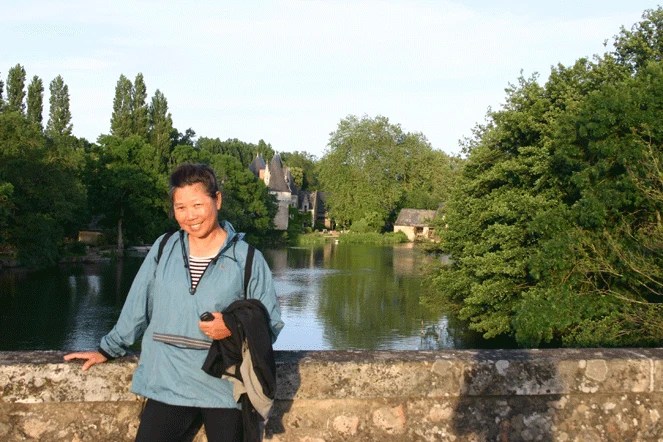
Bazouges-sur-le-Loir was a delight. Our room backed on to the river, and we talked with our host, Anne-Marie, for some time before exploring the village. She told us it was losing its people. We found one shop, just in time to buy dinner. The following morning took us over low hills through almost deserted villages to Saumur for lunch, across the Loire, and on to Thouars, where a very basic room had a great view of the town’s skyline.

3 Poitou to the Gironde
It was a Sunday and we were too hopeful about finding food. Luckily we stumbled on a country fair a few miles south of Parthenay and joined a small cycle rally within it, hot dogs and all. In Niort we had a superb meal and far too much wine.

The ride to the coast was the longest of the trip, 80 miles. The quiet road south from Sansais was a delight: little traffic, gentle hills and small villages. We picnicked by the river at Saint-Savinien, then followed a cycle path that ended suddenly in open country beside a busy road. We camped for two nights at La Palmyre, next to the beach, and rode into Royan on the rest day to look at the ferry.
We waited an hour for the boat across the Gironde to Le Verdon. Without a good map we ended up on busier roads than we had hoped, but they took us through the Médoc, past vineyards and châteaux at Pauillac and Margaux, and we reached Bordeaux that evening, which we had not expected.

4 The Landes and Gascony
Entering Bordeaux was easier than leaving it. Most signs led to very busy roads and motorways, and it took local help to find our way south through La Brède. The afternoon ran through wooded country on quiet roads, past the castle at Villandraut, to Captieux.
The next morning was brilliant: a ride through quiet and spectacular forest. We had lunch at Labastide-d’Armagnac, where tables were being set out in the old square for a feast, and stopped at the cyclists’ chapel a little way beyond. At Eauze we were taken in by Jacques and Lucianne at their bed and breakfast and waited on all evening.


Stop where the pines close over the road and let the freewheel go quiet. Breathe in: warm resin and dry needles. Listen for how little there is. A cone dropping. A bird, far off. Your own tyres ticking as they cool. Look down the road, straight as a ruled line, until it shivers in the heat. Then put a hand on the saddle. It is already hot.
From Eauze the road went up and down all day, with more ups than downs. Much of it followed a ridge with great views, and cloud gave us welcome cover after so much sun. We passed Lupiac towards lunchtime. There was still no sign of the high Pyrenees. The last four kilometres into Trie-sur-Baïse were downhill. Of Auzas I remember nothing. We rode there, found a place to stay, were too tired to explore and rode on the next morning. Some days were like that.
5 The Pyrenean foothills
On the way to Foix we briefly joined one of the pilgrim routes to Santiago de Compostela and met an Italian who had walked from his home and was going on into Spain. It put our efforts into perspective. The road also ran straight through the cave at Le Mas-d’Azil. Foix itself is spectacular.
Leaving it was less so. The town sits among mountains and between rivers, and twice I climbed out on the wrong road and had to come back down to cross the river. This was not popular. The rest of the day, over the foothills to Couiza, was excellent, and we treated ourselves to a night in a castle turned hotel, with dinner in its medieval courtyard.
The day after was spectacular. We left Couiza early and wound up the mountain past Rennes-les-Bains. A coachload of tourists applauded us at the top of the climb. Then it was down, into a spectacular landscape and through a gorge. We were not convinced there was a road at all. It seemed to disappear into the rock, so riding through was pure exploration. After lunch at Saint-Paul-de-Fenouillet came more climbing along the ridges, and at last we came out of the mountains to the river near Ille-sur-Têt and a small hotel at Thuir.
6 Into Catalonia
The ride to the border at Le Perthus was fast. We chose to cross there because the coast road from Argelès looked hillier and more winding. The price was the busy main road to the frontier, where luckily the traffic was queuing, and more main road on the Spanish side to Figueres, where we got lost.
The campsite at Sant Pere Pescador was special: a swimming pool, the beach, and a bar full of Dutch supporters in orange watching the football. From there we rode through Verges to La Bisbal d’Empordà and took the mountain road to Cassà de la Selva. It is not a huge mountain, but it seemed like one to us with our heavy bikes and packs. It is steep and winding in places, and cyclists use it for training. We ended the day on a very busy road into Granollers. The ways towards Barcelona seemed either very mountainous or to follow highways through the valleys.
The last day was a great one: nineteen miles, the final few on a riverside path among joggers and cyclists. We found the city centre, celebrated, took an excellent hotel and spoiled ourselves for the rest of the day.
We flew home from Barcelona with the bikes. At Heathrow we found that mine had been damaged in transit, probably in baggage handling: a wheel was buckled, and we had trouble riding home. I was very upset. By then the bikes were like our babies, and any damage to them hurt.
Places worth knowing along the way
We passed most of these with barely a pause. We have looked them up since, and each would repay a longer stop than we gave it.

A walled upper town above the Baie de Somme. Its eleventh-century gate towers were already standing when William of Normandy’s fleet put in here in 1066.

Château Gaillard stands above the Seine. Richard the Lionheart had it complete by 1198; Philippe Auguste took it in 1204, and Normandy with it.

The château above the Loire was made a palace in the fourteenth century. The town is also home to the Cadre Noir, whose riding tradition is on UNESCO’s heritage list.

A chapel given over to cycling, 2.5 km from Labastide-d’Armagnac. It holds jerseys of Anquetil, Merckx, Hinault and others. Opening hours are short, so check first.

D’Artagnan country. The real musketeer was born at the Château de Castelmore, which is private. The village has a museum to him and a bronze statue.

The road runs through the cave for more than 400 metres, with the river beside it. Prehistoric finds from the cave are shown in the museum nearby.

Three towers on a rock, the seat of the counts of Foix. Simon de Montfort failed to take the castle during the crusade against the Cathars.

The gorge between Cubières and Saint-Paul-de-Fenouillet. The road is narrow, limited to 30 km/h and closed to wide vehicles.
Both ferries we used still carry bikes: DFDS and P&O from Dover to Calais, and the Royan to Le Verdon boat across the Gironde, which takes 20 to 25 minutes. For the gorge, we could not find the traffic arrangements for 2026 on an official page, so check the gorge’s own site before you plan a day around it. Everything else here is how we found it in 2004.
What we learned
- Shops close at midday. Buy lunch in the morning, or plan the morning around a supermarket.
- Carry more water than seems sensible. In that heat we drank eight litres between us in a day.
- Rest in the shade when you need to. An hour lying under trees cost us less than pressing on would have.
- Have the right map before you need it. Without one in the Médoc we ended up on busier roads than we wanted.
- Cities are easier to enter than to leave. Bordeaux and Foix both proved it. Ask someone local.
- A cycle path is only as good as its end. Ours stopped in the middle of the countryside beside a main road.
- Book ahead with care. The hotel we had reserved in Niort turned out to be on the edge of the city, and we moved.
We reached Barcelona after 1,233 miles and celebrated properly. But we had also reached a decision: next time, let the boat do a bit more of the work. On our later rides we took the overnight ferry from Portsmouth to Saint-Malo instead.
If you are setting out on this route, pace yourself. Forget about camping and stay in small hotels with a restaurant. Get to know the local people. Find more time than we did for the west coast of France and for the Pyrenees. And do not do it alone: go with a friend or a partner.
Pace yourself, stay in small hotels, get to know the local people and go with a friend or partner. Treat it as a holiday, not as a slog.
— Andrew + MargaretA final word on London to Barcelona
The pleasure lies in the changing world around you: flowers and crops, forests and rivers, a village coffee stop, a shaded picnic, the welcome at the end of a day. There are challenges and uncertainties, and they can be considerable. But arriving in Spain after experiencing all of that brings an enormous sense of achievement.
You arrive tired, pleased with yourself and with a head full of places you would never have noticed from a motorway. And, quite possibly, ready for a very good dinner.
Andrew + Margaret
- Cycling journeys Journeys
- Barcelona Overview
- Visiting Spain Overview
- DFDS: taking a bike to France Booking
- Gironde: the Royan to Le Verdon ferry Official
- Notre-Dame des Cyclistes Highlight
- The cave at Le Mas-d’Azil Highlight
- Gorges de Galamus: visiting and access Safety