Whitianga
The harbour town on Mercury Bay, the Coromandel at its most beautiful, and the best base for the whole peninsula
The Coromandel Peninsula is one of the most beautiful coasts in New Zealand: white-sand coves under pōhutukawa, clear green sea, and bush-covered ranges running down to the water. Mercury Bay, on its eastern shore, holds its most famous places. Cathedral Cove is a great sea-carved arch between two beaches. At Hot Water Beach you dig your own hot pool in the sand. Whitianga is the harbour town on the bay and the natural base for all of it, with beds, restaurants, boats out to the marine reserve and a little ferry across the harbour mouth. Two nights let you meet the tides at the cove and the beach. Stay longer and the rest of the peninsula is within a day’s drive, from the Pinnacles to New Chums Beach.
What is ours, and what is researched. We drove in along the coast road in March 2026, slept one night at a bed and breakfast on Landel Place, and ate fish and chips from the town. The next morning we walked down to Cathedral Cove, and then reached Hot Water Beach at high tide, which taught us the lesson this page repeats. Everything else here, from the ferry and the boats to the places to stay and eat, is researched from the Department of Conservation, The Coromandel’s visitor site and the operators’ own pages, checked on 29 September 2026. On our North Island in two weeks route, Whitianga is the sixth night.
Last updated 29 September 2026
A little background
The bay’s Māori name is Te Whanganui-o-Hei, the great bay of Hei, after the ancestor of Ngāti Hei, whose people have lived around it for centuries. It is their name that the marine reserve at Cathedral Cove carries today.
In November 1769 James Cook anchored the Endeavour here to observe the transit of Mercury across the sun, and named the bay for it. Timber and gum followed Cook. For some sixty years the district shipped kauri from the forests behind the bay, and dug kauri gum from the ground. Whitianga today is a harbour town of about 6,000 people at the 2023 Census, much larger in the summer holidays, and its museum by the wharf tells the whole story in order.
How the place fits together
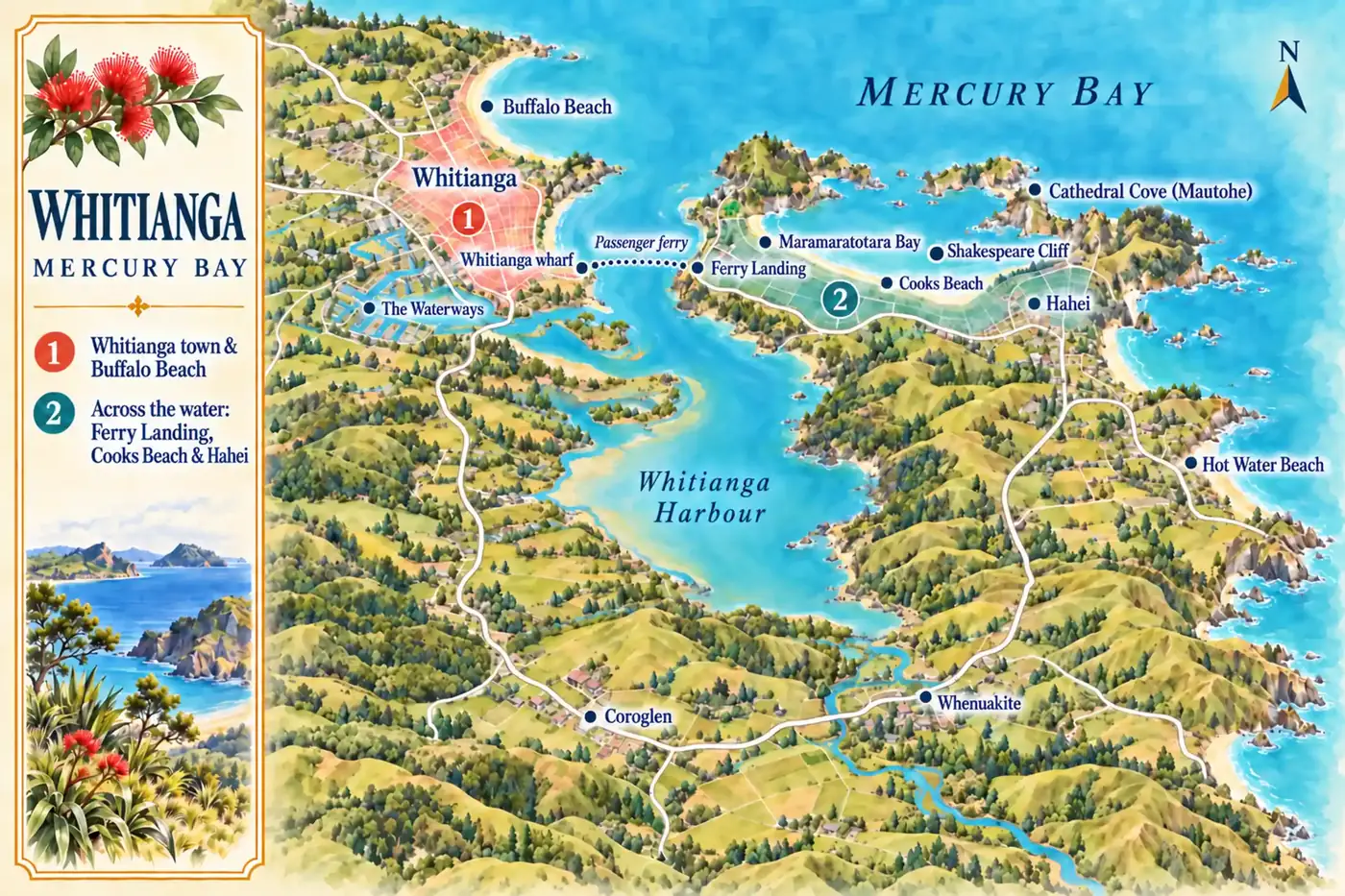
Whitianga faces Mercury Bay across a narrow harbour mouth, and the ferry puts the finest stretch of its coast a few minutes away. The town centre, the wharf and the museum face the harbour, and Buffalo Beach runs north from them along Mercury Bay. Across the mouth, a few hundred metres of water away, is Ferry Landing. From there the coast runs east past Shakespeare Cliff and Cooks Beach to Hahei, the village above Cathedral Cove, with Hot Water Beach beyond it to the south.
On foot, the ferry makes the crossing trivial. By car it is not: the road goes the long way round the harbour, and Hahei is about forty minutes away. South of the centre, the canals of the Waterways hold newer houses, a restaurant and a bed and breakfast named below. That gives two areas worth choosing between.
Whitianga town & Buffalo Beach
the harbour townThe shops, the wharf, the museum and the ferry sit together at the harbour mouth, and Buffalo Beach runs north from them along the bay. Motels and holiday homes line the beach road. Dinner is a walk away, and so is the morning ferry.
Across the water: Ferry Landing, Cooks Beach & Hahei
nearer the coveHahei is the village at the top of the Cathedral Cove walk, and Cooks Beach lies between it and the ferry. Stay here and you can be down at the cove at first light, before the summer crowds; a car is essential. We did not stay there, so check what is open in the evening before you book.
Places you don’t want to miss
Mercury Bay is the reason most people drive to the Coromandel, and its five best things are all within forty minutes of town.
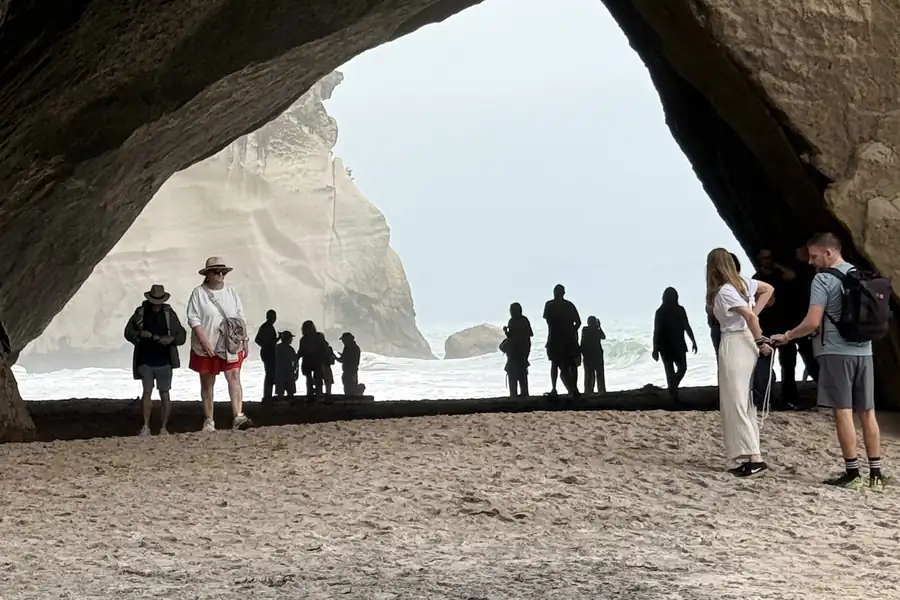
Cathedral Cove (Mautohe)
A sea-carved arch between two white-sand beaches, with Te Hoho rock standing in the shallows. It is the most photographed place on this coast, and it lives up to it. The walk down from Hahei is steep, twenty to thirty minutes for us; give the cove two hours at least. Read the guide →
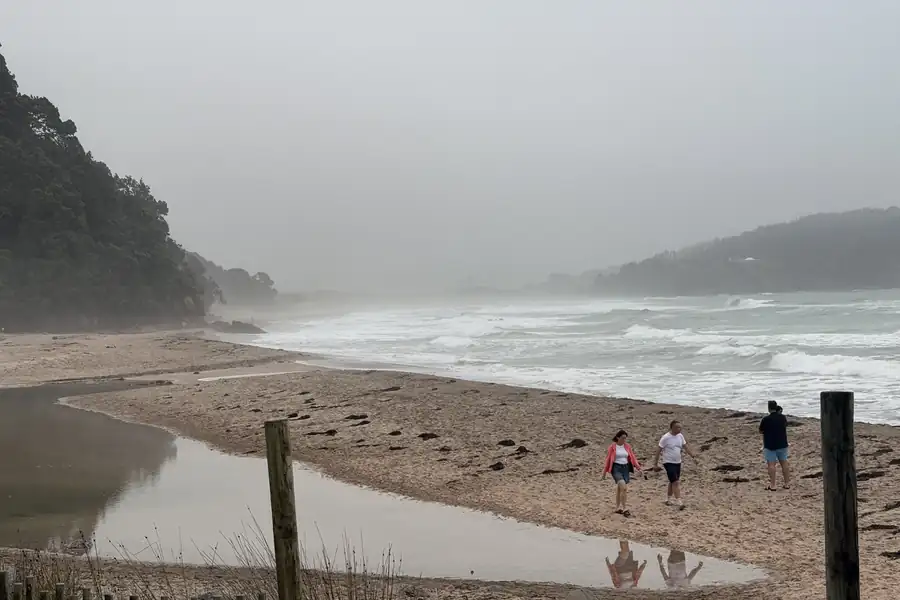
Hot Water Beach
One of the strangest pleasures in New Zealand: dig a hole in the sand of a surf beach and it fills with hot water rising from below. It works for about two hours either side of low tide, so plan by the tide table. We came at high tide and the hot sand was under the sea.
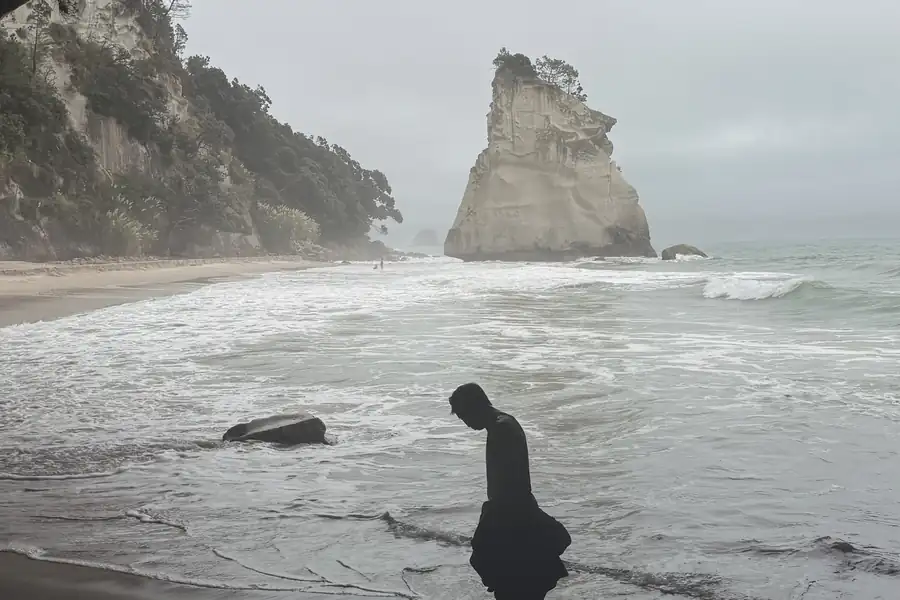
The marine reserve by boat
Te Whanganui-o-Hei has been a marine reserve since 1992, and with no fishing allowed the sea around the cove is clear and full of fish, ringed by caves and rock stacks. See it from the water: a glass-bottom boat leaves Whitianga wharf for about two hours, with snorkelling if you want it, and sea-kayak tours paddle the reserve.
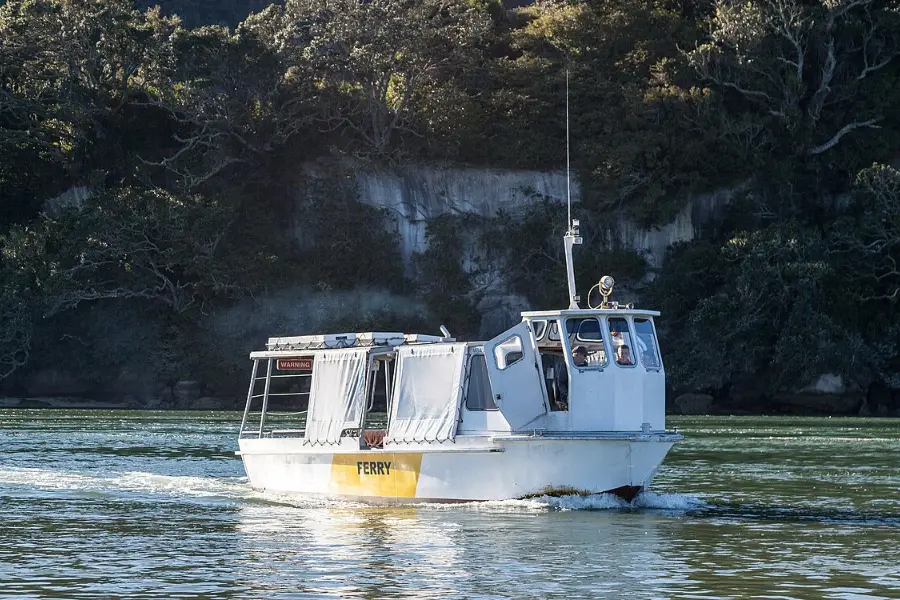
The ferry and Shakespeare Cliff
The little passenger ferry crosses the harbour mouth in minutes, and from Ferry Landing a walk of about two hours return by Maramaratotara Bay climbs to Shakespeare Cliff. From the top the whole of Mercury Bay spreads out below you: the beaches, the islands and the town across the water.
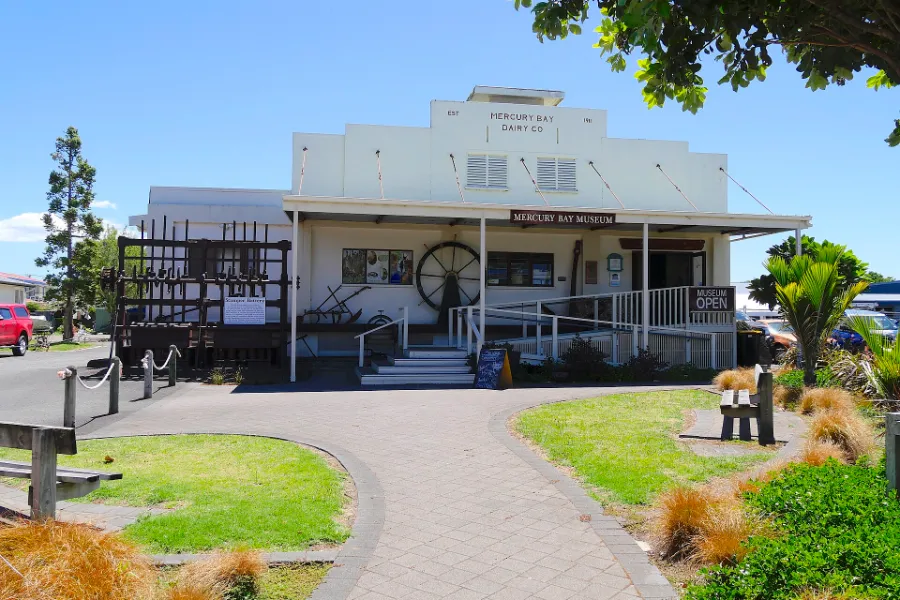
Mercury Bay Museum
The whole story of the bay, told in the old dairy factory opposite the wharf: Ngāti Hei, Cook and the transit of Mercury, the wreck of HMS Buffalo and the kauri years. Open Monday to Saturday.
We have not yet written up Hot Water Beach, the marine reserve, the cliff walk or the museum individually. Their cards carry no link, rather than a link to nothing.
If you have the day, come in by the coast road rather than over the ranges. South of the peninsula it runs so close to the Firth of Thames that the sea is a few metres from the car, grey-green over grey stones. Stop somewhere along it and listen to the stones turning in the wash. Later the road climbs into forested hills, and from the high ground the sea shows again through the trees. By the time you reach Whitianga, you have felt how far the Coromandel is from Auckland, even if the map says otherwise.
Further afield: the Coromandel from Whitianga
Whitianga sits halfway up the peninsula’s east coast, which makes it the best base for the rest of the Coromandel. Its most celebrated places lie around a loop of coast and ranges: a beach you can only walk to, a railway built by a potter, a gravel road over the hills, an island with a lagoon for a heart. Some are an easy half-day out and some make a full day, but three or four nights here will bring most of them within reach.
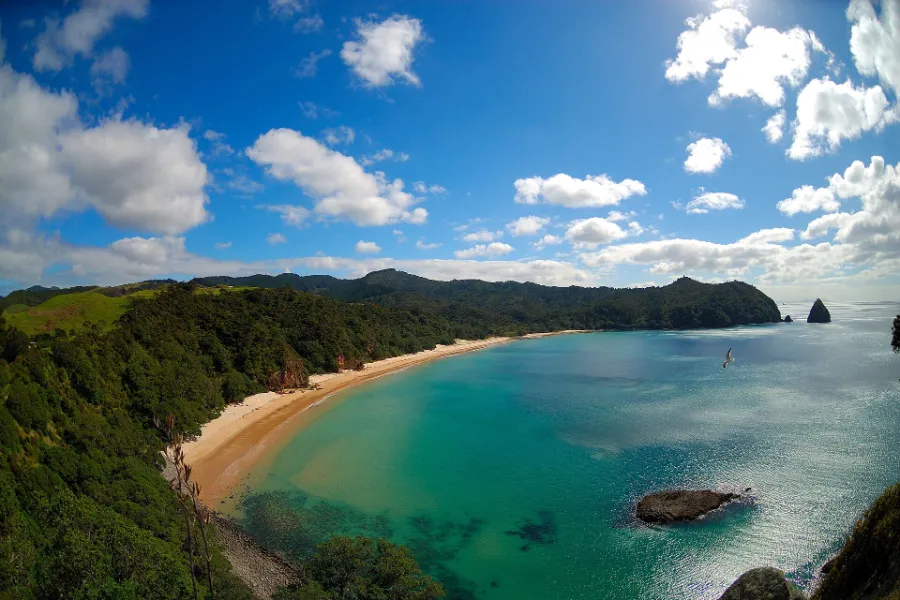
New Chums Beach (Wainuiototo)
Often named among the world’s best beaches, and it looks the part: a long curve of pale sand backed by unbroken bush, with no road and no buildings. You reach it on foot, 30 to 40 minutes over a saddle of nīkau and pōhutukawa from the north end of Whangapoua beach. Whangapoua is about 35 minutes’ drive from Whitianga.
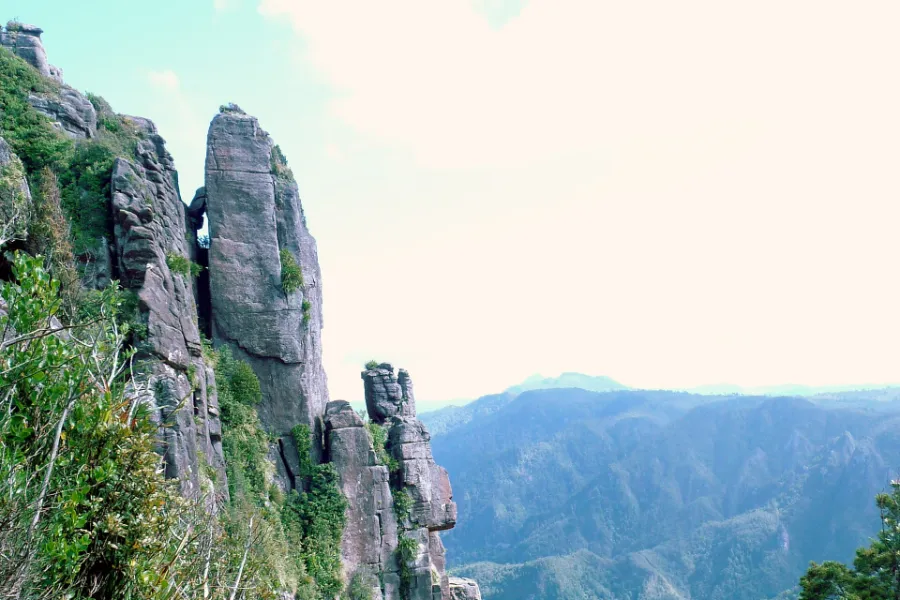
The Pinnacles (Kauaeranga Kauri Trail)
The Coromandel’s great day walk follows an old kauri loggers’ packhorse track up to jagged spires at 759 metres, with the bush, ranges and eastern coast spread out around you. Allow seven to eight hours return; the last climb uses ladders. The road end is up the Kauaeranga Valley near Thames, about two hours’ drive from Whitianga, and DOC’s Pinnacles Hut makes it an overnight.
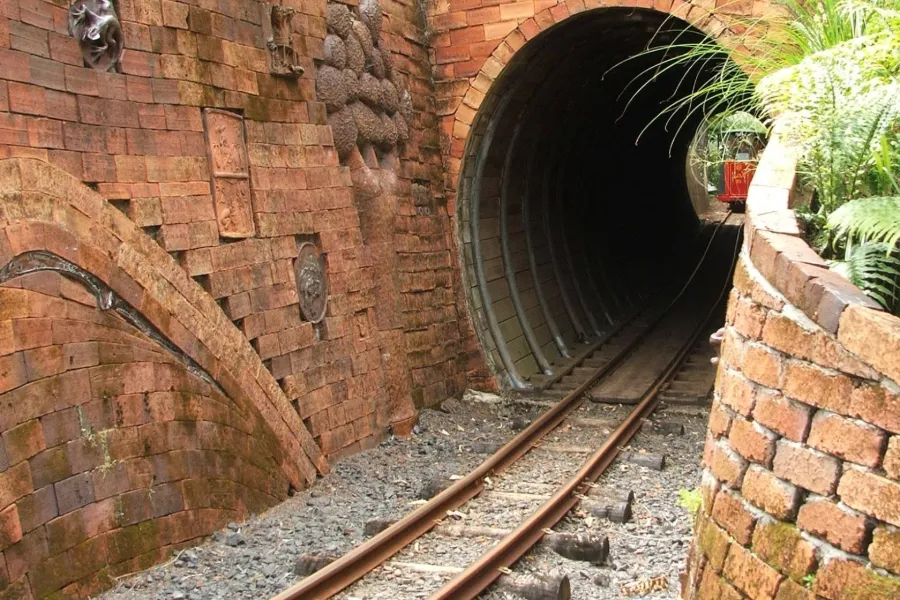
Driving Creek Railway
New Zealand’s only mountain railway, built by hand by the potter Barry Brickell to bring clay down to his kilns. The 75-minute ride climbs through regenerating bush, over ten bridges and through three tunnels, to the EyeFull Tower and a view over the Hauraki Gulf. It is at Coromandel town, about 50 minutes from Whitianga; book ahead in summer.
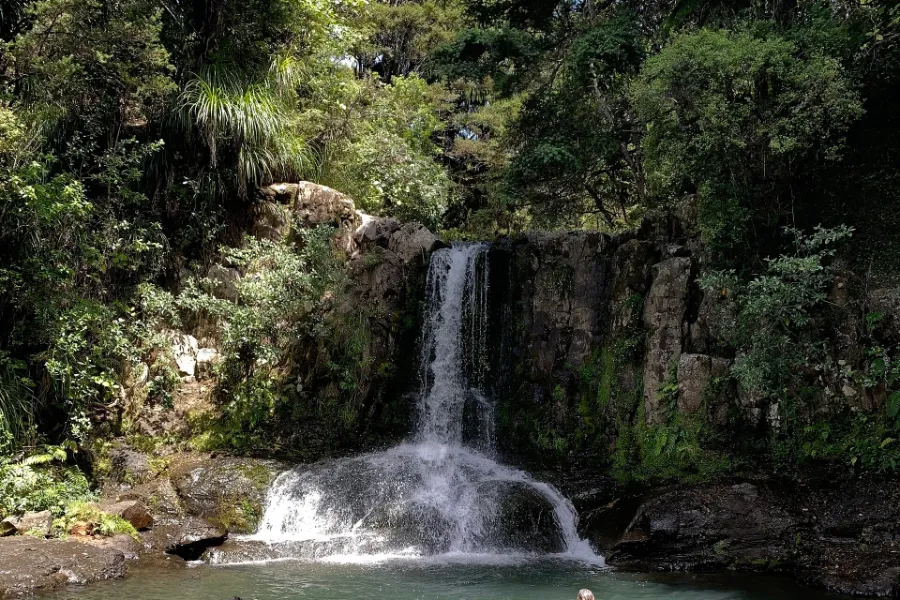
The 309 Road and Waiau Falls
The old road over the ranges to Coromandel town is 22 km of gravel, and the more beautiful way across. Its name may come from 309 bends, or from the 309 minutes the coach once took; nobody is sure. Near its western end an easy half-hour walk reaches Waiau Falls, and a kilometre on, the Kauri Grove, where mature kauri still stand. Drive it in daylight and take it slowly.
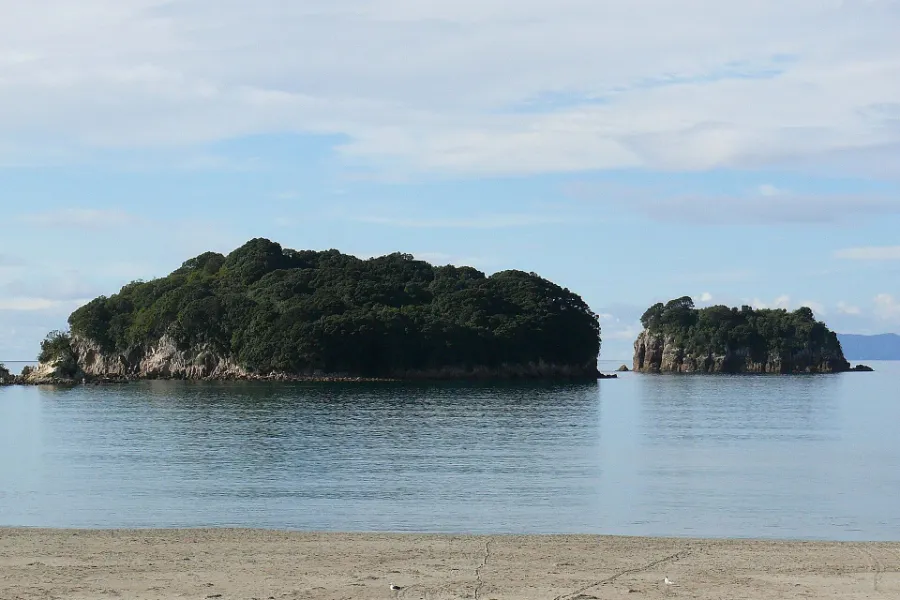
Whenuakura (Donut) Island
Off Whangamatā lies a volcanic island whose heart has collapsed, leaving a turquoise lagoon that you enter through a sea cave. It is a wildlife sanctuary cared for by its iwi guardians, so go with a certified guide by kayak or paddleboard, stay in the water and do not land. Whangamatā is about an hour and a quarter south of Whitianga.
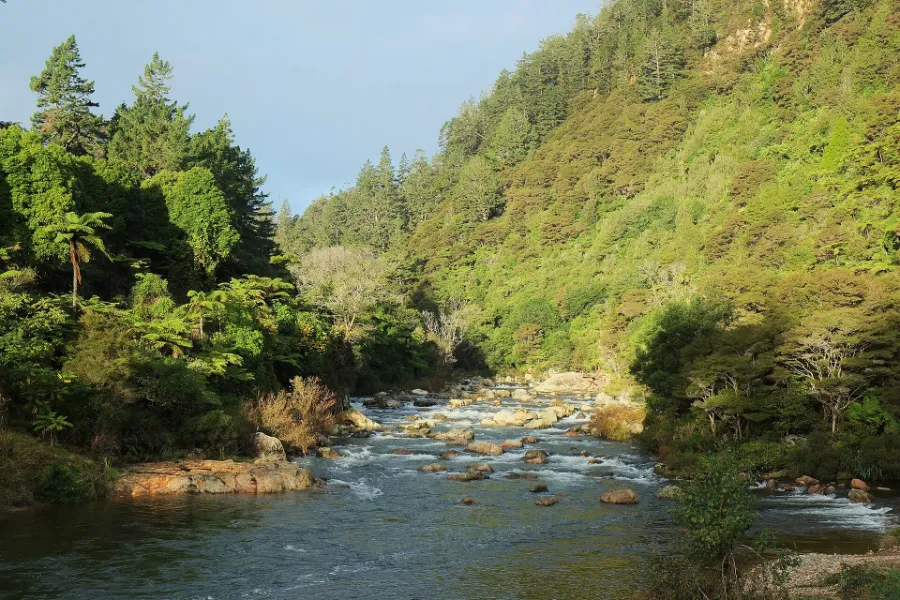
Karangahake Gorge
Just beyond the peninsula, between Paeroa and Waihi, the Ohinemuri River cuts a deep gorge still full of the remains of gold mining. The hour-long Windows Walk crosses suspension bridges and follows old mine tunnels cut into the cliff, with openings onto the river far below; bring a torch. It is about an hour and three-quarters from Whitianga, and a fine stop on the way south to Rotorua.
Drive times from Whitianga are our planning estimates in normal conditions, checked on 29 September 2026. The Coromandel roads are winding and slow, and prone to slips after heavy rain.
Getting there and around
By car is how nearly everyone comes, and how we did. Our itinerary measures Auckland to Whitianga at 191 km. Our advice is not to treat Cathedral Cove as a day trip from Auckland: with a steep walk down to the cove and two hours on the beach, a same-day return does not work. The Coromandel roads are long and very winding, and the drive on to Rotorua is a long one in its own right.
| To or from | Distance | What to expect |
|---|---|---|
| Auckland | 191 km | About 2½ hours direct; most of a day by the coast road |
| Rotorua | 232 km | Long and winding; the next stop on our route |
| Hahei (Cathedral Cove) | About 35 km | About 40 minutes round the harbour |
| Hot Water Beach | About 30 km | About 35 minutes |
Planning estimates in normal conditions. After heavy rain the Coromandel roads are prone to slips and roadworks, which we met ourselves in March 2026; check the NZ Transport Agency’s journey planner before you set off.
Without a car, Go Kiwi runs a daily shuttle between the i-SITE in Albert Street and Auckland city and airport. We found no InterCity coach to Whitianga itself, so check both operators’ timetables before you plan around them. Once you are here, the town is walkable and the ferry does the rest. We found no public transport to Cathedral Cove or Hot Water Beach, so without a car, ask the i-SITE about tours before you come.
When to go and practical notes
Summer, from December to March, is when the sea is warm enough to enjoy and the beaches are at their best. It is also when the town fills, above all over the Christmas holidays, and Cathedral Cove runs a park-and-ride shuttle from Hahei because the village cannot take the cars. Spring and autumn are quieter and still mild.
In any season, two things decide your day, and neither is the clock: the tide at Hot Water Beach and the weather at Cathedral Cove. Look both up the evening before.
Cathedral Cove is the finest walk on the coast, and it has been hard won: the track was closed from 2023 to December 2024 after Cyclone Gabrielle, and again after storms until the end of January 2026. DOC closes it, and the shuttles, whenever a severe weather warning covers Hahei. At Hot Water Beach there is a strong rip around the rocks, and the spring water can be hot enough to scald. Swim only between the flags.
Where to stay and eat
Stay in the town or on Buffalo Beach. You can walk to dinner and to the ferry, Cathedral Cove and Hot Water Beach are a short drive in the morning, and the roads north and south start at your door. Choose Hahei only if you want the cove at first light. There are no separate stay and eat pages for Whitianga, so our choices are here, researched on 29 September 2026. Confirm hours and availability yourself before you rely on them.
Mercury Bay Holiday Park, 121 Albert Street, has cabins, kitchen units, motel units and campsites, about 600 metres from the centre. No pets.
Baileys at the Beach Motel, 66 Buffalo Beach Road, is a motel across the road from the sand, with kayaks to borrow. The walk into town takes twenty to thirty minutes.
On the Point, on South Highway East in the Waterways, is a single self-contained studio with breakfast, for a quieter, more private night. With only one room, book early.
We stayed at Ocean View B&B, 8 Landel Place, in March 2026. It is still listed on booking sites, but we could not confirm that it is taking guests, so check before you rely on it.
Where to eat
Most places to eat are in the town centre and along the Esplanade by the wharf. On our night we had fish and chips as a takeaway, and we do not remember the shop.
Harbour House Cafe, 11 Esplanade, is in a villa by the wharf and serves breakfast and lunch. It closes in the afternoon; we could not confirm this season’s hours.
Snapper Jacks, 26 Albert Street, is the fish-and-chip shop, with paua and mussel fritters too. It has no website of its own, so its listed hours are unconfirmed.
Basker, 3 Reweti Drive in the Waterways, is on the water, with shared plates and seafood, and takes bookings online. On Mondays and Tuesdays it closes at 3pm, so there is no dinner those nights.
A final word on Whitianga
The Coromandel rewards the people who stay. Day-trippers see the arch at Cathedral Cove. Stay in Whitianga and you also have the hot sand at low tide, the bay from a boat, the empty curve of New Chums and the gravel road over the ranges. Come the long way round by the coast, eat your fish and chips by the water, and give the peninsula the days it deserves.
Andrew + Margaret
- Visiting New Zealand Overview
- Cathedral Cove Highlight
- The North Island in two weeks Journeys
- A North Island road trip Journeys
- Rotorua Overview
- Getting around New Zealand Practical
- Department of Conservation — Cathedral Cove and Hahei updates Safety
- The Coromandel — Whitianga Official
- Whitianga Ferry — times and fares Practical
- Mercury Bay Museum Official
- Glass Bottom Boat Whitianga Booking
- Department of Conservation — Kauaeranga Kauri Trail (the Pinnacles) Safety
- Driving Creek Railway Booking
- James Cook and Joseph Banks, the Endeavour journals (1769), at Mercury Bay Reading
Can I do Cathedral Cove as a day trip from Auckland?
Not well. It took us two days: a day to drive to Whitianga, and the next morning for the cove. The walk down is steep and the cove deserves two hours, so a same-day return means most of the day in the car.
Can I see the rest of the Coromandel from Whitianga?
Yes, and it is the best base for it. New Chums Beach, Coromandel town and the 309 Road are within an hour; Whangamatā and Donut Island are about an hour and a quarter south; the Pinnacles and the Karangahake Gorge are nearer two hours. Three or four nights gives you time for most of them.
Should I stay in Whitianga or Hahei?
Whitianga, for most people: it has the restaurants, the ferry and a choice of beds, and the cove is about forty minutes away. Hahei is closer to the cove, but smaller; we did not stay there, so check what is open in the evening.