Art Deco Napier
The town one morning in 1931 destroyed, rebuilt in two years in the style of its moment, and still standing together
Napier’s Art Deco Trust calls the town the Art Deco capital of the southern hemisphere, and the claim is a fair one. On the morning of 3 February 1931 an earthquake and the fires that followed destroyed the centre of the town. Within about two years it had been rebuilt, almost all at once, by a handful of local architects working in the styles of the day. What you walk through now is street after street of shops, banks and offices carrying sunbursts, zigzags and stepped parapets, and a story that explains every one of them.
What Art Deco is. Art Deco is the decorative style of the years between the two world wars. It takes its name from the great exhibition of decorative arts held in Paris in 1925, though nobody called it that at the time: to its makers it was simply modern, and the label stuck only after the historian Bevis Hillier's book of 1968. Its language is geometry: clean shapes and stylised ornament, the sunburst, the chevron, the zigzag, the stepped outline of a ziggurat, the parallel lines that suggest speed. It was the style of the cinema, the ocean liner and the skyscraper, and it still reads as confidence: a machine age that believed in itself.
How Napier compares. The world's famous Art Deco places are bigger and grander. New York has the Chrysler Building of 1930, its steel spire patterned with sunbursts. Miami Beach has some 800 buildings in a historic district listed in 1979, the first twentieth-century urban district in the United States to be recognised that way. Mumbai's Art Deco apartment blocks around the Oval Maidan are part of a World Heritage Site inscribed in 2018. Napier cannot match any of them for scale. What it has instead is unity: a whole town centre rebuilt in one short burst, at one modest height, by one generation of architects.
And it has something you will not find in Miami or Mumbai: Māori pattern worked into the ornament. Napier's is a provincial Art Deco, made quickly and on little money by people who had just lost their town, and that is its interest. Nowhere else shows so clearly how a whole community took up the modern style of its day at a single stroke.
What to know before you go. These are small, low-rise buildings, many of them plain concrete boxes, with the decoration saved for the parapets and doorways. At street level, shop fit-outs of recent decades have, in the Department of Conservation's words, “seriously eroded” the experience, and several important buildings have been lost. The pastel colours visitors expect are a careful restoration begun in the 1980s, not the paint of 1931. When Napier's case for World Heritage status was assessed in 2011, the finding was that its value is high locally and nationally, but not exceptional enough internationally. None of this spoils a morning's walk. It tells you where to look: up.
How this page was madeWe have not yet been to Napier. This page is researched, from the Art Deco Trust, Heritage New Zealand, the Department of Conservation, NZHistory, the museum and the official visitor sites, and we will say so here when we go.
Last updated 28 September 2026
Why it matters
The earthquake struck at 10.47am on 3 February 1931. At magnitude 7.8 it remains New Zealand's deadliest: 256 people died across Hawke's Bay, 161 of them in Napier. Brick buildings fell into the streets, and fire broke out in the business district. Once the reservoir had emptied, the firefighters were powerless, and almost eleven blocks of central Napier burned. The land itself rose by 2.7 metres, draining much of the Ahuriri Lagoon; that new ground now holds farms, housing and Napier's airport.
The rebuilding was fast because it had to be. The reinforced concrete buildings had stood where the brick ones fell, so the new town was built in what its engineers called ferro-concrete. The streets were widened, power lines went underground and the heavy parapets that had crashed into the streets were dropped. When the new business district opened, about two years after the earthquake, 108 shops were finished and 43 more were under way. By January 1933 Napier could call itself “the newest city on the globe”.
The style came with the moment. Money was short, and Art Deco suited a plain concrete box: ornament could be cast into the parapet and the doorway and left off everything else. A small group of local practices did most of the work, among them J. Louis Hay, Natusch and Sons, Finch and Westerholm, E. A. Williams and J. T. Watson. Not all of it is Art Deco. There is Stripped Classical, Spanish Mission and, in Hay's buildings, the influence of Frank Lloyd Wright and Louis Sullivan. What unifies the town is the moment it was built in, not a single rulebook.
The Māori thread
Napier's architects also reached for patterns from home. The bank at 100 Hastings Street, built for the Bank of New Zealand in 1932 and now the ASB, carries kōwhaiwhai, the painted scroll patterns of the Māori meeting house, in red, black and white, and Hawke's Bay Tourism points to Māori carving designs worked into its entrance. Art Deco everywhere borrowed from far away, from ancient Egypt and Mexico; here it borrowed from the ground it stood on.
Why it survived
It nearly did not. In the 1970s and 1980s, when Art Deco was out of fashion, more than a dozen significant buildings were demolished or badly altered. A group of residents formed the Art Deco Group in 1985, and in 1987 it became the Art Deco Trust, which now runs the guided walks with volunteer guides. From the mid-1980s the Trust and the council brought colour back to the facades. The palette of the 1930s had been muted, pink, buff and biscuit tinted into the cement, with stronger accents. By the 1980s most of it had been painted over, so today's colours come from research rather than surviving paint.
What it's like
Art Deco Napier is a walk, not a building. The centre is a compact grid of streets, flat and easily covered on foot, and the style is everywhere at once rather than concentrated in one showpiece. The first thing to understand is the height at which it lives. At street level Napier is an ordinary provincial town, with shopfronts, chain signs and verandahs over the pavement. The Art Deco starts above the verandah: in the parapets, the lettering, the cast-concrete panels and the lead-light windows. Walk with your eyes a storey up and the town changes.
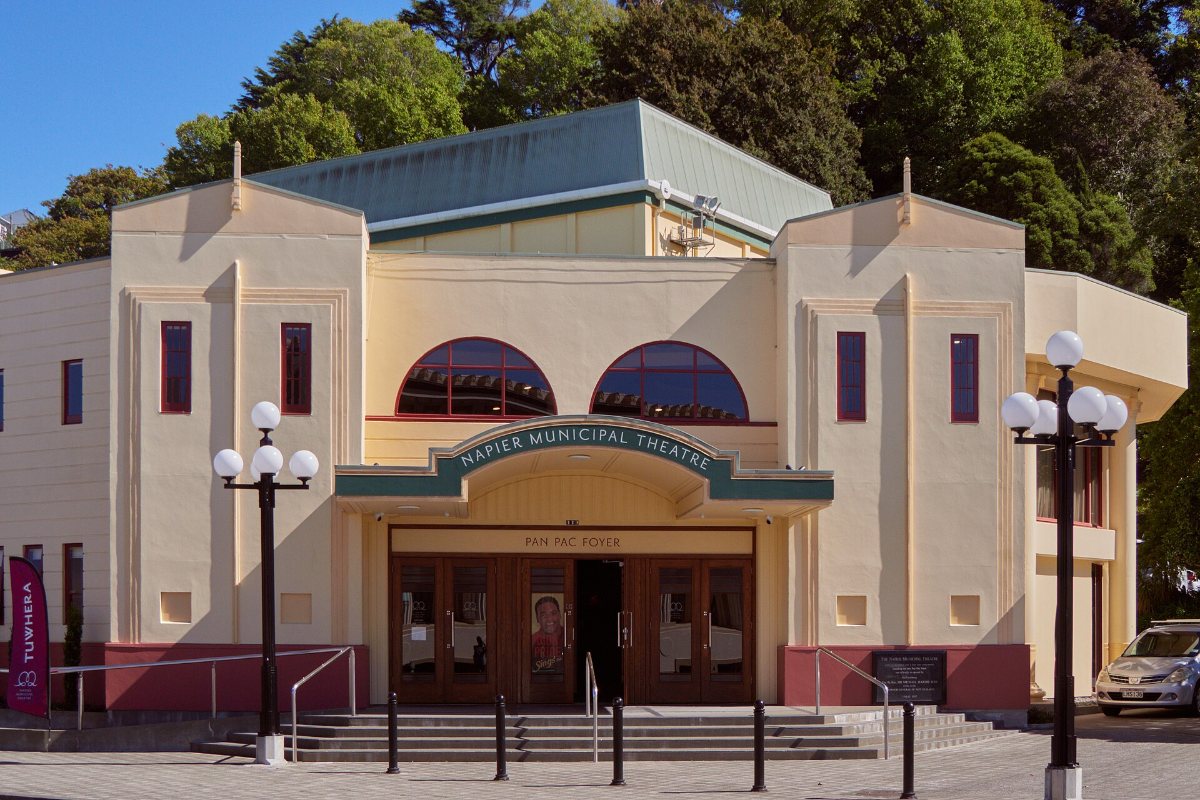
Tennyson Street holds two of the best. The Daily Telegraph Building at number 49, designed by E. A. Williams and finished in 1933, is the best known, its roofline stepped up to a ziggurat top. When it was ready, the newspaper moved its presses in a single weekend and printed there on the Monday. Further along, at number 119, the Municipal Theatre of 1938 by J. T. Watson keeps its Deco interior, with a curved walnut ticket box and plaster figures; you see it properly by going to a show.
Along Hastings and Emerson Streets the buildings are at their most concentrated: the old Bank of New Zealand with its kōwhaiwhai patterns and, around the corner in Market Street, E. A. Williams' Criterion Hotel of 1932. At the sea end of Emerson Street, the T&G Building of 1936 turns the corner onto Marine Parade with a curved front and a clock tower. Across the road the Sound Shell, built in 1934, and the colonnade finished a year later were designed to be seen through, so that the sea stayed in view.
Look out, too, for the styles that are not Art Deco. After an earthquake at Santa Barbara in California in 1925, that town rebuilt in Spanish Mission, and Hawke's Bay followed its example: rough white plaster, arched openings and tiled roofs among the zigzags. Louis Hay went another way, to the flat roofs, deep eaves and long horizontal lines of Frank Lloyd Wright's Prairie houses; the Art Deco Centre itself is his. Part of the pleasure of the walk is learning to tell them apart.
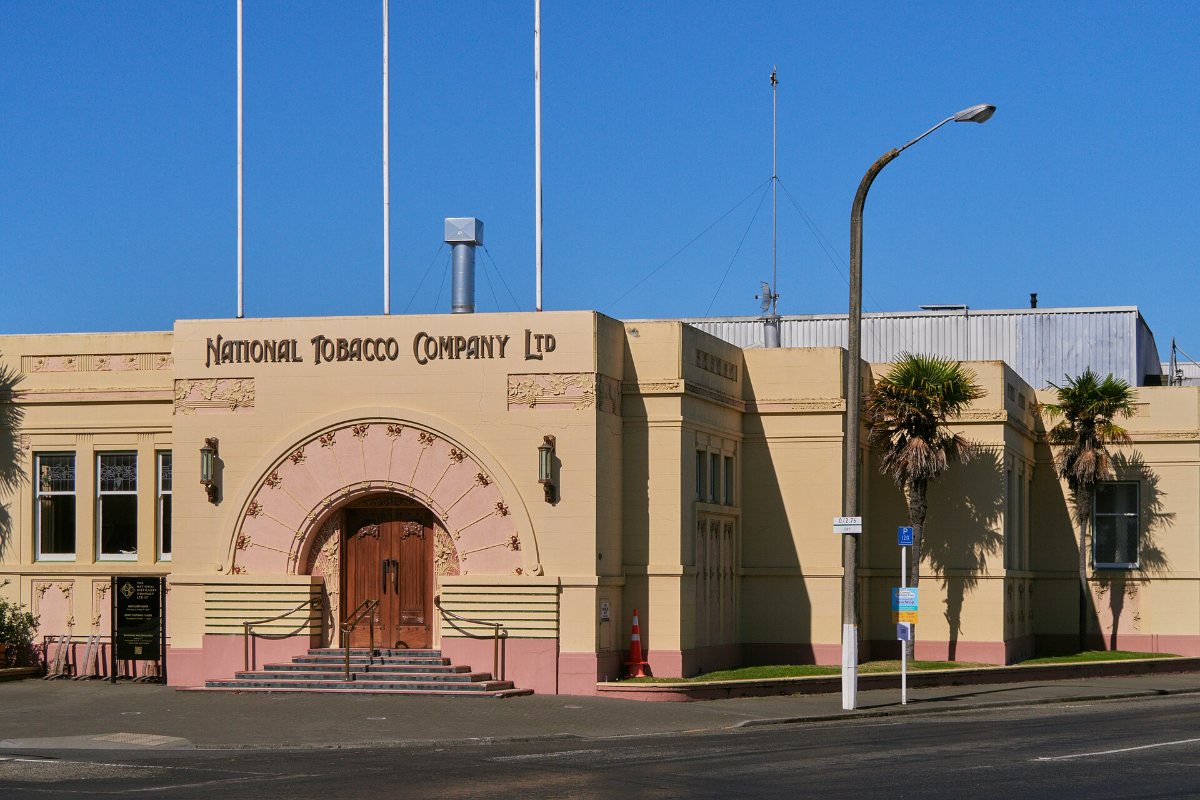
The most lavish of the post-earthquake buildings, in NZ Geographic's judgement, is not in the centre. The National Tobacco Company building at 1 Ossian Street, Ahuriri, on the far side of Bluff Hill, has an entrance designed by Louis Hay in 1933, framed by concrete reliefs of raupō, the swamp reed, and roses, with sunburst panels in the doors. Inside are marble panelling, mosaic tiles and a domed lead-light skylight. Heritage New Zealand says the entrance is open to the public in working hours, but the building is in private hands with businesses inside, so treat that as something to confirm when you are there.
What writers and artists have made of it
The poet Lauris Edmond grew up at Greenmeadows, just outside Napier. She was six, and at primary school, when the earthquake struck, and she made that morning the opening of Hot October, the first volume of her autobiography, published in 1989. It is worth carrying with you as you walk. The Deco town is easily read as a style, all confidence and sunbursts. Edmond's book is a reminder that the morning behind it was lived through by children like her, and that the people who rebuilt these streets had known them before.
Come to Memorial Square a little before 10.47 in the morning and stand by the Art Deco Centre. This building opened in 1926 and came through the earthquake; the town traded from temporary shops around it while the rest was rebuilt. At 10.47 on 3 February 1931 the ground under your feet moved. Put a hand flat on the wall and feel whether the morning has warmed it yet. Then close your eyes and listen: traffic, voices, a shop door. Nearly everything you can hear is happening in buildings raised after that minute.
How to visit
The Art Deco Centre is open every day, 9am to 5pm from 1 October to 31 March and 9.30am to 2.30pm from 1 April to 30 September. The 2pm walk, the fullest of the guided walks, runs 2 hours 30 in summer and 1 hour 30 in winter. Check the Trust's booking page for which walks run on your day.
Getting there
Napier is on the east coast of the North Island. Hawke's Bay Airport, which Air New Zealand calls Napier/Hastings, is about ten minutes by road from the centre. By car, Napier is about two hours from Taupō and about four from Wellington, and InterCity coaches run from both. Once you are in town you need nothing but your feet: the Art Deco Centre is in Memorial Square, at 5 Clive Square East, within walking distance of the hotels and motels of the centre, and the main streets are all a short walk from it.
The Art Deco Centre is at 5 Clive Square East, in Memorial Square on the inland side of the town centre. From there Tennyson Street runs towards the sea and Marine Parade, with the Municipal Theatre and the Daily Telegraph Building along it and the museum at its far end. Emerson Street, the main shopping street, runs parallel to it, and Hastings Street crosses both. Ahuriri is on the far side of Bluff Hill, a short drive or bike ride from the centre.
Ways to see it
Every guided walk starts at the Art Deco Centre with a short introductory film, and the guides speak through wireless headsets, so you can hear them from across a crowded pavement. The vintage cars take up to four people and must be booked at least 24 hours ahead.
| Way | How long | From | Best for |
|---|---|---|---|
| 10am guided walk | 1 h 30 | $33 | A morning start before the day warms up |
| 2pm guided walk | 2 h 30; 1 h 30 in winter | $35.50 | The fullest walk, including some interiors |
| 4.30pm guided walk | 2 h | $34.50 | Fitting the walk around a day elsewhere; check it runs from April to September |
| Self-guided download | About 1 h 30 | $10 | Going at your own pace, at any hour |
| Vintage car tour | 1 h or 1 h 30 | $270 a car | Seeing more in less time, or anyone who finds walking hard |
Prices in New Zealand dollars from the Art Deco Trust, read 28 September 2026. The vintage car price is for the car, for up to four people; the longer tour is from $330. The Trust also runs vintage car tours to the wineries, at $270 an hour.
The museum
Hawke's Bay Museum, formerly MTG Hawke's Bay, stands at 1 Tennyson Street, where it meets Marine Parade. Its exhibition Shockwave: Hawke's Bay's Great Quake, 1931 tells the story of the earthquake through the people who lived it, and entry to the exhibitions is free. It is open every day, 9.30am to 5pm.
From a cruise ship
Napier is a regular cruise port, and the Art Deco walk is the obvious way to spend a day ashore. The port is a working one with no pedestrian access, so passengers take the port shuttle, which drops them at the i-SITE on Marine Parade, about a kilometre away, in the middle of the town. From there the Art Deco Centre is a short walk up Tennyson Street. Book your walk before you sail, and choose one that leaves you time to get back to the shuttle; the Trust lists its walk times, and your ship lists the last shuttle.
Time, food and facilities
Allow the length of the walk plus an hour to look again on your own, and half a day if you add the museum. This is a town walk, so cafés, shops and places to sit are never far away, and there is no need to carry supplies. The Art Deco Centre and the i-SITE on Marine Parade both have staff who can answer questions, and the Centre has a shop.
Access
The two official sources describe the walk differently. The Art Deco Trust says its routes are flat, with wheelchair access. The Napier i-SITE says the walk covers about two kilometres over flat ground, with some steps. If steps matter to you, ask the Trust when you book which parts of the route they affect; the vintage car tours are the alternative for anyone who cannot walk that far.
The Art Deco Festival
Every February Napier dresses up. The Art Deco Festival fills the town with vintage cars, period costume and music; in its thirtieth year, 2018, it drew an estimated 45,000 people.
The 2027 festival runs from 18 to 21 February, and the 2028 festival from 17 to 20 February. Many events are ticketed, and costume can be hired from the Art Deco Centre. We could not find an official figure for how far ahead the town's beds fill, so book as soon as you have your dates. A smaller Winter Deco runs in July, with evening events, film and architecture tours; check the festival site for its 2027 dates.
Making the most of it
Take the walk first, then go back alone
A guide shows you what to look for; after that, the town is yours. Take the morning walk, then spend an hour retracing it on your own, stopping where you want to. The details repay slow looking: the lettering over a doorway, the lead-light in a transom, the way one parapet answers the next.
Start at the museum
Half an hour in Shockwave before the walk changes the walk. You go out into the streets knowing what stood there before 10.47, and what happened to the people in them. The museum is free, and a short walk down Tennyson Street from the Art Deco Centre.
Look up, and cross the road
From your own side of the street you see the verandahs and the shop signs. From across the road you see the building. The best views of the Daily Telegraph Building and the T&G Building are from the opposite pavement, and the colonnade on Marine Parade was built to be looked through: stand inside it and face the sea, as its designers intended.
Give Ahuriri its own hour
The National Tobacco Company building is worth the trip around Bluff Hill on its own, and Ahuriri, the old port, has cafés and bars along the waterfront. Go by bike on the Hawke’s Bay Trails, or drive, and make it lunch; our guide to eating in Napier covers the options there.
If it rains
The buildings are outdoors, but the story is not. On a wet day, start with the film at the Art Deco Centre, spend longer in the museum's earthquake exhibition, and see whether there is a show at the Municipal Theatre that evening; its interior is one of the finest Art Deco rooms in the town.
Decide whether you want the festival
The festival is Napier at its most theatrical, with the whole town in costume, and for many people it is the reason to come. It is also the busiest week of the year. If you want to study the buildings in peace, come another month; if you want the party, come in February and book early.
Nearby
Everything else Napier holds is on our Napier guide, and our guides to where to stay and where to eat will help you plan the nights.
Climb Bluff Hill, just north of the centre, for the view over the port and the bay: from the lookout you look down on the port and see how compact the town below it is. Hastings, a short drive south, was rebuilt after the same earthquake in Spanish Mission and Art Deco, and its clock tower of 1935 carries chimes saved from the post office tower that fell.
Between the two towns lies Hawke's Bay wine country, New Zealand's oldest wine region and, since 2023, one of the twelve Great Wine Capitals of the world. It is the natural other half of a stay in Napier, and the Art Deco Trust's vintage cars will take you there in style. Taupō is about two hours inland, and the natural stop on the way from the centre of the North Island; start with our Taupō guide.
A final word on Art Deco Napier
Napier is not the grandest Art Deco town in the world, and it does not need to be. It is the most complete story: a town that lost its centre in a morning and built a new one in two years, in the style of its moment, with its own country's patterns in the ornament. Take the walk, look above the verandahs, and let the buildings tell it.
Andrew + Margaret
- Napier Overview
- Where to stay in Napier Decide
- Where to eat in Napier Practical
- Hawke’s Bay wine country Highlight
- Taupō Overview
- Getting around New Zealand Practical
- Art Deco Trust — walks, vintage cars and the Art Deco Centre Booking
- Art Deco Festival Napier Official
- Napier i-SITE — Art Deco guided tours Booking
- Hawke’s Bay Museum Official
- NZHistory — the Hawke’s Bay earthquake Official
- Department of Conservation — Napier and World Heritage (2011) Official
- Lauris Edmond, Hot October (1989) Reading
- Janine McVeagh, Earthquake: The Diary of Katie Bourke, Napier 1930–31 (2004) Reading
- Peter Shaw, Art Deco Napier: Styles of the Thirties Reading
Why is Napier Art Deco?
Because an earthquake on 3 February 1931 and the fires after it destroyed the town centre, and it was rebuilt in about two years, when Art Deco was the modern style. The speed of the rebuild is why so much of it matches.
How long does the Art Deco walk take?
The Art Deco Trust's guided walks take 1 hour 30 to 2 hours 30, depending on the walk and the season, and the self-guided walk about 1 hour 30. Allow half a day if you add the museum.
When is the Napier Art Deco Festival?
The 2027 festival runs from 18 to 21 February, and the 2028 festival from 17 to 20 February. A smaller Winter Deco is held in July.