Where to Eat in Melbourne
Coffee, dumplings and a city built by its migrants.
Melbourne eats by community: Chinese in Chinatown and Box Hill, Italian on Lygon Street, Greek on Lonsdale Street, Vietnamese in Richmond and Footscray. Start with a morning at the Queen Victoria Market and soup dumplings in Chinatown, both of which we would put first for any visitor. Then give an evening to a tram or train ride out, where the cooking is for locals and the prices drop.
Areas, places and prices reviewed 24 September 2026.
First, how Melbourne eats
Melbourne's food follows its migrations. Chinese miners arrived in the gold rush of the 1850s and settled on Little Bourke Street. After the Second World War, Italian and Greek families changed what the city drank and ate, and gave it its espresso habit. From the late 1970s Vietnamese refugees settled in Richmond, Footscray and Springvale, and East African, Indian and newer Chinese communities followed.
The result is a city where each food has an address. Beyond the six areas below, Oakleigh is known for Greek food, Springvale for Vietnamese, and Sydney Road in Brunswick for Middle Eastern bakeries and grills. South Melbourne Market is the place for dim sims.
Melbourne's other food culture is the café. The laneway espresso bar, with a counter, a few stools and a queue out of the door, is the city's signature, and a morning here starts with a flat white rather than a hotel buffet.
Go to the Queen Victoria Market early on a market day, before the crowds, and walk the meat and fish hall first. Listen to the traders calling their prices, and watch who buys what. Then step out into the open sheds, where the fruit is stacked under the long roofs, and notice how many languages you hear before you reach the far end.
Two things are less visible than they should be. Aboriginal food knowledge, the oldest cuisine on this land, appears mostly as native ingredients on restaurant menus: wattleseed, finger lime, saltbush. We could not document a place where it is served as its own tradition, and we would rather say so than invent one. And fine dining exists here, but it is not why Melbourne is worth eating in.
What to eat in Melbourne
Eight dishes and ways of eating that tell you something about the city. One was invented here; the rest became Melbourne's by being cooked well for a long time.
Melbourne treats coffee as a civic matter. The lanes off Flinders and Collins Streets, Degraves Street and Centre Place among them, are lined with small cafés. Order a flat white and drink it standing at the counter, as locals do.
Xiao long bao: thin-skinned dumplings holding pork and a mouthful of hot broth. We ate them in Chinatown, and they were very good. Bite a small hole, sip the soup, then eat the rest with vinegar and ginger.
Melbourne’s own invention. In the 1940s a Chinatown restaurateur, William Wing Young, adapted Cantonese siu mai into the larger, sturdier dim sim. Eat one steamed or fried, from a market stall or a fish-and-chip shop.
Vietnamese families who arrived from the late 1970s built Victoria Street in Richmond, then Footscray and Springvale. Beef pho for breakfast or lunch and a pork roll to take away, both cheaper than almost anything in the city centre.
Italian migrants brought the espresso machine to post-war Melbourne, and one Bourke Street espresso bar has poured coffee since 1954. Lygon Street in Carlton is the Italian strip, for pasta, cannoli and a gelato after dinner.
Melbourne has the largest Greek-speaking population outside Greece and Cyprus. Eat souvlaki and grilled octopus in the Greek precinct on Lonsdale Street in the city, or at the cafés of Eaton Mall in Oakleigh.
Footscray is the centre of Melbourne’s East African community. Stews come on injera, a spongy, sour flatbread made from teff, and you eat with your hands, tearing off pieces to scoop them up. Order a platter to share.
The Queen Victoria Market has traded since 1878. Start with a hot jam doughnut from the van that has sold them there since 1950, then graze the deli hall. The market is closed on Mondays and Wednesdays.
Where to eat: the most useful neighbourhoods
| Area | Best for | Best time | Main catch |
|---|---|---|---|
| CBD, Chinatown & the market | A first day | Market mornings; any evening | Market closed Mon and Wed |
| Carlton & Fitzroy | Coffee and pasta | Afternoons and evenings | Lygon Street varies a lot |
| Richmond | Cheap Vietnamese | Lunch, any day | Plain rooms that fill at lunch |
| Footscray | A food walk | Daytime, any day | A train ride from the city |
| Box Hill | Regional Chinese | Lunch or dinner | Half an hour out by train |
| St Kilda | Something sweet | Afternoons | Crowded on summer weekends |
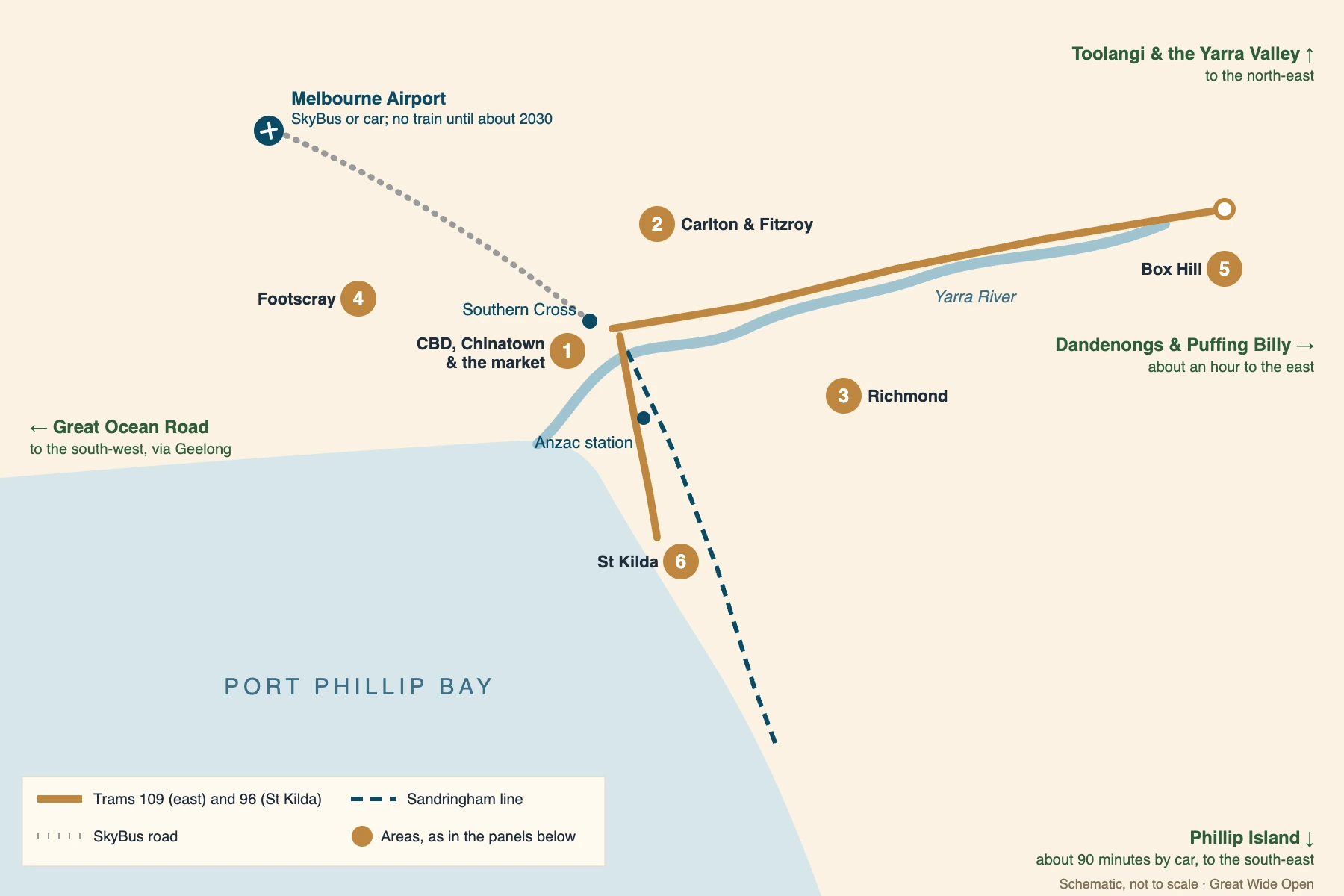
Three areas are in or next to the centre: the CBD, Chinatown and the market on foot or by free tram, and Carlton and Fitzroy and Richmond a short tram ride out. Three are journeys. Footscray is a short train ride west, St Kilda about half an hour south by tram, and Box Hill about half an hour east by train.
CBD, Chinatown & the market — the easy first day
$10–60The city grid holds three of Melbourne’s food traditions within a walk of each other: Chinatown on Little Bourke Street, which dates from the gold rush of the 1850s; the Greek precinct on Lonsdale Street; and the laneway cafés. The Queen Victoria Market is at the north-west corner, and the free trams link them all.
Eat here for: Soup dumplings in Chinatown, laneway coffee, a market breakfast, souvlaki on Lonsdale Street.
Carlton & Fitzroy — Italian cafés and more
$15–60Lygon Street in Carlton was the heart of post-war Italian Melbourne, and it still has the espresso bars, pastry shops and gelato counters to show for it. Fitzroy, just to the east, is newer and looser: Brunswick, Johnston and Smith Streets have Spanish tapas, vegetarian cafés and bars. Both are a short tram ride from the city.
Eat here for: Espresso and cannoli, a plate of pasta, gelato after dinner, tapas on Johnston Street.
What to look for: We could not document the opening year of a Lygon Street café to our standard, so we name none. Walk the length of the street and choose a place whose tables are full of regulars rather than visitors.
Richmond — Victoria Street pho
$12–35Victoria Street, a few minutes from the city on the 109 tram, is Melbourne’s original Little Saigon, settled by Vietnamese families from the late 1970s. Its pho kitchens, grocers and bakeries run for several blocks. Swan Street, on the far side of Richmond, has Greek tavernas from an older migration.
Eat here for: Beef pho, broken rice with grilled pork, a bánh mì to take away.
What to look for: Victoria Street’s restaurants change hands often, and none we checked could show its opening year, so we name none. Choose a room busy with Vietnamese families at lunchtime and order the house special pho.
Footscray — Vietnamese and Ethiopian
$12–35Footscray, in the inner west, is where many newer arrivals start out, and it cooks for them. Hopkins and Barkly Streets and the Footscray Market have Vietnamese kitchens and grocers, and the city’s densest run of Ethiopian and East African restaurants. It is the least touristy area on this page and among the cheapest, a short train ride west of the city.
Eat here for: Pho and bánh mì, an Ethiopian platter on injera, a wander through the market.
What to look for: We could not confirm an opening year for the restaurants we checked here, so we name none. For Ethiopian food, look for a room where platters are shared and eaten by hand.
Box Hill — Chinese beyond Chinatown
$12–40We stayed in Box Hill, and we think its Chinese food is as good as anything in the city. It is a busy eastern centre with a large Chinese community, and its restaurants, food courts and bakeries cook for them: regional Chinese food, at lower prices than the centre. The train takes about half an hour from the city, and the 109 tram runs all the way.
Eat here for: Regional Chinese dishes, dumplings and noodles, a food-court lunch, a Chinese bakery.
What to look for: Box Hill’s restaurants turn over quickly, and none we checked could show five years under one name, so we name none. Start around the station and the shopping centre above it, and follow the queues.
St Kilda — cakes by the bay
$8–50Acland Street’s cake shops were opened by European migrants from the 1930s, and their windows of cheesecakes, kugelhopf and vanilla slices are still St Kilda’s signature. The foreshore adds fish and chips on the sand. It is about half an hour from the city by tram, and it pairs well with a sunset walk to the pier.
Eat here for: A slice of cake and a coffee, fish and chips on the foreshore.
How much does it cost to eat in Melbourne?
| Meal or occasion | Typical spend | What that buys |
|---|---|---|
| A café coffee (flat white) | $5–7 | One cup, at the counter or to take away |
| A dim sim from a market stall | $2–4 | Each; steamed or fried |
| A bánh mì | $9–14 | A filled roll; a quick lunch |
| A bowl of pho | $16–24 | Breakfast or lunch, with herbs |
| A basket of soup dumplings | $14–22 | Eight or so, with a side dish |
| A food-court lunch | $15–25 | One dish and a drink, Chinatown or Box Hill |
| Dinner at a mid-range restaurant | $60–100 | Two courses and a glass of wine |
| A tasting menu | $150–300+ | A special-occasion dinner, before drinks |
Australian dollars per person, including GST, as at September 2026. These are indicative ranges drawn from menus and press reports, not a survey. Tipping is not expected. For a whole-trip food allowance, see our guide to the cost of visiting Australia.
Does Melbourne have street food?
Not as permanent street stalls. Melbourne's street food lives in its markets and food courts instead, and the best of it is at the Queen Victoria Market: the food vans and the deli hall by day, and a Wednesday night market with food stalls in summer and again in winter. Check the current season's dates on the market's own site before you plan around it.
After that come the food courts of Chinatown and Box Hill, where a dozen counters cook for one crowd of tables, and South Melbourne Market, where the dim sim stall has traded since 1949. That market is closed on Mondays and Tuesdays, so it is the one to choose on a Wednesday, when the Queen Victoria Market is shut.
Pay the way locals do: most counters take cards, a few older stalls and vans prefer cash, and market seating is shared. There is no etiquette to learn beyond clearing your own tray in a food court and not saving a table while you queue.
Building food into one day
This day works on any day except Monday and Wednesday, when the Queen Victoria Market is closed. It uses trams throughout, and the first three stops are inside the free tram zone.
Breakfast — the Queen Victoria Market
Arrive soon after opening, at six on most market days and nine on Sundays. Eat a hot jam doughnut from the van, then walk the deli hall and the fruit sheds. The market is closed on Mondays and Wednesdays, so this day does not work on those days.
Mid-morning — a laneway flat white
Take a free tram down Elizabeth Street towards Flinders Street and find a counter in Degraves Street or Centre Place. Drink it standing, and look up: the laneway walls change every few months.
Lunch — Chinatown, soup dumplings
Walk up to Little Bourke Street for xiao long bao. Lunch is quieter than dinner, and the kitchens close for a break in mid-afternoon, so go before two.
Afternoon — Lygon Street, espresso and gelato
Take a tram up Swanston Street to Carlton, walk through the Carlton Gardens, and finish on Lygon Street with an espresso or a gelato. The point is a pause: the best meal is still to come.
Evening — Victoria Street pho, or Box Hill
Take the 109 tram east. Get off in Richmond for pho on Victoria Street, or stay on to Box Hill for a Chinese dinner, if you are staying out that way, as we did.
Practical advice for eating in Melbourne
Booking and queues
Book weekend dinners in the city, Carlton and Fitzroy. Many of the best cheaper places take no bookings at all, so arrive before seven in the evening or after half past eight. Dumpling houses in Chinatown are busiest at dinner, and a queue there usually moves fast.
Meal times and closing days
Melbourne eats early by European standards. Dinner service in most suburbs runs from about six until half past nine, later in the city and Chinatown. Many independent restaurants close on Mondays, some on Tuesdays too, and the markets keep daytime hours. Check a place’s own page before a special trip.
Ordering soup dumplings
Soup dumplings come in steamer baskets of eight or so, and one basket each is plenty alongside a noodle or vegetable dish. Let them cool for a minute before the first bite, because the broth inside stays very hot. Use chopsticks and the deep spoon together: lift each dumpling into the spoon so that none of the soup is lost.
BYO, surcharges and tipping
Many smaller and Asian restaurants let you bring your own wine and charge a small corkage fee; ask when you book. From 1 October 2026 card surcharges on eftpos, Mastercard and Visa are banned, but weekend and public-holiday surcharges remain legal if they are shown before you order. Tipping is not expected; ten per cent for good service is generous.
Dietary needs
Vegetarian and vegan food is easy in Fitzroy and in the city, and Ethiopian menus in Footscray always include vegetarian dishes. Restaurants must tell you about allergens in a dish if you ask, but they are not required to print them on the menu, so ask every time.
A final word on eating in Melbourne
Start at the market and in Chinatown, where the city’s oldest food stories still cook every day. Then follow a tram line out to Richmond, Footscray or Box Hill. Melbourne’s best meals are rarely where the visitors are, and almost never expensive.
Andrew + Margaret
- Melbourne Overview
- Where to stay in Melbourne Decide
- Where to eat in Sydney Culture
- Cost of visiting Australia Practical
- Getting around Australia Practical
Is Melbourne’s Chinatown worth it?
Yes. It is one of the oldest in the western world and still cooks well, especially its Shanghai dumpling houses. For regional Chinese food at lower prices, Box Hill is as good.
Where can we eat at a market on a Monday or Wednesday?
On a Wednesday, go to South Melbourne Market, which is closed on Mondays and Tuesdays. On a Monday both markets are shut, so make it a Chinatown or Victoria Street day instead.